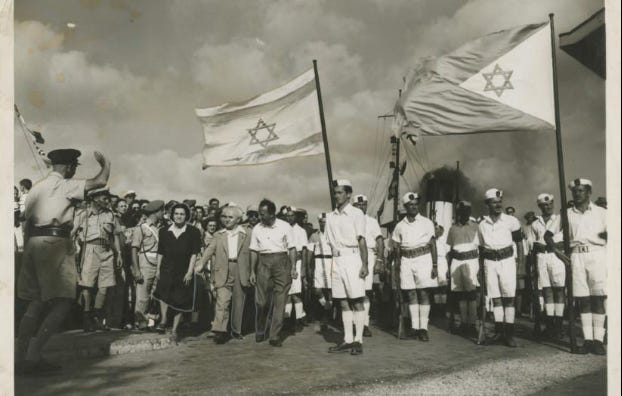
There’s this overly popular version of 1948 that begins with Palestinian refugees and works backward. By the time it reaches the months before Israel declared independence, the Jews have become this overwhelming military force bearing down on a largely passive, innocent Arab population that never stood a chance against them.
Interestingly, that wasn’t how Arab leaders described what was happening.
Before Israel existed, Arab military commanders were sending increasingly grim reports to their governments about the balance of forces in Palestine. After the war, Palestinian politicians and Arab intellectuals wrote postmortems that heavily blamed the British. But they also pointed fingers at Arab failures: poor preparation, political rivalries, inadequate weapons, competing commands, weak governments and a disastrous underestimation of the Jews.
No one had to invent these explanations. Arab leaders were writing them all by themselves.
On March 23, 1948, General Ismail Safwat sent a report to Syrian Prime Minister Jamil Mardam Bey, chairman of the Arab League’s Palestine Committee. Safwat was an Iraqi general, former Iraqi chief of staff, and head of the Arab League’s Military Committee for Palestine. His job was to assess the coming war.
His conclusion:
“There is no comparison between our forces and the Jewish forces.”
Safwat estimated Jewish strength at 50,000 men backed by additional local defense formations. The Arab forces available to oppose them were a fraction of that. Palestinian guerrillas were poorly equipped, Arab League forces were inadequate, and weapons promised by Arab governments hadn’t arrived in the agreed-upon quantities.
The details get way worse for the Arabs. Safwat described trained Jewish personnel, engineers and technicians, organized transportation, armored vehicles, reserves, repair facilities and domestic arms production. Egypt had supplied only part of the rifles it had promised. Saudi Arabia and Transjordan hadn’t fulfilled their rifle commitments. Arab ammunition was short, artillery was old, and mortars were scarce.
Safwat was worried about what happened once equipment broke. The Jews had workshops and facilities capable of repairing weapons and vehicles. The Arabs didn’t.
“Our side has nothing of the sort, not even a single small repair shop.”
And this was only part of his concern. Palestinian armed groups answered to competing political leaders and factions. Some, Safwat reported, were accumulating weapons for conflicts with other Arabs rather than for the war against the Jews.
“This situation has led to a rise in factionalism and local alliances among Palestinians and has pitted them against one another.”
Safwat had been pushing the Arab League since 1947 to recruit and train more men, provide weapons, and create a unified command. It hadn’t happened. Now the war was approaching, and there was still no effective Palestinian command comparable to the Haganah.
And Safwat saw another problem, one that had nothing to do with rifles or ammunition. He wrote about Arab morale remaining relatively strong because:
“The Arabs still tend to look down upon and depreciate the Jews.”
They were completely underestimating the Jews even as their military commander had raised the red flag, warning them how dangerous that was.
This report was dated March 23, 1948. Israel wouldn’t exist for another seven weeks.
Safwat’s description makes a lot more sense when looking at what had been happening the decades before he wrote it.
The Yishuv had built the Jewish Agency, Va’ad Leumi, Histadrut, Haganah, schools, hospitals, universities, banks, agricultural organizations and municipal institutions. Thousands of Palestinian Jews served with Allied forces during World War II and came home with stronger military training and experience.
None of this was top secret information. In 1946, the Anglo-American Committee of Inquiry looked at the Jewish community in Palestine and called it a “virtual Jewish nonterritorial State”