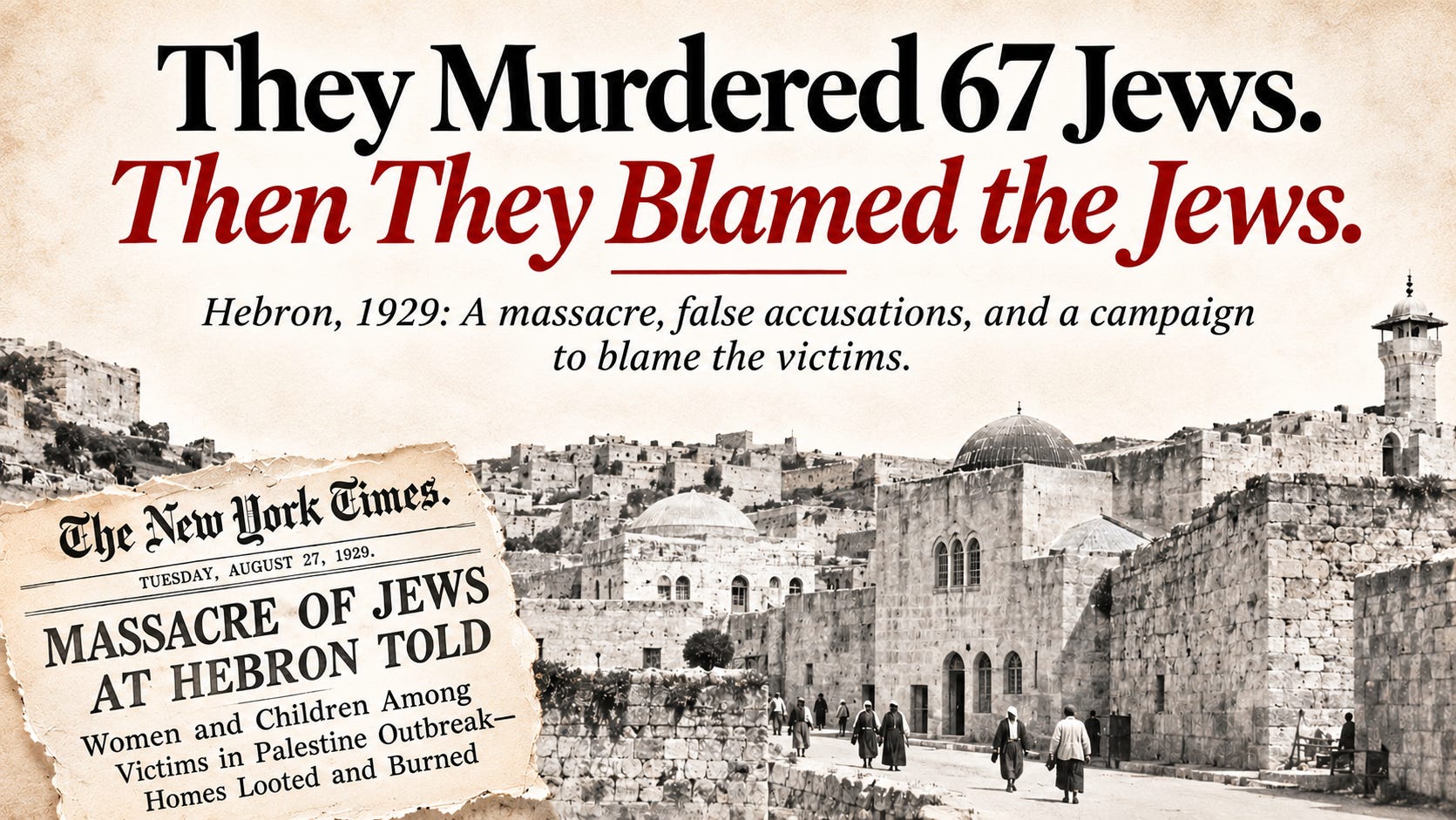
On Saturday morning, August 24, 1929, Sheikh Taleb Markah visited a Jewish hotelkeeper in Hebron, sat down for tea, and assured him that everything was fine. There was no reason to be frightened, he said. The family could leave its doors open.
The hotelkeeper’s son, Yehuda Leib Schneurson, later told a Jerusalem court that the sheikh had spent Friday afternoon urging Arab crowds to avenge thousands of Muslims supposedly murdered by Jews in Jerusalem. Schneurson had heard him demanding Jewish blood. Now Markah was sitting with his father, promising that nothing would happen.
About an hour after the visit, Schneurson said he saw Markah outside the Slonim family home urging an armed crowd to break in. Dozens of frightened Jews had gathered there, including religious students who believed the family’s standing in Hebron would protect them. According to Schneurson, the sheikh told the attackers that wealthy foreigners and young women were sheltering inside.
The house became one of the principal killing sites of the Hebron massacre. Eliezer Dan Slonim, his wife Chana, their young son Aharon, and numerous relatives and neighbors were murdered. Their baby son Shlomo survived with a serious head injury and was found alive after the attack.
Schneurson escaped into a Muslim family’s home. When he testified in October, the prosecutor asked whether he had seen his friend Slonim dead. Schneurson explained that he had attended the funeral, one of only nine Jews permitted to be present. He began to describe what he had witnessed, but the prosecutor stopped him.
The testimony appeared during the criminal trial of Sheikh Taleb Markah, who denied inciting the violence. Other witnesses described the sheikh displaying what he claimed was a telegram from Jerusalem’s Grand Mufti, Haj Amin al-Husayni, announcing that Jews were murdering Muslims. They testified that Markah urged the crowd to kill Hebron’s Jews before traveling to Jerusalem.
The accusation about Jews slaughtering Muslims was contradicted by the British government’s subsequent investigation. The Shaw Commission found that the violence in Jerusalem on August 23 had begun with an Arab attack on Jews. No earlier Jewish murders had been established to justify it.
Yet the story had already reached Hebron, where Jewish families had lived for generations. The accusations were repeated in the streets, the authorities received warnings, and frightened residents sought shelter in homes they believed would be safe.
The court proceedings that followed recorded far more than a general account of communal violence. Witnesses identified men they accused of inciting crowds and committing murders. Children described watching their parents killed. British officials were questioned about warnings they had received and the protection they had failed to provide.
And after the massacre, some newspapers circulated a new accusation: that the Jews of Hebron had “arranged the killings themselves.”
The confrontation began nearly a year earlier, with a temporary prayer partition at Jerusalem’s Western Wall.
On September 24, 1928, Jews gathered there for Yom Kippur services. A screen had been erected to separate men and women during prayer, as required by Orthodox Jewish practice. Muslim religious authorities objected, claiming it violated the established rules governing the site, and British police removed it.
The Wall was part of the ancient Jewish Temple complex, and Jews had prayed there for centuries. Under the British Mandate, however, the narrow pavement used by worshippers was subject to Muslim religious property rights. Even modest changes to the prayer area had become sources of confrontation.
On October 8, the Supreme Muslim Council, headed by Amin al-Husayni, submitted a memorandum to the British government accusing Jews of pursuing a plan to take possession of Al-Aqsa Mosque. According to the council, Jewish demands at the Western Wall were the beginning of a campaign to gain control of the Muslim holy places above it.
The memorandum supplied no evidence that Jews were planning to seize Al-Aqsa. What began as a dispute over a prayer screen had become an official accusation that Jewish worshippers intended to threaten one of Islam’s most important religious sites.
The Va’ad Leumi, the representative body of Palestine’s Jewish community, answered in November. Its representatives denied any intention of encroaching on Muslim holy places and insisted that Jewish worshippers were entitled to respect at their own sacred site.
The British government later reproduced both documents in its investigation of the violence. The accusation and the denial were preserved together, allowing investigators to trace how the dispute developed.
Through the following months, Muslim religious organizations promoted the defense of Al-Aqsa, while Jewish organizations continued pressing for religious rights at the Wall. Newspapers carried heated arguments about the site’s future, and religious leaders encouraged their communities to take an interest in the controversy.
The dispute reached another turning point in August 1929. Jewish demonstrators gathered at the Western Wall on August 15, followed by a Muslim demonstration the next day. During the Muslim gathering, Jewish prayer papers were removed from the Wall and burned, according to the British government’s later historical account.
The Shaw Commission would eventually identify the demonstrations and the activities of organizations defending Muslim holy places as important immediate causes of the outbreak. Its commissioners also examined the role of the Mufti, finding that he had helped foster the religious campaign to mobilize Muslim opinion against Jewish claims at the Wall.
They did not conclude that al-Husayni intended the campaign to produce violence, but they assigned him a share of responsibility for the disturbances that followed.
By August 23, the accusations were circulating far beyond Jerusalem.