Welcome to Voices of the Fight— a Saturday Q&A series featuring the warriors, innovators, advocates, and volunteers standing under fire for free people.
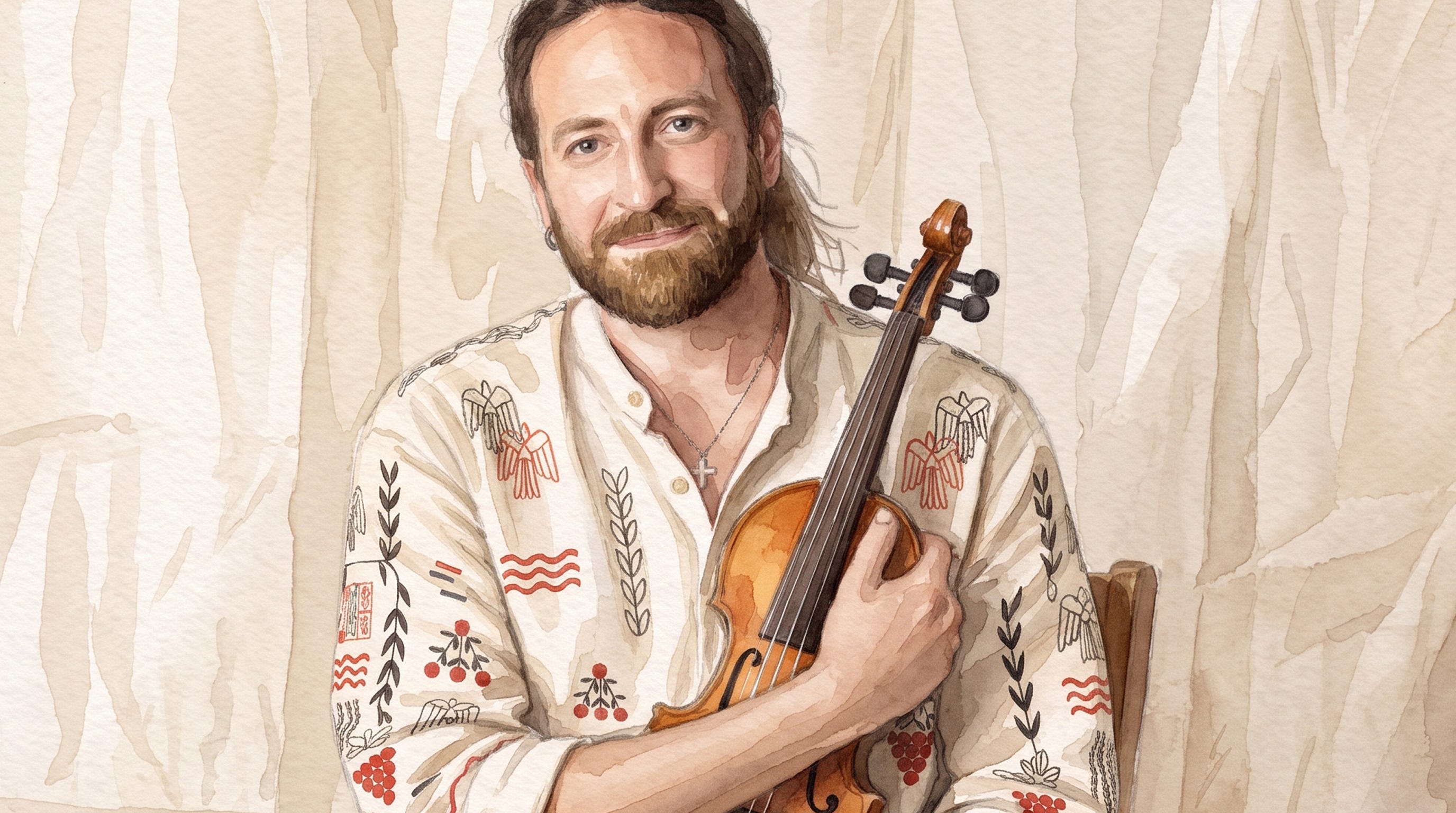
My name is Benya Stewart. I’m an American folk musician and English teacher living in Kyiv. I originally came to Ukraine as a volunteer, but the nature of my mission has changed over time.
My first visit was in January 2020, just before the pandemic. Some friends back in Ohio had lived in Lviv, and that connection eventually brought me here for a musical project called Slavalachia. I knew almost nothing about Ukraine.
Lviv blew my mind. I always describe it as the New Orleans of Ukraine. Different cultures have mixed there for centuries, and you can hear that in the music. There was so much experimentation happening. I remember thinking that perhaps Ukraine would become part of my future.
We publish this newsletter every day at 9:05am NYC time / 4:05pm Kyiv.Your subscription fuels our work.
Then the Russians invaded. But my friends weren’t anonymous people on television. They were people I had jammed with, played cards with, talked with late into the evenings—and here they were sending me videos of themselves making Molotov cocktails in the streets. Others sent videos of themselves waiting in line to join the army.
My colleague Brett Hill, who performs as Brother Hill, and I began raising money through concerts in the United States to buy tactical medical supplies.
In such cases, people understandably worry about where their donations end up. There are too many examples of large institutions wasting donations either through negligence or corruption. We, on the other hand,could take money raised at a concert, buy a tourniquet or an individual first-aid kit, and deliver it directly to someone who needed it. That connection was very powerful.
We came to Kyiv in October 2022, bringing medical supplies and a car we had bought in Poland to donate to the army. The city was cold and dark. Yet the people we met were working hard for their communities, helping one another, and somehow remaining upbeat.
That was when I began wondering what it would be like to live here.
At 31, I had traveled a lot, but had never lived outside my hometown of Athens, Ohio. Moving to Kyiv during a war was a strange possibility to be considering, but something about this place and the people here made me want to try.
I ultimately moved here in September 2023 after finding a teaching job. Teaching English has given me a way to support myself and stay here, and it offers something Ukrainians want as they build more connections with the wider world.
Alongside that, I’m performing, learning Ukrainian, and spending time with people working to protect and popularize traditional music. Some are folklorists who have spent their careers traveling to villages and recording songs. Others are taking those recordings out of the archives and finding new ways to use them, whether that means preserving the original form or putting them over techno beats.
I want to support Ukrainians already doing this work and explore the music through my own performances and collaborations.
Learning the language is a huge part of it. In September, I had a solo concert where I spoke only Ukrainian throughout. That was a huge breakthrough. Learning someone else’s language demonstrates an investment of time that you can’t really communicate any other way. And more importantly, it allows me to go deeper into the cultural context in a way that only a fluent Ukrainian speaker could experience.
I’ve stepped back somewhat from the direct fundraising and supply work I started with. The war has changed, and I’m neither a soldier nor an engineer. I’ve found a clear role for myself as a cultural advocate.
I want people abroad to understand more about Ukrainian life, history, and culture. I also want Ukrainians to know that someone from outside their country values their culture enough to live here, learn their language, and spend years understanding it.
Ukrainian musical culture is deep, powerful, and far less widely known than it deserves to be. Understanding it takes time. But I’ve realized I’m here for the long haul, and I wouldn’t want to be anywhere else.
About a year ago, I performed at the Slovo Building in Kharkiv. It housed Ukrainian writers and artists associated with the Executed Renaissance, many of whom were later persecuted or killed by the Soviet authorities. Today, there’s an arts residency there.
The concert was warm and intimate. Afterward, I went to get dinner with some friends and my Ukrainian musical partner.
There was an active air raid alert, of course. The alarms are essentially constantly on in Kharkiv. We were walking toward the restaurant when we heard a Shahed drone flying somewhere above us. It was dark, so we couldn’t see it, but then the air defenses started firing. Tracers were going up into the sky. It felt like something out of Star Wars.
People were coming out of the restaurant with their drinks, watching and cheering on the air-defense crews.
Then one of the drones exploded nearby. We learned the next day that a hospital had been hit, about five blocks from where we were.
I had never been that close to a Shahed explosion. I felt the shock wave through my entire body. It seemed likeit had happened right beside me.
Some people were cheering. I think they thought the drone had been shot down.
We went inside. The restaurant was packed, and another drone could still be heard outside. People were talking and having a good time, but everyone was also checking their phones for updates.
We asked the waitress whether they were staying open.
“Oh, yes. No problem. We’ll be here.”
Then, suddenly, everyone else in the restaurant suddenly got up and filed out. I still don’t know exactly what prompted it, but we were the only customers left.
We asked again whether we should leave.
“You can, but we’ll be here, anyway,” she said. She pointed us toward a table at the back, away from the windows. “That’s the safest table in the restaurant.”
We moved. She came back to take our order, and I was in the middle of ordering rabbit when there came the second explosion.
Again, another shock wave through the chest.
Without missing a beat, she asked, “and how would you like that cooked, Sir?”
How does a person get to that point?
I’ve come to associate that waitress as representing something essential about Ukrainians. She was kind, attentive, and carrying on with her work while drones were exploding outside. She seemed almost bored by the situation.
I’ve performed a lot for soldiers and had some extraordinary experiences with them. But moments with civilians sometimes strike me even more forcefully.
A soldier preparing to enter a trench is in one kind of mental state, one that we can sort of understand. A waitress who works under explosions while serving dinner is experiencing something else, something harder to comprehend, I think.
The first time Brett Hill and I performed near the front, in October 2022, we played for roughly 80 fully equipped Ukrainian soldiers. It was 10:00 in the morning. We pulled our instruments out from the car trunk, where guns and helmets and armor were piled.
You could hear artillery in the distance. The men’s faces were mostly covered, so all you could see were their eyes. They wanted to hear four or five songs before going back to what they were doing. The intensity of that attention was unlike anything I had experienced. You could tell that they were hanging on every note. I could feel it especially when we sang in Ukrainian—they were silent and still, totally in the moment.
This moment really hit me. It was one of the peak experiences of my entire life. Growing up in America, you constantly hear arguments about whether the arts really matter. They’re always being cut in favor of other subjects. But standing there, I realized: You can’t tell these men that this doesn’t matter. You can’t tell a soldier that his emotions don’t matter.
That was the real moment when I understood that music, my music, had some role to play here. I’ve returned to perform for soldiers several times since, often in small groups in the houses where they’re staying. Wanting to participate fully in those conversations is another reason I’m working so hard on my Ukrainian. Hearing about the experiences and emotions of such individuals is a true privilege.
I’ve chosen to be here, to live here, to stay here, for the foreseeable future. I’ve decided that it’s a central part of my life’s mission to bear witness to the evil that Russia commits against the Ukrainian people every day. But this choice, in and of itself, serves to protect me.
My experience fundamentally differs from the experience of a Ukrainian person, who may not have the same choice.
Recently, I was talking with a Ukrainian friend whose hometown is in the central-western part of the country, far from the frontline. Yet even so, a drone had been shot down over the city, and the debris hit a building near the café where he used to spend time in high school. He told me that this affected him far more deeply than the more brutal strikes in Kyiv. It got me thinking about how this would affect me.
I tried to imagine this happening to a place I grew up with in Athens, Ohio. Even after living here and experiencing countless horrific attacks, my imagination simply can’t comprehend what that would feel like.
I’ve come to love Ukraine, to feel at home here; but my childhood isn’t here. My memories of growing up aren’t being destroyed. My language isn’t under constant threat. And, the elephant in the room: I have the option to leave. Those things protect me from a large part of the emotional weight which each Ukrainian carries.
People sometimes thank me for my bravery or sacrifice. I appreciate that my presence feels helpful, feels important;, but I really don’t do it out of a sense of self-sacrifice. I live here because I love living here.
What keeps me going is that I’ve fallen in love with the entire, complicated place. When you love a person, you come to appreciate their flaws as well as their wonderful qualities. You don’t require everything about them to be perfect.
I called 2025 my year of disillusionment (with Ukraine). I broke my knee because of some of the terrible, old infrastructure in Kyiv. I could have become very bitter about it. But the difficulties are part of the place I’ve chosen to make my home. And it’s part of the ethic here that each of us is ultimately just responsible for ourselves. It’s not a place where you can go and sue someone for negligence.
The dangers of living here are incredibly real. But despite them, there’s something here I want to keep living for and participating in.
The longer I stay, the more I understand how much harder this is for the Ukrainians themselves, and how much support they deserve.
4 | How can people support your work?
I have a Substack called Letters from Kyiv. It’s a place where I write at length about what I’m experiencing and thinking about, beyond the short clips and updates on social media.
People can become paid subscribers. That’s essentially my version of “buy me a coffee,” and it helps me continue doing this work. I’m a huge fan of Substack in general, and strongly recommend folks to start exploring that platform.
You can also listen to my music and follow me on whichever streaming platform you use. Much of what I’ve released involves collaborations, and more music is always on the way. Following an artist really does encourage platforms to introduce their work to other listeners.
Beyond supporting me personally, I hope Americans and Europeans vote for politicians who will support Ukraine.
As an American living here, I’ve come to understand how little we appreciate the impact our votes have on the rest of the world.
Inside the United States, we’re often focused on domestic politics. Outside it, you meet people living with the consequences of American foreign policy—who have absolutely no influence over who is making those decisions. You see how much of their lives is spent reacting to decisions made in Washington.
That influence comes with responsibility. We need to elect the most mature and qualified people we can.
I understand being angry about politics. I find both parties detestable. But anger doesn’t relieve us of the responsibility to think about what our choices will do to other people.
I wish more Americans would travel, have deeper conversations when they do, and build friendships with people abroad. Living here has shown me the scale and depth of American influence in a way I never understood living in the States.
5 | Where can people follow you?
Instagram is the best place to follow my day-to-day life. Find me there as Benya Stewart. I’m actively posting Stories of performances, trips, late-night singing sessions, time with friends, and whatever else I happen to be doing. Sometimes that even includes calling a square dance.
For longer writing and more depth, there’s * Letters from Kyiv* on Substack. You can find me under my full name,
Your subscription fuels our work.
Nikolaus Muchitsch is chief of staff and strategy at Under Fire News.
underfire.news | PayPal | X | Instagram | LinkedIn | Youtube | Facebook