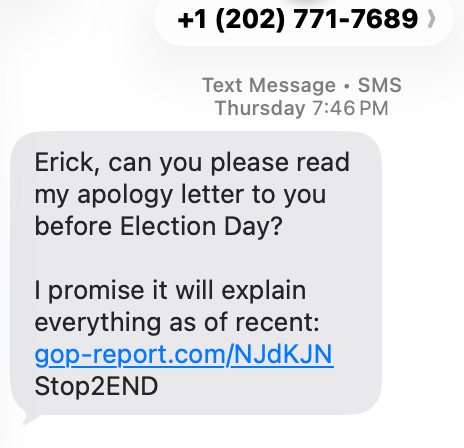
Every day, many of us get bombarded with emails and text messages grifting for dollars for the GOP. I never knowingly signed up for any of them, and neither did anyone I know who gets them. When I reply STOP, I do not actually stop getting them. The number changes, the web address changes, and the next one shows up a few hours later.
Republican consultants tried to tell us Google was censoring them.
The Republican National Committee sued Google in 2022, claiming Gmail was dumping its fundraising emails into spam folders. The Federal Election Commission rejected a similar complaint, a federal judge threw out the lawsuit, and the Ninth Circuit finished it off this year. Google’s explanation was the obvious one: Gmail users were marking the RNC’s emails as spam because the emails looked like spam. Google even offered campaigns a pilot program to get around the filter, and the RNC reportedly never bothered to use it.
Then, because Apple decided to let iPhone users put texts from unknown numbers in a separate folder that you have to go looking for, the consultants decided Apple was censoring them. The National Republican Senatorial Committee wrote a memo warning the change could cost it more than $25 million because roughly 70 percent of its small-dollar money comes in by text. The feature is opt-in. People are choosing it.
The reality is that Google and Apple have been protecting us from the predatory grift of Republican consultants. The data now definitively shows that the Republican politicians who let this happen for their benefit have actually allowed the consultant class to kill the goose that laid the golden egg.
Politico reported today that about 1.5 million federal donors have given through WinRed, the Republican online fundraising platform, so far this cycle. At the same point in 2022, it was 2.2 million. Over the same stretch, the Democrats’ ActBlue grew from 4.9 million donors to roughly 6.6 million. James Talarico, the Democratic Senate nominee in Texas, has had about as many ActBlue donors by himself as every Republican candidate and committee in the country combined has had on WinRed. Wesley Donehue, a Republican digital strategist in South Carolina, put it about as plainly as anyone can: “We beat the absolute hell out of low-dollar donors with texts and emails.”
Elon Musk’s nearly $500 million to super PACs has papered over the problem this year, but it cannot fix it. Candidates can only take so much from any one person, so House and Senate candidates need a wide base of small donors. Super PACs also pay more for the same television ad than candidates do, which is why Democrats have been able to air nearly as many ads as Republicans while trailing in overall cash.
John Hall has been warning about this for years. He ran Targeted Victory, one of the largest digital fundraising operations in Republican politics, and raised more than $1.5 billion online, so he is not some outsider throwing rocks. Two years ago he said that if you give to almost any Republican candidate, within three weeks, you will start getting 30 to 50 texts from candidates you have never heard of. His firm surveyed Republican donors and found a majority kept getting text solicitations after they asked to be removed. Donors told him they felt abused, never thanked, and unable to get off the lists. Several told him they had stopped giving entirely because they no longer believed the texts were coming from Republicans at all and assumed they were being scammed.
Here are some of mine.
On October 16th, someone told me it “absolutely DESTROYS us” that I would not verify my 2026 voter profile and asked whether they meant nothing to me. Four days later, a different number warned me I was making a huge mistake by continuing to ignore them and was asking one last time. There is no 2026 voter profile that anyone verifies by clicking a link at win-26.us or gop-poll.com. In August, I was scolded because Elon Musk was spending $100 million, and I would not help by “verifying.” In September, the same number told me Barack Obama had just collapsed and the DNC was screaming. So far as anyone has reported, Barack Obama did not collapse. On October 7th, I got a text that opened “From Trump,” even though the Trump campaign told Republican fundraising vendors back in 2023 that he did not consent to outside groups using his name and image to raise money. This week, someone wants me to read an apology letter before Election Day. My father, who is celebrating the 47th anniversary of his 40th birthday next month, got a text last month saying he was going to be audited for not pledging to vote MAGA.
I have no idea who is behind gop-report.com, gop-poll.com, win-26.us, 26gop.us, or maga-poll.com. Neither does the retiree getting the same texts, and that is the whole problem.
A text with Michele Tafoya’s name on it, asking for $15 and assuring me it is not $500 or even $50, arrives in the same inbox and in the same format as a text announcing a former President’s collapse. Candidates get lumped in with the garbage because the garbage is dressed up to look exactly like them. And I never signed up to get texts from Michele Tafoya anyway.
The only text in the batch that sent me to an actual government website, the Georgia Secretary of State, was also the one that opened by telling me public records show I voted in 2022 and 2024. The political stalkers wanted me to know they knew I had not yet voted this year, though I have now by absentee ballot.
Most of the people receiving these are disproportionately older, loyal, and living on fixed incomes. These are the same donors who discovered in 2020 that a one-time contribution had been quietly turned into a recurring one through a prechecked box, which led to more than $64 million in refunds in the final 10 weeks of that campaign alone. They remember. They tell their friends.
Many of these vendors are paid on a share of what they raise, and as Hall has pointed out, everyone is renting the same lists and chasing the same donors rather than going out and finding new ones. The vendor gets paid whether the donor gives once and never comes back or gives for the next 20 years, so the vendor has every incentive to wring the donor dry this month. The candidate is the one who loses that donor for good.
Politico found that about twenty-two percent of WinRed donors this cycle have given only to President Trump’s groups, and another thirty-nine percent have given to President Trump and at least one other Republican. When the President leaves the stage, the party will realize it has burned through and burned out its donors.
Every candidate who rents out a donor list, every committee that signs off on “Did we mean nothing to you?”, and every member of Congress who lets a vendor send guilt trips in his name owns the result. The leadership of the party tolerated it for years because it worked for a while. They have not respected their donors, and the donors have figured it out.
The fix is not complicated.
Honor STOP the first time someone sends it. Stop selling and renting lists to anyone with a credit card. Stop impersonating President Trump, inventing voter profiles, and announcing fake medical emergencies. Thank people when they give. Go find new donors instead of harassing the old ones.
Republican donors have been asking the party some version of “Did we mean nothing to you?” for years. This cycle, there are 700,000 fewer of donors on WinRed than there were in 2022, and the consultants still have not figured out the answer. They will never figure it out as long as they can keep cashing in.
By the way, if you are thinking of running for office or run a nonprofit, consider Anedot, which I have used and find less scammy than many online fundraising tools. They work with a lot of churches and other nonprofits, and I have always preferred them to WinRed for campaigns.
The late Shimon Peres 𝕏once said, “Israel is the only country where people tell the truth to pollsters and lie at the ballot box.” Polling in Israel has shown voters weary of Benjamin Netanyahu’s tenure in office. Even the Prime Minister’s own campaign seemed to expect worse than they got.
When it was all said and still not yet done, it appears the Prime Minister’s party will be the largest party in the Israeli Knesset, but will be short of an outright majority. Despite all the mythology about Israel, Arab Israelis vote and voted in high enough numbers to have a measurable impact on the composition of the Knesset, though the final numbers will not be as high as the initial estimates. They may have the numbers to help form a center-left coalition, though it is too soon to tell.
I am no expert and will not pretend to be one. Many who claim to be are not. Israeli electoral outcomes are complicated affairs.
Israelis do seem tired. But they are also still very united against external threats, and most Israelis still signal they want a strong defender of Israel in charge, which Netanyahu has been. The Jewish vote itself has disproportionately gone to Netanyahu.
What is most certain is that much of the American press rushed to write Netanyahu’s political obituary, but he is not done yet. And Republicans in the United States, overnight, were pointing to the issues in Israel as another reason not to believe the pollsters. In fact, there appears to have been a major error not just in the public opinion polling, but in the usually highly accurate exit polling. Once the error in the exit polling was caught, it has changed the picture of the election. It is still too soon to tell if Likud will have an outright majority, though it does not look like it will. It will certainly do much, much better than both public opinion polling and the early exit polling had suggested.