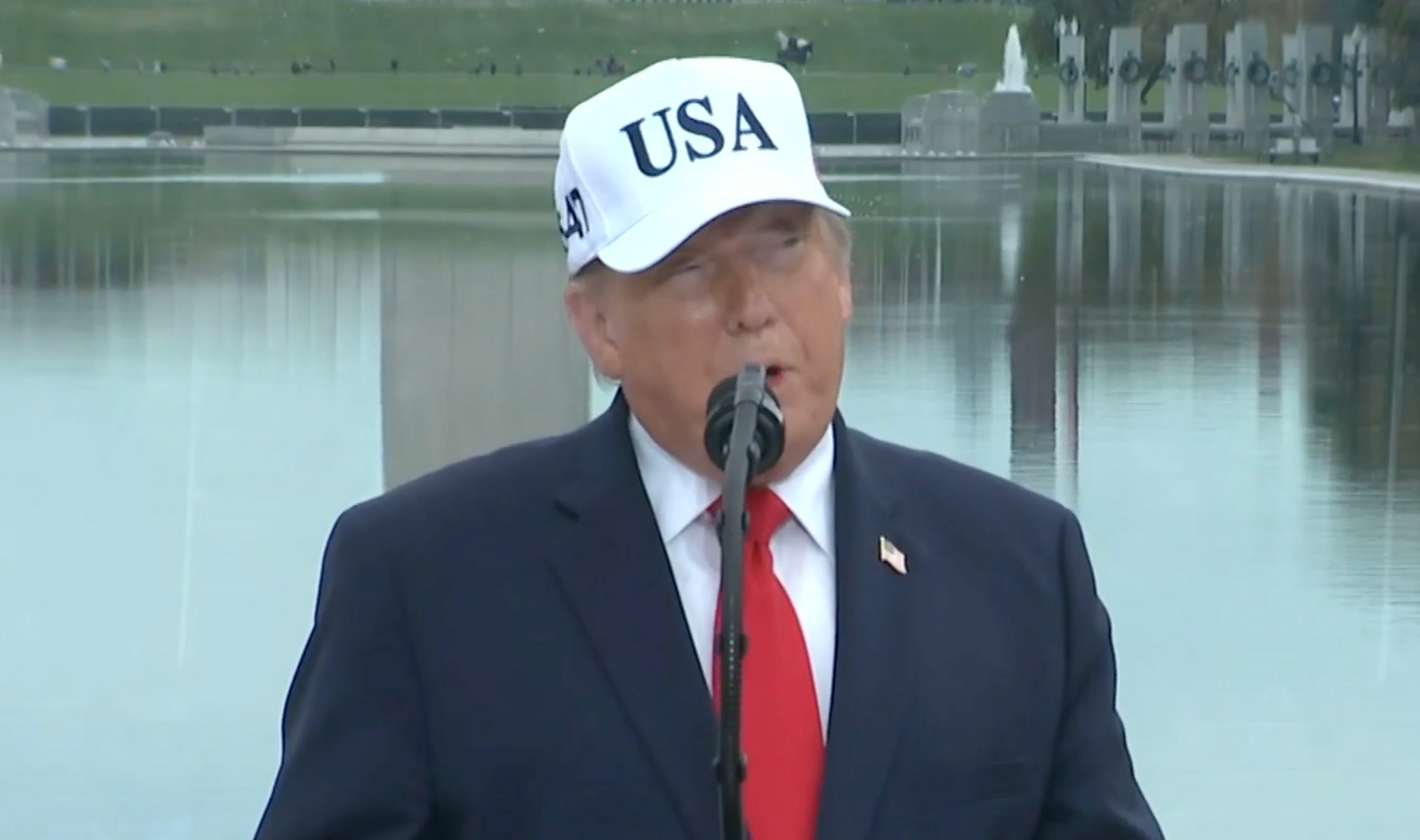
Happy Election Day, though my guess is that for most readers of this newsletter, it’s going to be miserable. Did you see that the leader of the Republican Party chose to spend a big media opportunity on the final day of the campaign 𝕏by standing next to the Reflecting Pool on the National Mall and boasting about his refurbishing it, as if he were the manager of a golf course (as one commenter under that tweet observed)? So that’s where we are. At least he didn’t make a cringy gay joke about Abe Lincoln’s rear end. Thoughts and prayers, my fellow conservatives, thoughts and prayers.
Politico reports this morning that the Trump coalition is about to broadside an iceberg. Excerpt:
President Donald Trump roared back into office two years ago after making major gains with young voters and Americans of color. Now those key groups appear to be moving away from him amid an unpopular Iran war and his lagging approval ratings, according to new results from the POLITICO Poll conducted by PF Global.
Roughly 9% of Trump 2024 voters plan to cast their ballot for a Democrat this year, compared with just over 2% of former Vice President Kamala Harris’ voters who now plan to back Republicans.
Underlying that shift is a lack of enthusiasm from two groups central to Trump’s win: Latinos and young people.
At the end of last year, 56% of Hispanic Trump voters identified as MAGA Republicans. As of this October, just 37% still do, revealing a frustration with the label that denotes some of the president’s most loyal supporters.
At the end of last year, 50% of young Trump voters ages 20 to 29 said they were certain to vote. As of this October, just 38% say this.
Woke up to a text from a friend who was a Trump campaign field organizer in 2024, and who now lives in Asia. He hustled his butt off two years ago to get Trump elected. He asked about my feelings going into today. I sent him the Politico story, and it shocked him. He texted, “Man, after all that hard work to win them over in 2024.”
We agreed that the two marquee races for us tonight are the Senate races in Michigan and Texas. If you had told me a year ago that Michigan was on the cusp of electing a Muslim with all the radical Muslim baggage of Dr. Abdul El-Sayed, and that Texas — Texas! — stood a better than even chance of electing a wokester like James Talarico, well, I would have thought you had been smoking toad venom. Yet here we are. Losing Michigan to that kind of candidate, and losing Texas at all, in a blue wave would be the clearest repudiation of Trumpism imaginable.
And here we are. Nobody’s fault but Trump’s, and the GOP’s. A war stupider and more consequential than Bush’s Iraq folly, the bungling of the economy, and corruption on a scale that makes Tammany Hall seem as tame as a Lake Wobegon potluck.
Just putting this out there for consideration. It’s the text of 𝕏a Mario Nawfal tweet featuring an interview clip with a pollster (click to watch the clip):
Half of Americans say economic hardship will push ordinary people to rise up against the government... and nearly 60% expect political violence within a few years Those numbers come from a survey pollster Mark Mitchell is still weighting and plans to release this week, but his settled Rasmussen poll already had 43% calling a civil war likely. Only 50% say they’ll accept Tuesday’s result as legitimate if their side loses.
Mark has Democrats up 13 on the generic ballot, a 16-point swing that would rank among the biggest in 150 years, with Trump at 38% and independents at 27%. His read on why voters are this angry:
“There’s literally nobody with the credibility to fix America right now.”
Mark says Republicans got the transactional young voters Trump won in 2024 and gave them a war and $4 gas, and the party now runs on consultant-tested fear words instead of results.
So Tuesday settles who holds Congress, and the next question is what a country this far past trusting either party does with the answer.
No trust in either party? Nearly half of voters seeing civil war as likely? Golly, it’s almost like we are living in a Weimar-like situation. In related news, I’m told digital copies of * Weimar America* will be available tomorrow for journalists and reviewers. Seems timely, unfortunately. If the book sells well, at least I’ll be able to build a tiny bunker in Uruguay to escape Woke 2.0: The Reckoning. But seriously, I’m hearing more reports from friends in Hungary that anybody who had anything at all to do with the Orban government, no matter how low-level, is being blackballed in job hunting, even in the private sector. I look across the pond to my former country of residence and see the future of post-2028 America. But you know me, Mr. Merry Sunshine.
I would like to think that a blue wave today would chasten President Trump during his last two years, and make him get serious about governing. But who am I kidding? This is Donald Trump we’re talking about. I don’t think he has it in him. Remember, this is a president who spent this campaign praising the backsides of male GOP candidates, and saying things like (as he did at the Reflecting Pool yesterday), that he kept more promises than he made. For the past two years, a lot of us on the Right have rolled our eyes at things like that, and told ourselves, “Hey, it’s just Trump being Trump.” Well, now that Trump has no apparent way to end a disastrous war he started, the cost of living continues to rise, and the GOP may be about to lose both houses of Congress … it’s not funny anymore, or tolerable.
Yet he has no other way to be, does he? In fact, he might even be more rhetorically unhinged in these last two lame duck years than he has been till now. He won’t be thinking of his potential successors, or the good of his party. He can’t.
I know, I know: I backed this guy in 2024. I knew that he was a hot mess, but the woke extremism of the Biden-Harris administration, plus the wine-mom dingbattery of Kamala, made it very easy to overlook or downplay Trump’s flaws. Besides, whatever criticism one might have of Trump, at least he could be counted on not to start any new wars — and maybe even end the one between Russia and Ukraine. Well.
I won’t go on, except to say that if the polls bear out, and the worst for the GOP happens today, my party has nobody but itself — and its Maximum Leader — to blame. What is going to be interesting to observe in the recriminations slaughterhouse is whether or not party leaders and activists are capable of recognizing their own faults, and Trump’s faults. 𝕏Ron DeSantis is showing the way. He was my first choice for GOP 2024 nominee. Think about where we would be today if he had been the party’s choice…
That said, it is possible to overdose on blackpilling. With the exception of his enthusiasm for the Tech Right, 𝕏I agree with Jonathan Keeperman’s forecast for post-Trump conservatism: no return to Zombie Reaganism or collapsing into crackpot Tuckerism, but steadily building on the real and positive gains under the very flawed Trump, and no retreat from the nationalist concerns that brought him to power in the first place. A massive challenge for realistic Republicans will be not being intimidated by Trump’s fatmouthing and what remains of his personality cult (𝕏Fox News Boomers, in particular).
Last point on this dismal topic. I would never vote El-Sayed, and I don’t think economics are the main reason the young aren’t having kids, but the Democratic gentleman from Michigan has a point:
The American commentator Kristin Ziccarelli was among those shut out by the French government, which banned a “remigration” conference there at the last minute (“remigration” is what Europeans call deportation). Excerpt from her dispatch:
At the 2025 Munich Security Conference, Vice President JD Vance stated bluntly that we, as Americans, are worried about “the retreat of Europe from some of its most fundamental values,” including values shared with the United States. He cited a number of free speech cases across the continent that reveal the extent to which our allied governments censor political opposition while simultaneously neglecting their native populations in favor of often-hostile immigrants.
Vance received a lot of criticism about that speech, but the French government’s actions this past weekend are unfortunately a perfect illustration of the problem the vice president correctly identified. Not only were French citizens prevented from expressing their beliefs, but Americans and other European activists were too. All this because the government decided in advance which positions may be heard.
… That said, plenty of Europeans still regard the Trump administration’s criticism of European speech restrictions as intrusive. Why should Washington concern itself with the domestic political decisions of democratic allies? Why should the United States question European governments over their treatment of activists and political organizations?
The answer is that American foreign policy must consider not only the condition of allied nations today but also the direction or trajectory in which they are moving. European leadership
[restricting freedom of speech]and banning entry to peaceful activists cannot be dismissed as purely domestic when it affects American citizens and raises questions about the values on which the transatlantic alliance rests.
In next-door Germany, almost half the Catholics want to merge with Germany’s Protestants (note well we are not talking about vigorous Evangelicals, but the moribund liberal Lutheran state church). We who follow European religious news are accustomed to hearing Germany’s Catholic bishops stake out ever more liberal, heretical ground, but the truth is, they speak for a significant number of the Catholic laity there. I don’t think Rome has any idea what to do.
Finally, ▶Prof. David Betz continues to bring the hard facts to the discussion about Europe’s future that almost nobody in power wants to have. In the speech at that link, he predicts Ireland will be the first European country to fall into civil war.
Yeah, we’re in a tight spot here in Murca, but it could always be worse.
One of the great things about being an Orthodox Christian is that one almost never has to hear our bishops jumping on whatever progressive bandwagon comes rolling down the street. But that doesn’t mean we are without problems.
Here are the slides from a presentation Deacon Michael Hyatt recently gave as part of catechist training at St. Vladimir’s Seminary in New York. I advise you to look at the page, and click on some of the material presented there. For example, this summary of a lecture given by a Greek Orthodox computer scientist talking to a “working group” on AI and theology. Excerpt:
Another point raised in the discussion referenced Yuval Harari’s book, Nexus, in which he argues that, not only is the rise of AI the next technological evolutionary leap, but it may also be the defining and even final step in humanity’s tenure on earth.
5Many years ago, John Irving Good predicted that the development of a super-intelligent machine—one whose computing power exceeds that of humans—would be the last human invention, and the end of human-dominated history: not the end of humanity, but the end of human-dominated history. In other words, while humans may well persist despite the threats posed by climate change, it may be that our AI creations will be the inheritors of human culture and society. It may be that they will begin to create their own cultures and will ultimately explore the stars and populate the universe.6Dr. Papakonstantinou responded to this last point by noting that the emergence of intelligence that is greater than our own is not necessarily such a bad thing: “The reality is that for thousands of years, humans have lived with hope and faith that there is an entity that is much more knowledgeable, and much more humane, than humans. It’s called God. It’s a good thing. But why do we now consider the emergence of a super-human intelligence to be a scary development? We exist in the matrix (the creation) of a benevolent entity. I think an interesting question is, why do we think that an entity that is much more intelligent will also be malevolent?” Perhaps we our fear of AI reflects our own human preponderance for violence and domination. The question of the degree to which sentient AI may or may not emulate the range of human behaviors is an invitation to explore what we do and do not know about our own human nature, and what this knowledge might mean for our AI creations.
Here’s a short essay by Deacon Hyatt on why the Orthodox writer Paul Kingsnorth is wrong to condemn AI as a threat to writing.
I have confidence that serious sacramental Christianity, of which Orthodoxy is the fullest expression in my view, offers the strongest theoretical, theological, and metaphysical opposition to AI taking over our lives, our minds, and indeed our souls. But there, at the leadership level of the US Orthodox churches, they’re getting a different story.
I’ve been binging the TV show * Mad Men* lately. It ran from 2007 to 2015. I watched the first three seasons when they aired, but I seem to recall there was a writer’s strike, and a long gap before Season 4. I never returned to it. That was a mistake; I write to you as I’m reaching the end of Season 6, and it’s so, so good. As it has been almost a decade since the last episode aired, I’m going to include some spoilers in this discussion, but I’m going to try to avoid them as much as possible. In the comments, if you’ve seen Season 7, I’d be grateful if you’d avoid spoilers too.
Today’s discussion will be short and general; I’m offering this as an introduction to what I hope will be a longer, deeper discussion of the show once I’ve completed its final season.
If you’ve never seen the show, it’s a sophisticated dramatic series set among the employees of a fictional Madison Avenue ad agency in the years between 1960 and 1970. It tracks the most tumultuous decade of cultural change in the 20th century, and maybe in all of American history. It’s all there: consumerism, feminism, politics, racism, the rise of youth culture, drugs, sexual liberation, the whole megillah. As someone who grew up in a small town in the 1970s, I can tell you that the Sixties didn’t really arrive for us till the Seventies. Watching all the smoking, the rigid gender roles, the heavy drinking, and so forth, was pretty familiar.
For me, unsurprisingly, the key to the series appears in the first scene of the first episode of Season 6, in which Don Draper (Jon Hamm), the main character, sits on a Hawaiian beach reading Dante’s Inferno. If you read my canto-by-canto blog…