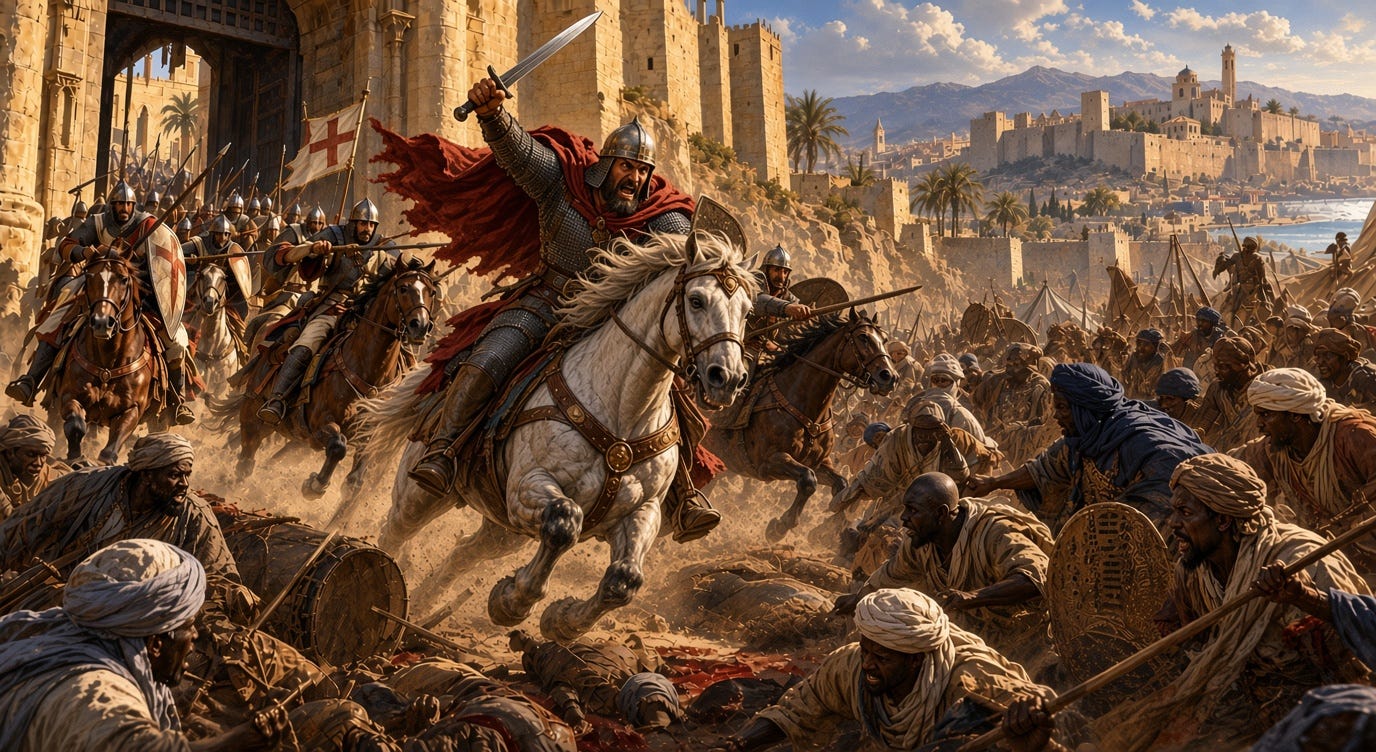
Today in history, on October 21, 1094, a tiny force of Christian knights destroyed a massive Muslim horde in Spain, where the jihad and the Reconquista had been raging for years.
For later Christians, including the Templars, the leader of these knights had validated the biblical verse that “one man will chase a thousand, and two put ten thousand to flight” (Deuteronomy 32:30).
Background: Around 1085, the Almoravids, a jihadist North African group committed to ribat warfare and led by the emir Yusuf bin Tashfin, began pouring into Spain to aid their Islamic counterparts, the Moors, who had just lost Toledo to the Christians.
In 1086, the Muslim and Christian forces clashed at Sagrajas. The Christians were annihilated; their king barely managed to escape with a dagger stuck in his thigh. Afterwards, in typical Islamic supremacist fashion, Yusuf constructed a pyramid of 2,400 Christian heads, atop which a muezzin ascended to call the faithful to prayer.
Following the disaster at Sagrajas, several Muslim kingdoms that had been liberated during the Reconquista—even a few Christian strongholds—fell back under Islamic control.
When, however, the Muslims overran Valencia in 1093, its lord, Roderick (or Rodrigo) Díaz of Vivar—better known to posterity as “the Cid”—returned and laid siege to Valencia for nearly 19-months, finally reconquering it.
As a result, the pride and prestige of the glorious jihadist victor of Sagrajas, who had subsequently unified virtually all of Muslim Spain under his authority, was shaken to its core.
“He has forcibly invaded my territory, and he attributes all his success to Jesus Christ!” blurted Yusuf, who, on hearing of the fall of Valencia, “was powerfully moved to anger and bitterness.”
He was, accordingly, “determined to recover the city at all costs,” writes the contemporary Muslim, Ibn Bassam, before adding that “the news of the fall of Valencia filled every Moor in Spain with grief and humiliation.”
A showdown was inevitable: “Islam and the Occident were now each represented by an outstanding personality,” writes historian Ramón Menéndez Pidal: “Yusuf the Saharan and the Castilian Cid stood face-to-face in the struggle between the two civilizations.”
The emir responded by sending the supreme Almoravid general of Spain, his nephew, Muhammad, “with an infinite number of barbarians and Moabites [Almoravids] and Ishmaelites [Moors] drawn from all over Hispania to besiege Valencia and to bring Roderick to him captive and in chains,” wrote a contemporary.
Reportedly consisting of some 50,000 fighters, the Almoravids dwarfed the Cid’s Valencian garrison of 4,000 men. By late 1094, “the infidel hordes” had arrived and “pitched their tents and encamped” at Cuarte, three miles from Valencia.
The final showdown between the Cid and his African adversaries had arrived and is recorded in both song and chronicle.
Continue reading below.
If you value unflinching, historically grounded analysis that mainstream outlets soften or ignore, consider upgrading. Paid subscribers get:
**Several new, full-length articles every week.**Carefully researched pieces you won’t find elsewhere.
Full access to the complete premium archiveArchive of in-depth writing, research, and commentary — all in one place.
Entry into the subscriber chatA private space for serious readers and thoughtful discussion.