I know. At one point I promised only one article per day. But I had to get this off my chest before I exploded.
Somewhere along the way, being a good Jew became inextricably knotted together with being willing to put Jews last.
Care about everybody. Fight everybody else’s bigotry. Defend everybody else’s rights. Learn everybody else’s grievances. Understand everybody else’s rage. Make room for everybody else’s fear. And when the subject finally turns to Jews, make absolutely certain everyone knows you care about the rest of humanity too.
Preferably first and foremost.
We have obligations to other people. Lots of them. They’re all over Torah. But American Judaism has elevated two words, tikkun olam, into something much larger: a measure of Jewish goodness increasingly tied to how universal our concern is and how little we appear to ask for ourselves.
Take that far enough and choosing to sacrifice yourself stops being a personal decision and starts becoming a moral expectation of Jews.
As most of us know, last weekend Michigan Attorney General Dana Nessel stood before the Michigan Democratic Jewish Caucus and told the room that Jews have “a moral imperative to place the needs of the world above even our own self-interest and, yes, even our own survival.”
And then she brought poor Esther into it.
Esther would have sucker-punched her name right out of Nessel’s mouth. Or whatever the ancient Persian equivalent was for getting someone to stop talking.
Esther is perhaps the worst possible Jewish woman to recruit for an argument about Jews putting their survival second. Haman was planning to annihilate the Jews. Esther risked her own life by approaching the king without being summoned precisely to stop him. “If I perish, I perish” meant Esther was willing to die to save the Jews. She wasn’t offering up the Jews to save everybody else.
Nessel went on to argue that climate change, artificial intelligence and nuclear war transcend Jewish concerns about Israel and personal safety. She asked what good it would do to defend the Jewish ancestral homeland if the planet itself becomes uninhabitable.
Fair enough. I, too, happen to be opposed to nuclear annihilation. I simply hadn’t realized the Jewish contribution to preventing it might include agreeing in advance that the Jews are expendable.
That version of tikkun olam ends in martyrdom, and I’m pretty sure Esther would like to be excused from this assignment.
Tikkun olam is translated today as “repair the world” and is now attached to every worthy cause imaginable: feeding the hungry, welcoming refugees, fighting racism, protecting the environment and pursuing social justice. All good things. But that broader meaning is mostly an American development of the twentieth century. Jews weren’t using the phrase this way for most of Jewish history.
In the Mishnah (which I completely had to do some research on) compiled around 200 CE, mipnei tikkun ha-olam shows up in discussions about laws meant to keep society functioning and prevent harm. Divorce documents. Freeing slaves. Ransoming captives. Very practical problems. Nobody appears to be standing around shouting at Jews that they are personally responsible for fixing the planet.
Centuries later, Jewish mysticism (another little thing I had to research) did something completely different with tikkun. Isaac Luria’s Kabbalistic tradition understood creation itself as spiritually shattered. Human beings helped repair it through mitzvot, the commandments and obligations of Jewish life. Cosmic repair through Jewish religious practice. Also not quite a reusable grocery bag telling you to vote.
The version we're all familiar with came much later. Jewish educator Shlomo Bardin was using tikkun olam as a call to social action by the 1950s, and it caught on. By the 1970s and 1980s, it was spreading through American Jewish organizations and movements. Historian Jonathan Krasner has pointed out that a Jew living in nineteenth-century Poland, Iraq or New York might not have thought tikkun olam was particularly important at all.
That doesn't mean Jews suddenly discovered social justice in the twentieth century. We've had plenty to keep us busy for a few thousand years. Torah tells us to care for the poor, the widow, the orphan and the stranger; give tzedakah; practice gemilut chasadim; maintain honest courts; and treat people with dignity.
American Jewish culture eventually bundled a whole lot of that together and called it tikkun olam. And somewhere in there, two Hebrew words picked up an additional burden…apparently repairing the world might occasionally mean Jews should stop worrying quite so much about the Jews.
Which made me curious about what Judaism actually says when helping somebody else comes into direct conflict with staying alive yourself.
There’s a Jewish principle called pikuach nefesh, saving life. (Yes, I looked that up, too.) It’s a pretty big deal. Preserving human life overrides almost every other commandment. If fasting on Yom Kippur could kill you, you don’t fast. If somebody’s life is in danger on Shabbat, you don’t stand there debating whether saving them counts as work. You save them.
The Talmud gets this partly from the biblical command to “live by” the commandments. Live by them.
Then I found the water.
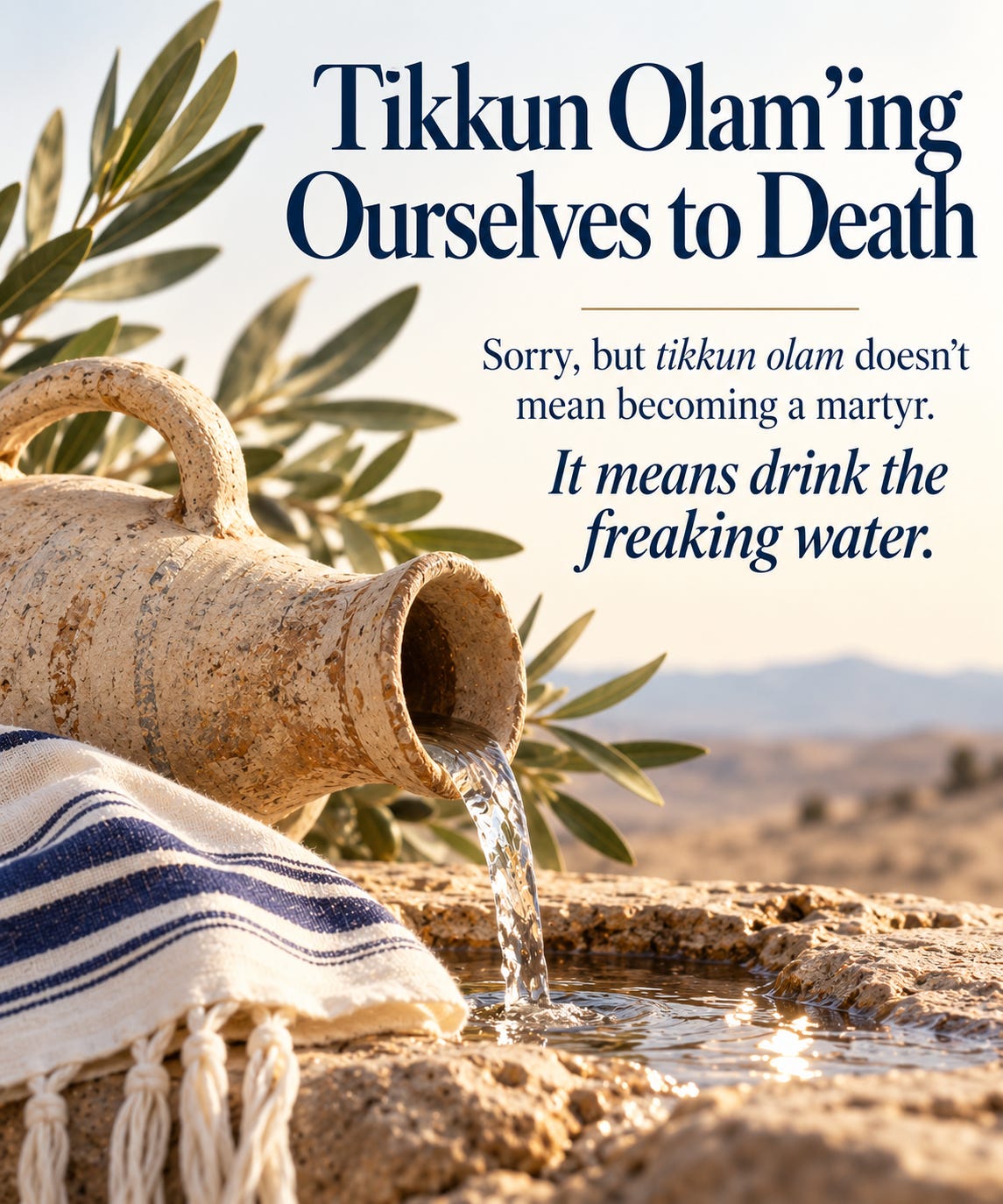
In Bava Metzia, two people are walking through the desert. One has a jug containing enough water for one person to complete the journey. If they share it, neither will make it. Ben Petora taught that they should share the water rather than have one witness the death of the other. Neither traveler chooses himself. They share the water, and both die.
Rabbi Akiva disagreed: “Your life takes precedence over the life of the other.”
The person holding the water has obligations toward his companion. Those obligations do not include dying with him. Jewish ethics can demand generosity, sacrifice and concern for another human being while still allowing the person carrying the water to drink it.
Hillel put the balance into a few lines in Pirkei Avot: “If I am not for myself, who will be for me? And if I am only for myself, what am I?”
We seem awfully fond of the second question. “If I am only for myself, what am I?” Look outward. Care about other people. Don’t become so concerned with yourself that you stop seeing everyone else.
Absolutely. But Hillel first mentioned another, pretty big obligation: “If I am not for myself, who will be for me?”
Both belong in the same sentence, which seems to me a pretty good indication that both belong in Judaism.
American politics has added another layer to this. Jews are regularly asked to tolerate things they would recognize immediately as unacceptable if they came from the other political camp.
Abdul El-Sayed recently stood before Michigan Jewish Democrats and invoked the Jewish “value of tikkun olam, to repair the world.” This came after months of controversy over his response to the terrorist attack on Temple Israel, when he followed his initial condemnation by explaining that the attacker had lost relatives in an Israeli strike and saying, “Hurt people hurt people.” He has since apologized and said there is never justification for terrorism. Good. Apologies should count for something.
El-Sayed has also resisted demands that he break with Hasan Piker, a political ally who recently warned that if American Jews keep presenting themselves as especially invested in Israel, eventually “someone is going to come around and take action” against American Jews. When prominent Democrats condemned Piker’s comments, his response was, “Aipac boss call was made.”
This is where I lose my s*#t with the idea that Jewish morality has this brand spanking new requirement that Jews are expected to swallow whatever makes them uncomfortable because the alternative political coalition is worse.
Tikkun olam doesn’t need agreement with Abdul El-Sayed because the Republican candidate is worse. Hasan Piker doesn’t get a pass because he supports causes you support. Zohran Mamdani’s positions on Israel remain fair game for criticism even if you love his positions on housing, immigration or affordability.
Mamdani has supported BDS and initially refused to condemn “globalize the intifada,” although he later said he discourages the phrase after Jewish New Yorkers explained what it means to them. He has also repeatedly promised to protect Jewish New Yorkers and combat antisemitism. This remains to be seen.
We have become so accustomed to sorting people into Team Good Jew and Team Bad Jew that moral judgment sometimes disappears entirely. A person can support policies you believe would help millions of Americans and still say something you should oppose. A person can be excellent on Israel and terrible on something else. Nobody gets a certified kosher stamp on his entire worldview passport because he passed one issue.
The right doesn’t get one either.
Tucker Carlson sat down for a friendly two-hour conversation with Nick Fuentes, who spoke about “organized Jewry,” complained about “these Zionist Jews” and described Jewish conservatives as people who needed to be defeated. Carlson pushed back when Fuentes generalized his argument to “the Jews,” but he also gave an avowed antisemite a massive platform and treated much of the conversation as legitimate political discussion.
Dan Bilzerian has called “Jewish supremacy” the greatest threat to America and the world, blamed “Jewish Special Interests” for running the country into the ground, questioned the number of Jews murdered in the Holocaust and trafficked in conspiracy theories about Jewish control. Candace Owens has spent years pushing her own collection of conspiratorial claims involving Jews and Israel.
Someone on the right saying the correct things about Hamas, immigration, universities or Israel doesn’t erase any of that. Antisemitism doesn’t acquire a political exemption because the person delivering it agrees with you about taxes.
The quantities don’t have to match. The motivations don’t have to match. The political consequences don’t have to match. The standard does.
Jews don’t owe the left our tolerance of antisemitism because it promises to protect vulnerable people. Guess what? We’re vulnerable people. Maybe that would be better in all caps. WE’RE A VULNERABLE PEOPLE. And as a whole, the people who spend an exorbitant amount of time talking about protecting vulnerable groups don’t seem particularly interested in extending that protection to us.
We don’t owe the right our tolerance of antisemitism either. Although, and it pains me a little to admit this, the situation isn’t identical. Outside the alt-right (and the growing collection of people willing to entertain its garbage), much of the American right currently lumps Israel and Jews into the big category of people it considers worth defending. I’ll take it. I’m not going to pretend I don’t see it simply because it complicates the political symmetry.
But gratitude doesn’t buy immunity or straight-ticket voting. Supporting Israel doesn’t erase antisemitism. Defending Jews on Monday doesn’t give anyone permission to entertain conspiracy theories about us on Tuesday. I don’t have to choose between pretending the left has our backs when it doesn’t and pretending every person on the right who waves an Israeli flag is automatically safe for Jews.
Neither political camp gets custody of Jewish morality. And neither gets to decide how much antisemitism Jews should tolerate as the price of admission.
Hamas crossed into Israel on October 7, 2023, murdered about 1,200 people and abducted around 250. Entire families were killed. People were hunted at a music festival. Israelis hid for hours while terrorists moved through their communities. We know this, but for the sake of this section...I had to repeat the basics.
Because almost immediately, Jews were handed a list of reasons their dead couldn’t simply be their dead. Occupation. Genocide. Apartheid. Colonizing. Blockade. Power imbalance. History. Root causes. Context. I know I missed some, but you can mentally fill in those blanks. The list is long.
There always seemed to be something we were expected to acknowledge before we were permitted to grieve without qualification. Jewish suffering has developed this really annoying habit of arriving with homework.
A massacre of Jews should be able to remain a massacre of Jews for the length of a sentence.
Feed people. House people. Fight bigotry. Protect minorities. Help refugees. Give generously. Volunteer. Protest injustice. Worry about the climate. Oppose war. Repair whatever pieces of the world you can reach.
There are eight billion people on Earth and a bit over 15 million Jews. I have confidence in our multitasking abilities.
A synagogue can hire security without first solving global violence. A Jewish student can object to antisemitism without producing a footnote acknowledging every other form of hatred. Jews can support causes that have nothing to do with Jews and still recognize obligations to one another. Israel’s existence doesn’t need to solve somebody else’s problem to justify itself.
Universalism doesn’t become purer as Jews become less particular about whether Jews are included in it.
Keep tikkun olam. Put it back beside pikuach nefesh. Put Hillel’s first question beside his second. Care for the stranger and care for your community. Help repair the world without turning Jewish vulnerability into proof of Jewish virtue.
And remember the two travelers in the desert. There isn’t enough water for both. Rabbi Akiva says the person holding it drinks first.
Tikkun olam doesn’t mean becoming a martyr. It means drink the freaking water.