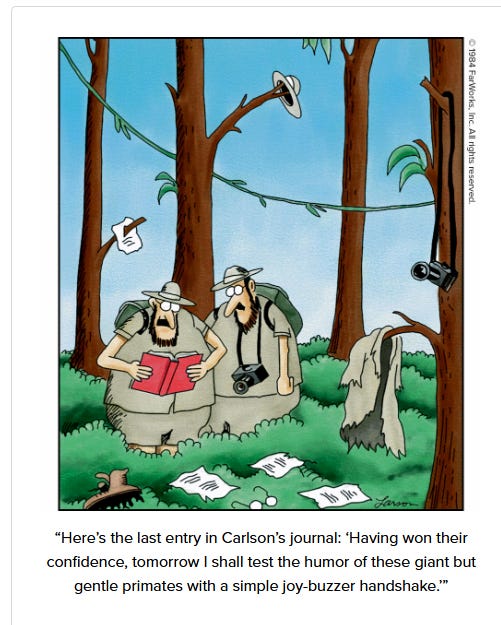
"We're all mad here. I'm mad. You're mad." ~Cheshire Cat
“Politics, n. A strife of interests masquerading as a contest of principles. The conduct of public affairs for private advantage.” Ambrose Bierce
Don Quixote is one of the most interesting characters in literature ( and, cmon, ‘quixotic’ is one of those words that NO ONE knows how to pronounce!). Quixote’s problem was never courage. He had plenty. His problem was classification: he looked at a windmill and saw a giant, lowered the lance, and charged. Sancho, the only adult in the book, pointed out the sails.
Washington has the disease and it runs in both directions. It charges windmills, and it mistakes giants for windmills. Same week, same podium, sometimes the same afternoon.
The windmills first, because they are both sadder and funnier.
The United States is ‘giving serious consideration’ to renaming Lake Ontario as Lake America, on the grounds that we do not expect to do much business with Ontario any longer. A friggin’ lake, that has had the same name since the Wyandot, being
**renamed to punish a province that ships us more goods than most countries.**Then the Kennedy Center: officials threatening to
demolishit if it cannot be renovated to the President’s taste, with, one assumes, a new name over the door. A concert hall.And the Saudi nuclear accord, thirty years, US firms with an exclusive on the kingdom’s reactors, sent to Congress this week with the last-minute condition still attached that Riyadh normalize with Israel first, and with the door to uranium enrichment on Saudi soil propped open (WSJ). A treaty, then, that demands
the one thing the counterparty has said it cannot deliver, in exchange for the one thing nonproliferation policy has spent fifty years refusing. Lance lowered. Charge!
Now the giants, the ones we keep calling windmills.
Canada. Ottawa’s counter-tariffs go live September 8: 15 to 50 percent on more than 700 American products; steel and aluminum doubled to 50, which is exactly what Washington has charged on theirs since before this round started, plus paper, appliances, farm goods, dairy, and seafood. Champagne at the podium: ‘Canada must respond, and today we are in a proportionate, targeted, and strategic way.’ A $7.5 billion support package rides along, on top of the $25 billion Ottawa has already spent keeping workers whole. Carney’s own account of what died at midnight Friday was that the Americans ‘asked too much and offered too little,’ and the reporting out of the room says the asks included a say over Canada’s other trade deals and a go at Quebec’s language protections, bilingual labels included (
Dean Blundell). Partisan source, deliberately partisan, and Carney’s quotes are Carney’s quotes. Treating a G7 country’s language law as a tariff concession is the giant-for-windmill error in its purest form.
And the lever Ottawa has not yet pulled sits right there in the chart. Canada supplied 63% of US crude imports last year, nearly four million barrels a day of heavy crude piped into refineries built to run on nothing else. An export levy on that barrel does not hurt Alberta. It lands in Ohio, Michigan, Wisconsin and Pennsylvania, at the pump, ten weeks before a midterm, with a strategic reserve at its lowest since Reagan’s first term. Carney has said ‘I don’t see the value of it’ and, in the next breath, ‘there’s other things we can do if we need it.’ The loonie at 1.3869 this morning, up two tenths against the dollar, has priced the tariff war. Nobody has priced the lance in the scabbard.
Iran. The economic offensive Bessent branded ‘Operation Economic Outcast’ named dozens of Chinese and Hong Kong entities and stopped short of any major Chinese bank, and oil fell through the announcement, through the day after, and is falling again this morning. Tehran’s incentive runs the other way from ours: the deeper the isolation, the more the leadership feels it has to lose from restraint and the less from escalation, and success depends on Turkey, Iraq, Russia and China agreeing to starve a neighbor (
NYT). A country running 80% inflation with a rial at two million has a pain tolerance our electorate does not. Giant.
The bond market. Bessent doubled the long-end buyback to ‘at least’ $4 billion a run, off-cycle, the day after the thirty-year printed a nineteen-year high, and told investors the yields did not ‘reflect the underlying fundamentals.’ Druckenmiller, his and Warsh’s old boss, used his Journal column to say the quiet part in eleven words:
“This wasn’t liquidity management, it was price management, and a mistake far larger than $4 billion suggests.” (
[WSJ])
And the last line of the same piece is the whole windmill in one sentence:
*governments defending prices against fundamentals always lose, and the only variable is how much they spend before conceding.*The FT counted the cost in credibility: PGIM’s Greg Peters calling the intervention ‘self-limiting, self-defeating,’ Morgan Stanley’s Lisa Shalett saying a Treasury that intervenes ‘because you’re cranky’ about yields ‘smacks of whimsy,’ and Jason Furman reaching for the phrase everyone has been avoiding, ‘a whiff of fiscal dominance’ (
FT).Katie Martin’s version: three interventions in three weeks, bonds and dollar falling together, Treasuries starting to look like ‘gilts in an expensive suit and with good teeth’ (
FT).A year ago Stephen Roach reached all the way back to the Qin dynasty for Bessent, to Zhao Gao presenting the emperor with a deer and calling it a horse as a loyalty test for the court (
Stephen Roach). The deer this month is a $32 trillion bond market. The court is being asked to agree it is a horse.
Here is the part the knight will not enjoy. This week the windmill turned. The thirty-year fell from 5.27% Friday to 5.17% Tuesday, ten basis points in two sessions, and the Treasury has not bought a single bond yet.
Bessent will claim it. He did not do it. Oil did, with a nine percent weekly collapse on a Hormuz corridor headline, and positioning did, with the trend-following complex carrying its most stretched long-end short in the data.
The wind changed. The sails moved. The knight is still on the horse, and Friday at ten his squire gets the microphone in Wyoming.
One more list, because the classification error has a body count. The actual giants nobody in Washington is charging this week:
the DRC Ebola outbreak is on track to be the worst in history, 5,605 cases and 2,683 dead since May, already past 2018 to 2022 and moving faster than West Africa 2014 did in its opening months (
Washington Post).A study of every former NFL player who died from 2016 to 2021 found C.T.E. in 215 of 878, 24.5%, and the 643 brains nobody examined make that a floor (
BMJ,NYT).And in Geneva next week, the United States sits with Russia and North Korea against binding limits on weapons that pick their own human targets, while the eastern Pacific boat campaign runs its tally to 67 strikes and 223 dead (Reuters, AP). Real giants. Real arms. Nobody is lowering a lance at any of them; the lance is busy with a lake.
Bret Stephens asked this week whether World War III has already started and answered, more or less, that the theaters are merging, the axis is an operating alliance, the West is a mess, and ‘in periods of economic distress, democracies almost always become more risk-averse, while dictatorships become risk-prone’ (
NYT). His fifth point was the economic brink, and his exhibit was the bond market. Which brings the note to the only institution in this story that has never once mistaken a windmill for a giant.
**The war premium is leaving through oil, not through peace.**Brent 85, down 9% for the week, pinned at the low. The corridor is a framework. The tape has priced the strait open.**The long end rallied ten basis points in two sessions and the fiscal windmill never moved.**30Y 5.17%, two basis points from my kill. Half the duration short becomes a 2s30s steepener today.**PCE at 8:30 decides which curve I am short.**A soft print with the 30Y holding 5.15 keeps the frame. A settle below it on any print takes the sheet down.**Financials dispersion compressed again, 354 basis points after 511.**Fee complex on top, spread complex on the floor. Insurance brokers lost their driver, so the long leg becomes IB and brokerage.
Futures flat into a double binary, ES unchanged and NQ off a tenth, after a third straight winning session that took the Dow to a record 53,577 on negative breadth. Tech carried it, semis repositioned into Nvidia, and staples gave back Monday’s entire defensive bid in one day.
Oil is the tape. Brent 85.00 pre-open, session low 84.59, third consecutive down day and roughly nine percent on the week, on an Iran-Oman ‘interim framework’ for a temporary two-way lane through Hormuz, commercial vessels only, permanent route talks inside thirty to sixty days, and Tehran insisting nothing reopens until Washington makes good on ‘breached commitments’ (Bloomberg, via Tasnim). Gold sits near its record at 4,678. One of those two prices is wrong about the same war.
The curve fell six to seven basis points in parallel Tuesday, front end leading: 2Y 4.17%, 10Y 4.64%, 30Y 5.17%. First soft American data of the stretch did it, confidence at 89.4, new home sales down 10.5%, Richmond Fed at 4.
Today: core PCE at 8:30 (consensus 0.2% on the month, 3.3% on the year), second-cut GDP, durables, a $70 billion five-year auction at one after two tails, Nvidia after the close ($2.09 on $92.2 billion against a $91 billion guide, four straight post-print declines). Friday at ten, Warsh’s first Jackson Hole keynote as chair, at a symposium themed on payments, into a bond market that has stopped waiting for him.
Two weeks ago, I wrote the kill condition for the whole term-premium frame as a 30-year settlement below 5.15%. Friday it closed 5.27. Monday, sanctions day, 5.23. Tuesday, 5.17. Two basis points from the line, the morning of the print that decides it.
4.24% · Tenor 2Y · 24 Aug 4.24% · 25 Aug 4.17% · Two-day -7bp
4.43% · Tenor 5Y · 24 Aug 4.41% · 25 Aug 4.35% · Two-day -8bp
4.74% · Tenor 10Y · 24 Aug 4.70% · 25 Aug 4.64% · Two-day -10bp
5.25% · Tenor 20Y · 24 Aug 5.21% · 25 Aug 5.16% · Two-day -9bp
5.27% · Tenor 30Y · 24 Aug 5.23% · 25 Aug 5.17% · Two-day -10bp
So the honest question, before the sales pitch: did the fiscal thesis just lose? Read the shape. Not a flattener, not a steepener. Every tenor down together, front end a touch more, 2s10s from 50 to 47, 2s30s from 103 to 100. A parallel bull shift on a nine percent oil collapse and one soft data trio has an inflation-input explanation before it has a fiscal one. The war premium in the barrel was an inflation premium in the bond, and when the barrel handed it back, the bond did too. Monday’s leg was oil. Tuesday’s was confidence, housing and Richmond. Neither was Bessent, and neither was the deficit getting smaller.
Then the positioning, which is the part that makes me uncomfortable in the other direction.
Minus 2.28 z-scores in the ultra-long end. A rally in the thirty-year from here does not need a change of view from anyone. Machines that are short at a two-and-a-quarter sigma extreme cover into strength, and the Bessent operation, which starts buying September 9, is a scheduled bid they can see. Bloomberg’s long-bond desk write-ups have started calling the swap-spread compression a ‘Bessent put.’ Positioning does not care whether the put is credible. Positioning cares that it is scheduled.
Which produces the least comfortable sentence of the week: I would not put on a naked short of the thirty-year at 5.17% this morning, into PCE, with the trend complex that short and a sovereign buyer that visible. And under the discipline of this sheet, a position I would not open fresh at today’s price is a position I have not underwritten. So half of P1 changes shape at the open. Half stays outright; kill at 5.15 live today. Half converts into a 2s30s steepener, long the two-year at 4.17 against the same thirty-year short, curve at 100 basis points. Read what that does. The fiscal argument that the price-insensitive buyer is gone and the term premium has to be paid by somebody lives at the long end and retains its expression. The oil-and-data argument, that the hike case just lost its most quotable exhibit, lives at the front end and now gets one too. And the Treasury twist, buying tens-to-thirties and issuing bills, is a flattener by construction. A steepener is the trade against the knight. He needs the curve to flatten. Druckenmiller’s prescription, term the debt out honestly and pay the price the market sets, is a steepener written as policy.
What the steepener costs me: a hot PCE with the two-year leading the selloff, a bear flattener, hurts the new leg and helps the old one, and on a big enough front-end move the sheet is roughly flat. Fine. On a soft PCE with the whole curve rallying, the outright half loses, the curve half is roughly flat to better, and I own less of the thing at the kill line than I did yesterday. On a hot PCE with the long end leading, the original supply signature, both halves pay, and the add at 4.80 comes back into view. Three branches, none of them fatal, which beats the version where one of them is.
The frame itself has not changed, and the chart says why.
Net interest above $1.1 trillion this fiscal year, more than defense. Deficits near six percent of GDP at full employment, which the country has never before produced in peacetime. Forty trillion crossed the week Treasury intervened.
Eurointelligence put the level in one sentence this morning: a 5.2% thirty-year ‘for a country that produces 3-4% inflation, with no improvement in sight’ is ‘a pretty low number,’ and their endgame is a default that does not look like Argentina’s, printing or a debt-ceiling stoppage rather than a missed coupon (
News Items). Strong words, from a normally sober shop.Whether or not you buy the endgame, the arithmetic underneath it is what a steepener is long: the front end can be talked down by a Fed chair; the long end has to be bought by someone with money, and the someone has changed.
And the equity market has quietly agreed with the bond market’s price. Fifteen percentage points a year of excess return over Treasuries on a rolling ten-year basis, a reading matched only by the 1950s.
Run the arithmetic forward instead of backward: a 3.6% earnings yield against a 4.64% ten-year is a negative risk premium of roughly a hundred basis points. Equity is not being paid to take duration risk.
Which is why the fee-driven parts of financials keep outperforming the balance-sheet parts, why utilities get sold on rallies, and why the AI complex now finances itself with vendor backstops and discounted placements rather than free cash flow. Same discount rate, different costumes.
So…Friday. The FT framed it as a collision course, and it is: a Fed chair whose ‘core view’ is that the market signal should be respected, and a Treasury Secretary who has told the market its signal is wrong and started bidding against it.
Guha’s line was that Warsh ca…