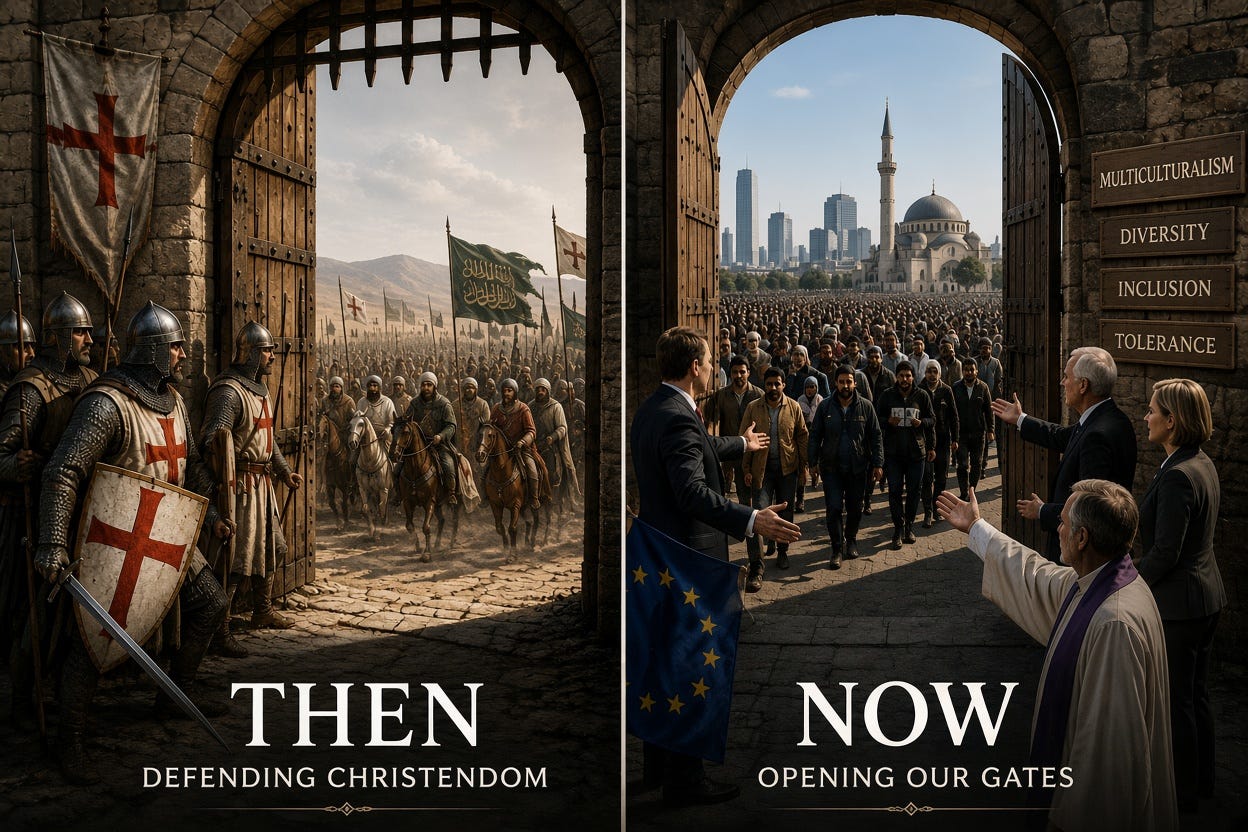
Is it time to call for a new crusade?
Not long ago, merely uttering the word “crusade” in connection with Islam was enough to provoke outrage. When George W. Bush casually referred to the coming war on terrorism as a “crusade” in the immediate aftermath of 9/11, the backlash was swift enough that the administration distanced itself from the word. Considering the countless apologies, condemnations, and mea culpas concerning the crusades that Westerners have been subjected to ever since, one might have assumed that “crusade” had been permanently banished from public discourse.
Yet, today, amid mounting anger over Islam and mass Muslim immigration, Westerners are once again openly invoking the crusades—and some appear to mean it quite literally.
Last week, for example, Jake Lang led what was explicitly billed as a “Christian Crusader” march in Dearborn, Michigan, home to one of America’s largest Muslim populations. Its stated purpose was to oppose the “Islamification of America,” and Lang was hardly coy about what he thought was happening.
“The Muslims have not come here to assimilate,” he said. “They have come here to steal the wealth of this land to rape our women… The crusade has begun,” he declared, adding to Muslims, “Your time in this country is running short… Muslims go home before we send you home.”
Nor are these sentiments confined to America. In Britain, Katie Hopkins has ▶declared that her nation has been “overrun in every way” by Islam; therefore, “the time of the crusades will need to come again.”
Even * Deus vult*—“God wills it,” the famous cry associated with the First Crusade—is making a mighty comeback.
It is hardly difficult to understand the sentiment behind all this. Millions of Westerners look around their cities and scarcely recognize them. They see Muslim enclaves and parallel societies, mosques and preachers promoting doctrines diametrically opposed to Western norms, demands for ever greater Islamic accommodation, elements of sharia appearing in Western life, and the ▶targeting and killing of apostates and critics of Islam. They have also witnessed sexual-abuse scandals, attacks on Christians and Jews and their holy sites, and a seemingly endless succession of jihadist atrocities.
To many, especially in parts of Western Europe, all of this looks suspiciously like an Islamic conquest unfolding before their eyes. Hence the appeal of an old and once-forbidden word: Crusade.
There is, however, a fundamental problem with this diagnosis. Against whom, exactly, is this new crusade supposed to be fought—Muslims in the West?
The historical crusades arose in circumstances dramatically different from those confronting the modern West. For centuries before the First Crusade, Muslim armies had conquered enormous swaths of previously Christian territory, including Syria, Egypt, North Africa, and most of Spain. The crusading movement eventually became equally important in the defense of Europe against Ottoman expansion, from Nicopolis and Varna to the Holy Leagues associated with Lepanto and the wars surrounding Vienna. The logic of crusading was perfectly intelligible to contemporaries: Muslim powers were conquering Christian lands, and Christian rulers were responding with armed resistance.
But what Muslim army conquered Dearborn? Who stormed Birmingham, Paris, Brussels, or Berlin? No Muslim armies battered down their gates. Rather, the gates were opened for them—and by the Western authorities themselves.
Put differently, it was the leaders of Europe—the pope, emperors, kings, and nobles—who called for and spearheaded the crusades in defense of Christendom and for the liberation of Christian peoples. Yet it is their very counterparts—the pope, presidents, prime ministers, politicians (and certain kings, such as Charles III)—who are now responsible for the exact opposite: importing and empowering Islam in the West, to the detriment of Western people.
Nothing will be accomplished until this ironclad fact is understood.
It was Western politicians who created the immigration policies that brought millions of Muslims into Europe and America; Western governments that permitted temporary migration to become permanent settlement and facilitated family reunification; Western institutions that abandoned assimilation in favor of multiculturalism; Western bureaucracies that funded the resulting programs; and Western political, academic, and media establishments that stigmatized opposition to these policies as racist, xenophobic, or “Islamophobic.”
In other words, whatever one thinks of Islam, to call for a crusade against Muslims already living in the West is to mistake the most visible symptom for the underlying disease.
Keep reading below.
If you value unflinching, historically grounded analysis that mainstream outlets soften or ignore, consider upgrading. Paid subscribers get:
**Several new, full-length articles every week.**Carefully researched pieces you won’t find elsewhere.
Full access to the complete premium archiveArchive of in-depth writing, research, and commentary — all in one place.
Entry into the subscriber chatA private space for serious readers and thoughtful discussion.