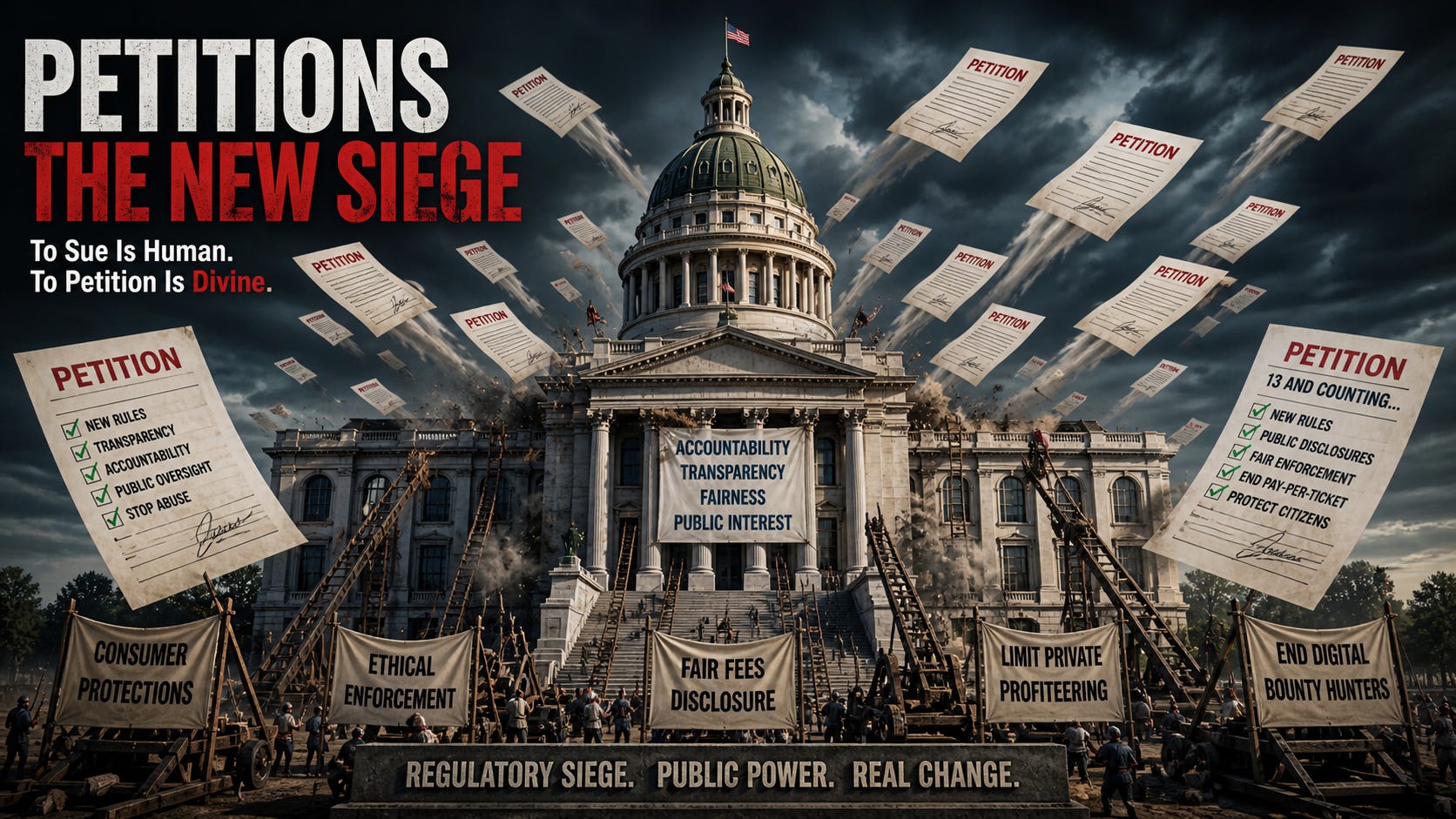
To Sue Is Human. To Petition Is Divine.
There comes a point where litigation stops feeling like strategy and starts feeling like a subscription service—for opposing counsel. You file, they respond, you reply, the clock runs, and the meter never stops. One case turns into months of procedural trench warfare with uncertain payoff. Even when you “win,” the impact is usually narrow and easily contained.
So I changed the game.
I stopped swinging a hammer and started pulling levers. Instead of one courtroom, I now operate across multiple agencies. Instead of asking for relief, I propose rules. That shift alone changes the posture—from reactive to structural.
You don’t fight the system. You rewire it.
Right now, there are 13 active petitions in front of Florida regulators, each one targeting a specific pressure point in the parking enforcement ecosystem. These are not complaints or emails; they are formal rulemaking petitions that trigger mandatory responses. Agencies have deadlines, they have to publish, and they have to explain themselves on the record. That creates a paper trail that doesn’t disappear.
This is where most people miss the opportunity.
Regulatory petitions are underused because they’re misunderstood. People assume you need to be a lobbyist or a trade group to file one, but the process is open to citizens who know how to use it. When a well-structured petition lands with statutory backing and a clear rule proposal, it stands out immediately. You’re no longer arguing over a ticket—you’re defining how tickets can be issued statewide.
That’s a very different conversation.
The economics flip in your favor almost overnight. A lawsuit drains your resources while the system absorbs it as routine. A petition forces the system to allocate time, staff, and legal spend to respond. Multiply that across multiple agencies and the cost curve bends hard against them.
Now imagine you’re on the other side of that table.
You’re staring at simultaneous rule proposals, each one carrying compliance risk, public exposure, and potential precedent. Your outside counsel is billing by the hour while internal teams scramble to assess impact. And you know that even a single adverse rule could ripple across jurisdictions.
You don’t need to win everywhere. You need to win once.
One rule in one jurisdiction can change the operating model. It forces adjustments, triggers copycat efforts, and opens new legal angles. It also creates a documented standard that others can point to. That’s how small wins compound into systemic pressure.
This is not theory—it’s mechanics.
The pressure points are obvious once you start looking: who is authorized to issue citations, how private contractors are compensated, what disclosures are required in app-based systems, and how consumer protections apply to digital compliance. These are not edge issues; they go to the core of how the system functions. When you define the rule, you define the boundary.
Define the boundary and you control the game.
There’s also a visibility advantage that litigation rarely provides. Petitions force agencies to articulate their positions in writing, often in public dockets. That means explanations, justifications, and sometimes contradictions. Those records become leverage in media, in court, and in subsequent filings.
And they don’t get buried.
Each filing adds to a growing administrative record that can’t be ignored. Over time, that record becomes a map of pressure—showing exactly where the system is vulnerable and how it responds under scrutiny. That’s intelligence you can use.
Every response is data.
This approach also scales. Parking is the proving ground, but the same framework applies wherever regulation intersects with behavior. Digital platforms, data practices, algorithmic visibility—anywhere there’s a rulebook, there’s an opportunity to challenge or rewrite it. The mechanics don’t change; only the subject matter does.
That’s where this goes next.
If you’re serious about using this strategy, it’s not about filing random grievances. It’s about precision—identifying the right agency, framing the right rule, and backing it with the right authority. Structure matters. Tone matters. Credibility matters.
Serious filings get serious responses.
I’m putting together a detailed breakdown of how to do this the right way—how to identify targets, draft petitions that get traction, and use AI to accelerate the process without sacrificing quality. It’s a repeatable system once you understand the components. And it works across jurisdictions.
If you want the playbook, you know where to find it.
This is how you put them on the defensive—without ever stepping into their courtroom.