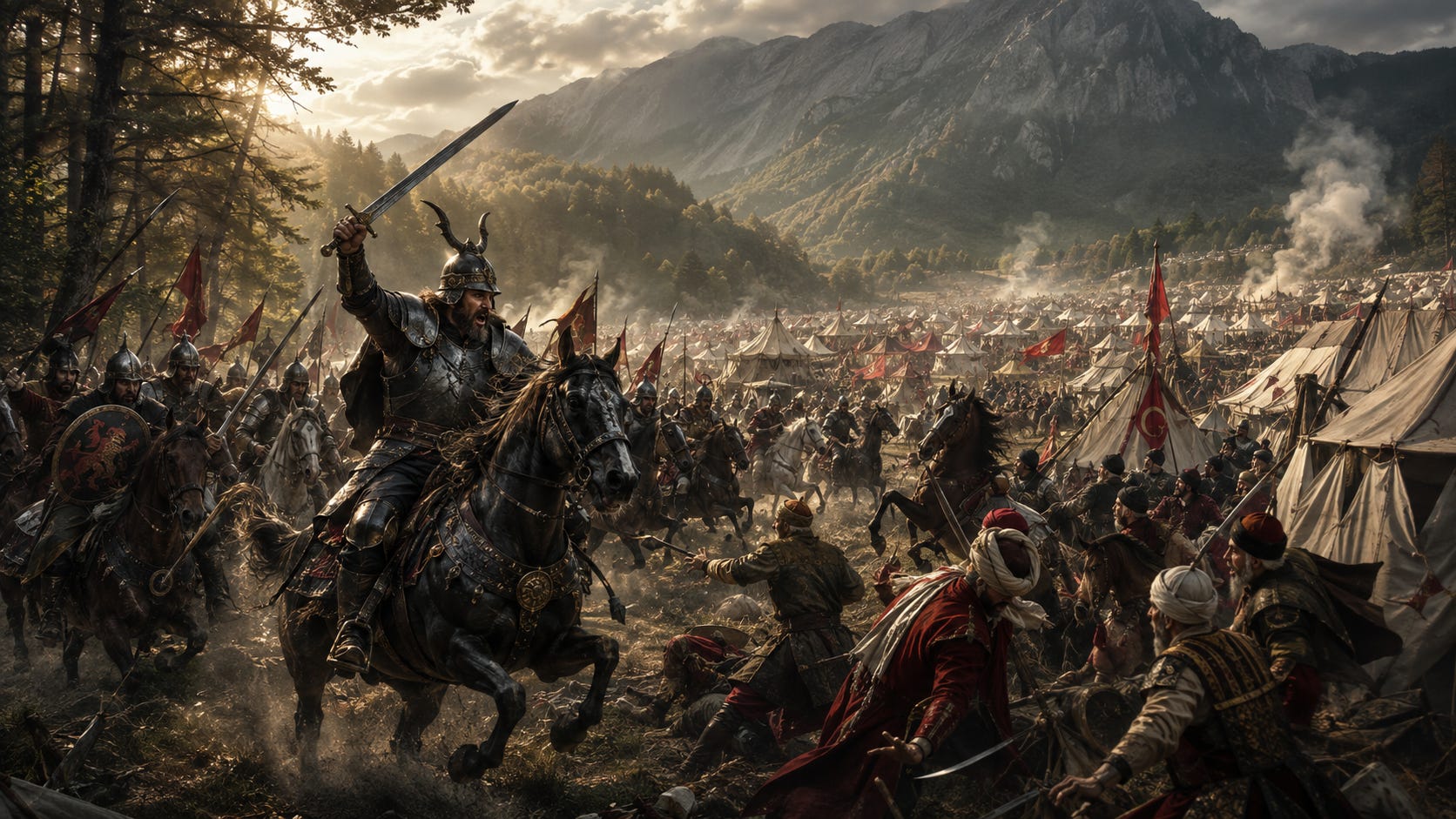
Today in history, Europe witnessed one of its most remarkable stands against Islamic aggression: the little-known Battle of Albulena, fought in the rugged heart of Albania in 1457.
To appreciate the significance of this epic clash, one must first appreciate the leader of the Albanian forces, George Kastrioti, better known as Skanderbeg (“Lord Alexander”). Today, he is as little known in the West as he was once widely celebrated throughout Europe. His life validates the saying that “truth is stranger than fiction.”
Born of Albanian royalty, he was taken captive as a child by the Ottoman Turks, and trained to be a janissary, a Christian slave indoctrinated into becoming a Muslim soldier.
Excelling at war, he quickly rose among the Ottoman ranks until he became a celebrated general, with thousands of Turks under his command. Despite all the honors showered on him, however, once the opportunity appeared, he showed where his true allegiance lay. He broke free of the Muslims and fled to his native and continuously harried Albania.
There, after openly reclaiming his Christian faith, he “abjured the prophet and the sultan, and proclaimed himself the avenger of his family and country,” to quote Edward Gibbon.
Thereafter, from 1443 to 1468 — a quarter of a century — Skanderbeg committed his life to the successful defense of his tiny homeland against the world’s most powerful empire.
In so doing, he renounced a life of wealth, prestige, and untold pleasures among the Ottomans and willingly embraced a life of nonstop war among and on behalf of his own people — frequently living in mountains and caves as a fugitive, though always living in freedom.
His “ingratitude” naturally provoked the Turks to no end and prompted wave after wave of jihadist invasions, each larger and crueler than its predecessor. Yet, in a total of twenty-four battles and sieges, he beat them all back, always while being vastly outnumbered by his Muslim foes, often by as much as ten-to-one.
Little wonder he is known as the Albanian Braveheart.
The Battle of Albulena, which occurred on today’s date, represents the pinnacle of his career. In late May 1457, 80,000 Turks under the command of Skanderbeg’s own treacherous nephew, Hamza — whose jealousy had caused him to betray his uncle — marched through and devastated the Mat River valley in north central Albania.
Because Hamza was well acquainted with his uncle’s guerilla tactics, Skanderbeg had to improvise. Instead of hiding his vastly outnumbered army — barely one-tenth the size of the Muslim army — in the mountains and awaiting the opportune moment to strike, as he had often done, he divided it into many smaller units and dispersed them in the valleys and woods.
For three months, all the Turks saw were tiny roving bands of Albanians, none of which dared leave the mountains and engage them. As a result, nearly three months later, by late August, the Ottomans concluded that Skanderbeg had become a moot point — that he was “done up with,” that his men had “deserted” him, and that he himself had quit to “the mountain fastness in order to save his skin,” to quote from the sources.
Continue reading below.
If you value unflinching, historically grounded analysis that mainstream outlets soften or ignore, consider upgrading. Paid subscribers get:
**Several new, full-length articles every week.**Carefully researched pieces you won’t find elsewhere.
Full access to the complete premium archiveArchive of in-depth writing, research, and commentary — all in one place.
Entry into the subscriber chatA private space for serious readers and thoughtful discussion.