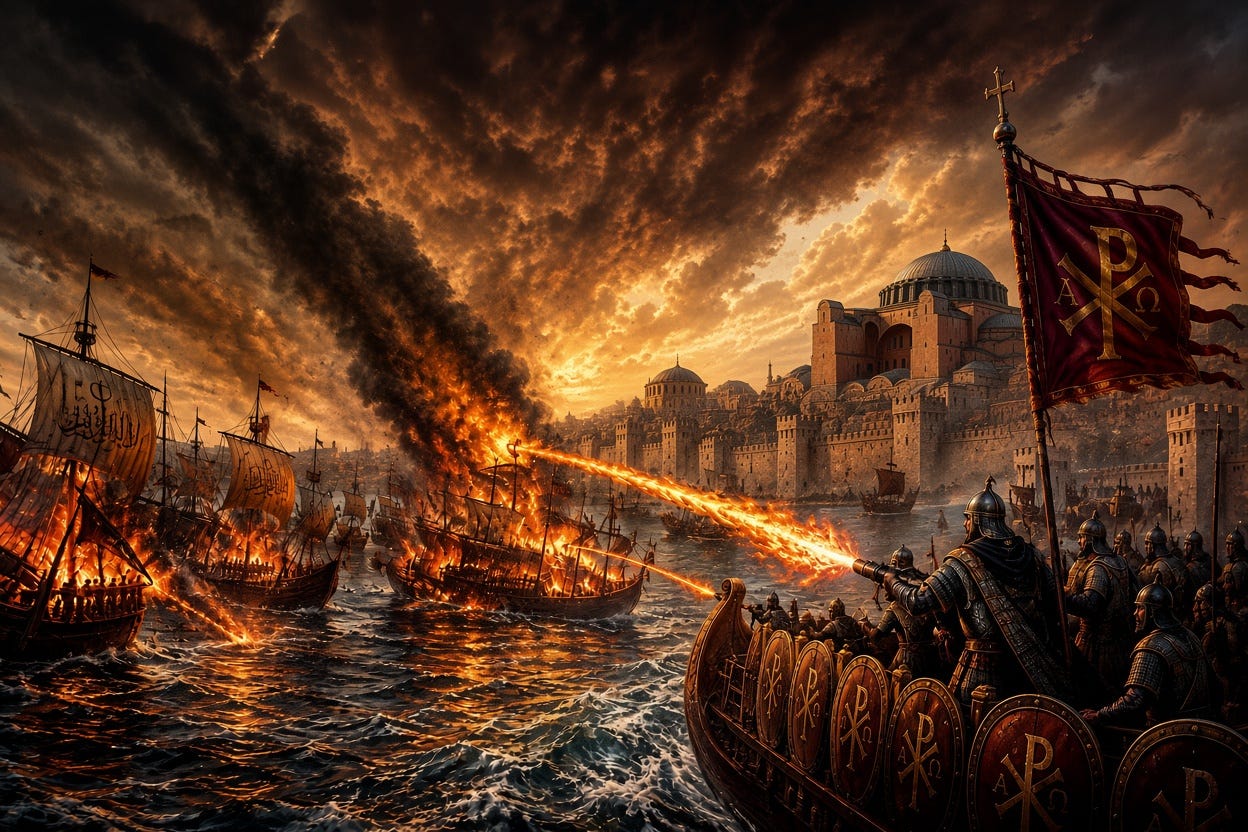
On August 15, 718, Constantinople prevailed over the forces of Islam—and in so doing, saved all of Western civilization.
That story is worth recounting:
After several failed sieges against the seat of the Eastern Roman Empire, in the year 715, the Umayyad caliphate concluded that enough was enough: it would vomit forth all it had in one final, all-out effort to conquer the ancient Christian capital.
Caliph Suleiman summoned his younger brother, Maslama, and commanded him to lead Islam’s combined forces to Constantinople and “stay there until you conquer it or I recall you.” The young emir embraced the honor: “I [will] enter this city,” proclaimed he, “knowing that it is the capital of Christianity and its glory; my only purpose in entering it is to uphold Islam and humiliate unbelief.”
At the head of 120,000 Muslim fighters, Maslama crossed into Christian territory and, with “both sword and fire, he put an end to Asia Minor,” wrote a near contemporary chronicler. On August 15, 717, he began bombarding the city, which was defended by Leo III, formerly a general. Just weeks earlier, and because he was deemed the ablest man, Leo had been consecrated in the Hagia Sophia Cathedral as new emperor.
Unable to breach the cyclopean walls of Constantinople, Maslama waited for 1,800 vessels containing an additional 80,000 fighting men to approach through the Bosporus and completely blockade—and thus starve—the city.
Suddenly Leo ordered the ponderous chain that normally guarded the harbor cast aside. Then, “while they [Muslim fleets] hesitated whether they should seize the opportunity . . . the ministers of destruction were at hand.”
Leo had sent forth the “fire-bearing ships” against the Islamic fleet, which was quickly set “on fire,” writes Theophanes the chronicler: “some of them were cast up burning by the sea walls, others sank to the bottom with their crews, and others were swept down flaming.”
Matters worsened when Maslama received word that the caliph, his brother Suleiman, had died of “indigestion” (by reportedly devouring two baskets of eggs and figs, followed by marrow and sugar for dessert). The new caliph, Omar II, was initially inattentive to the Muslim army’s needs. Maslama stayed and wintered in.
Unfortunately for the Arabs, “one of the cruelest winters that anyone could remember” arrived, and, “for one hundred days, snow covered the earth.” All Maslama could do was assure his emaciated, half-frozen men that “Soon—soon supplies will be here!”
But they did not come. Worse, warlike nomadic tribesmen known as Bulgars—whence the nation of Bulgaria—accustomed to the terrain and climate, began to harry any Muslim detachment that left the starving camp in search of food.
By spring, Muslim reinforcements and provisions finally arrived by land and sea. But the damage was done; frost and famine had taken their toll on the Muslims encamped outside the walls of Constantinople.
“Since the Arabs were extremely hungry,” writes Theophanes, “they ate all their dead animals: horses, asses, and camels. Some even say they put dead men and their own dung in pans, kneaded this, and ate it. A plague-like disease descended on them, and destroyed a countless throng.”
Even so, knowing that such a massive force—which had taken years to assemble and had severely taxed the caliphate’s resources—was already at the walls of Islam’s archrival was too much of a temptation for Omar to order a withdrawal. The new caliph also knew that nothing could bolster his credentials as the conquest of that one Christian kingdom that remained a thorn in Islam’s side.
Thus, while the Muslim land force recuperated, a new navy, composed of eight hundred ships, was outfitted in the ports of Alexandria and Libya. The fleet arrived under the cover of night and managed to blockade the Bosporus. Having learned the lesson of Greek Fire, the prudent ships kept their distance.
Just as the beginning of the end seemed to have arrived for Constantinople, sudden delivery—and from the least expected corner—came: the crews manning the caliphate’s new ships were not Arab Muslims but Egyptian Christians (Copts).
Continue reading below.
If you value unflinching, historically grounded analysis that mainstream outlets soften or ignore, consider upgrading. Paid subscribers get:
**Several new, full-length articles every week.**Carefully researched pieces you won’t find elsewhere.
Full access to the complete premium archiveArchive of in-depth writing, research, and commentary — all in one place.
Entry into the subscriber chatA private space for serious readers and thoughtful discussion.