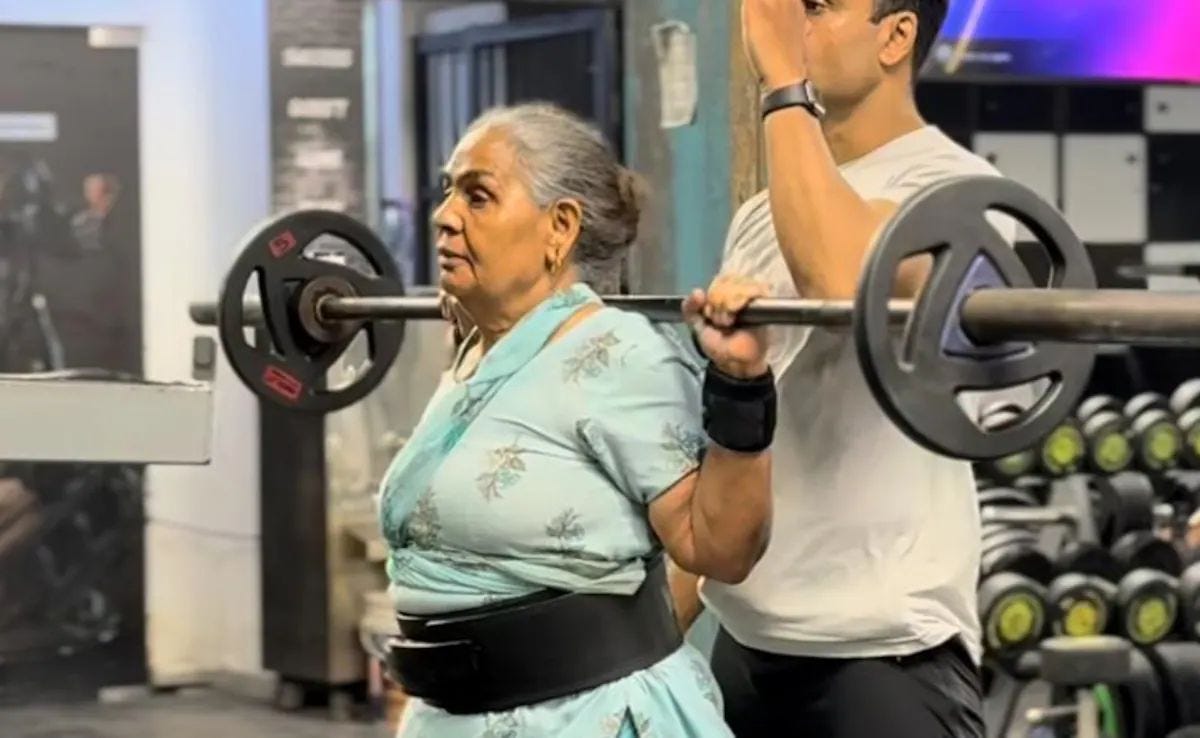
I remember the first time I saw a video of someone in their 60s lifting weights that I would probably struggle with at the gym. My first reaction wasn’t, “Of course, why not?” It was, “Wait, how old are they?”
And that reaction stayed with me.
Why was I surprised? Why had I automatically associated heavy lifting, speed and physical ambition with younger bodies? Somewhere along the way, we had quietly decided that ageing meant becoming slower, weaker and more cautious and that fitness after a certain age was mostly about gentle walks and stretching.
But social media is telling a very different story.
When age changes the rules
There are grannies and grandpas lifting weights, running marathons, doing squats, boxing, training in gyms and taking on physical challenges that many younger people would think twice about.
Take 66-year-old fitness entrepreneur Renu Sindhu, who celebrated her birthday by working out at the gym with her granddaughter. It is a small but powerful image of how our understanding of ageing is changing.
Then there is 68-year-old Portugal-based runner José Aguiar, whose high-speed running videos have earned him more than a million followers. Watching him sprint, it is easy to understand why people online joke that the videos must be AI.
Roshni Devi, popularly known as “Weight Lifter Mummy”, started weightlifting at 68 and now shares videos of her workouts and vegetarian diet. Meanwhile, a video of a 79-year-old woman lifting heavy weights caught the attention of longevity doctor Carlos De La Hoz, who highlighted her as an example of maintaining strength with age.
In India, 74-year-old Shibani Bagchi, Smriti Irani’s mother, has shared videos of herself doing dumbbell shoulder presses, while 93-year-old Madhukar Talwalkar has appeared in gym videos doing exercises including push-ups and squats.
The more I came across these stories, the more I realised that perhaps the surprising part isn’t that older people are exercising. It’s that we are surprised to see them doing it.
For many older people, fitness isn’t simply about maintaining a certain body shape. It is about maintaining the freedom to live the life they want.
Take 72-year-old Christine Hobson. After retiring from teaching, she discovered running and went on to complete 125 marathons across all seven continents, including Antarctica. She is now planning a marathon at the North Pole in 2027.
Then there is 75-year-old Penny Jarvis, a grandmother of six, who recently completed a marathon in 3:57:13 and set a British record in the women’s 75–79 category. She only joined a running club in her 60s.
Anjali Hazari, 70, took another route. A former marathoner and mountaineer, she turned to powerlifting after undergoing major knee and abdominal surgeries.
And 71-year-old David Hughes started running at 62 after surviving stage-three melanoma. What began with 100-metre runs eventually turned into marathons, ultramarathons and more than 200 parkruns.Age isn’t the limitation
These stories are different, but they have something in common: they aren’t exercising because they are trying to turn back the clock. They are exercising because they still want to move forward.
We’ve been taught to see ageing as a slow list of things we can no longer do. So when someone in their 70s runs a marathon or someone in their 80s lifts weights, we treat it like an exception
.
But maybe it shouldn’t be.
Fitness at any age isn’t about looking younger. It’s about staying strong enough to live the life you want, to travel, climb stairs, carry your bags, play with your grandchildren or simply stay independent.
These people aren’t really defying age. They’re challenging the assumptions we attach to it.
Maybe the number isn’t the limitation. Maybe our idea of ageing is.