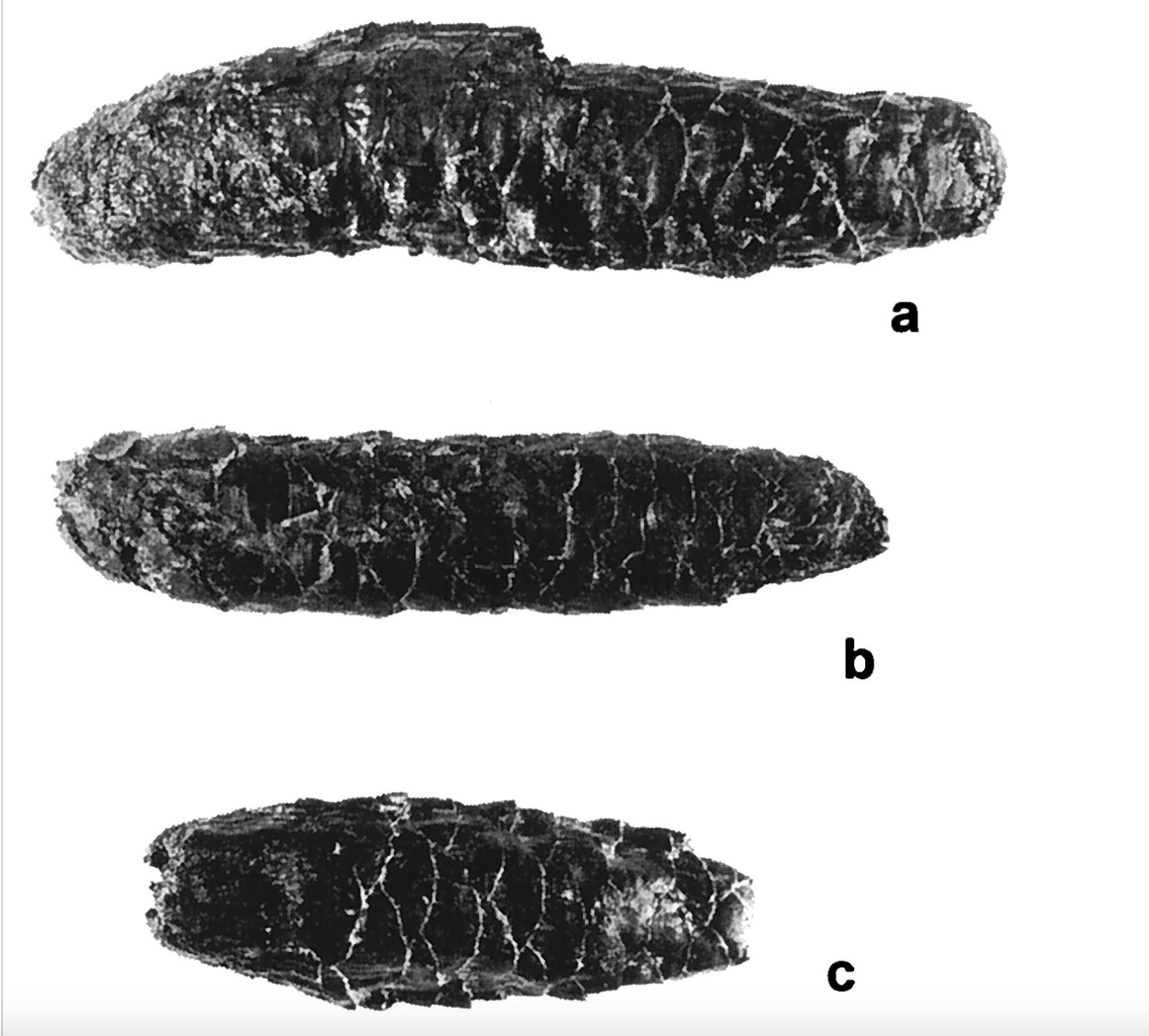
Images of fossilized Critchfield Spruce from Mississippi are above in Late Quaternary Extinction of a Tree Species in Eastern North America by Stephen Jackson & Chengyu Weng.
Overall:
An extinct species of spruce was found in the late 1990s in old lake beds & floodplain deposits (pollen, old fossilized cones, needles, twigs) dating back tens of thousands of years in the Southeast U.S. In fact spruce pollen & fossilized spruce is found with Beech, Magnolia & hickories in northern Florida dating back to +12,000 years ago.
Ocean drilling research along the Gulf Coast revealed that abundant pollen of this spruce species tanked at the last part of the Illinoian glaciation & then continued, but remained low (less than 4%) between the Illinoian & Wisconsin glaciation (i.e. the Sangamonian interglacial or the ice-free period like today between our two glaciations here). However, the pollen of this mystery spruce increased again to 10-15% by 70,000 to 80,000 years ago.
It seems as CO2 increased, spruce dropped & as CO2 dropped, oak increased in the pollen profiles per pollen profile analysis.
Regardless, it was found to be abundant & even in pure stands with other temperate & even southern tree species in various periods over the past quarter of a million years in the Southeast. Even there & then, the climate was still rather warm for spruce species that we find now in North America. However, spruce species in China are cold-sensitive. This extinct species represents a single member of that Asiatic family of more temperate weather spruces. Some of these cold-sensitive spruces are quite rare & seem to represent a dying branch of spruce species. This shows that even abundant species can alarmingly become rare & extinct with climate change &/or disease & competition pressures. This serves as a warning for future native species that may be abundant now, but may have pressures in the future as climate changes & disease & pests may increase.
The authors of the below referenced study give 3 speculative causes for its extinction. A pathogen spread as the climate warmed. Critchfield’s spruce failed to disperse and colonize newly available habitat–something other species of spruce did as the Laurentide Glacier retreated. And habitat space disappeared when broad-leafed trees outcompeted them. I would like to add some other speculative causes. It could have just as easily been an insect infestation as a pathogen in an environment with a longer time for a potential insect pest to reproduce. Maybe it was a pathogen spread by an insect or a pathogen plus an insect infestation. During previous interglacials broad-leafed trees very nearly outcompeted Critchfield’s spruce into extinction, but the latter survived in some refuge per chance. Maybe this time perchance it didn’t find that refuge. I doubt man played a role in its extinction, but there is a possibility Indian-set fires eliminated these isolated refuges where this tree had previously survived during interglacial periods.
Discussion: