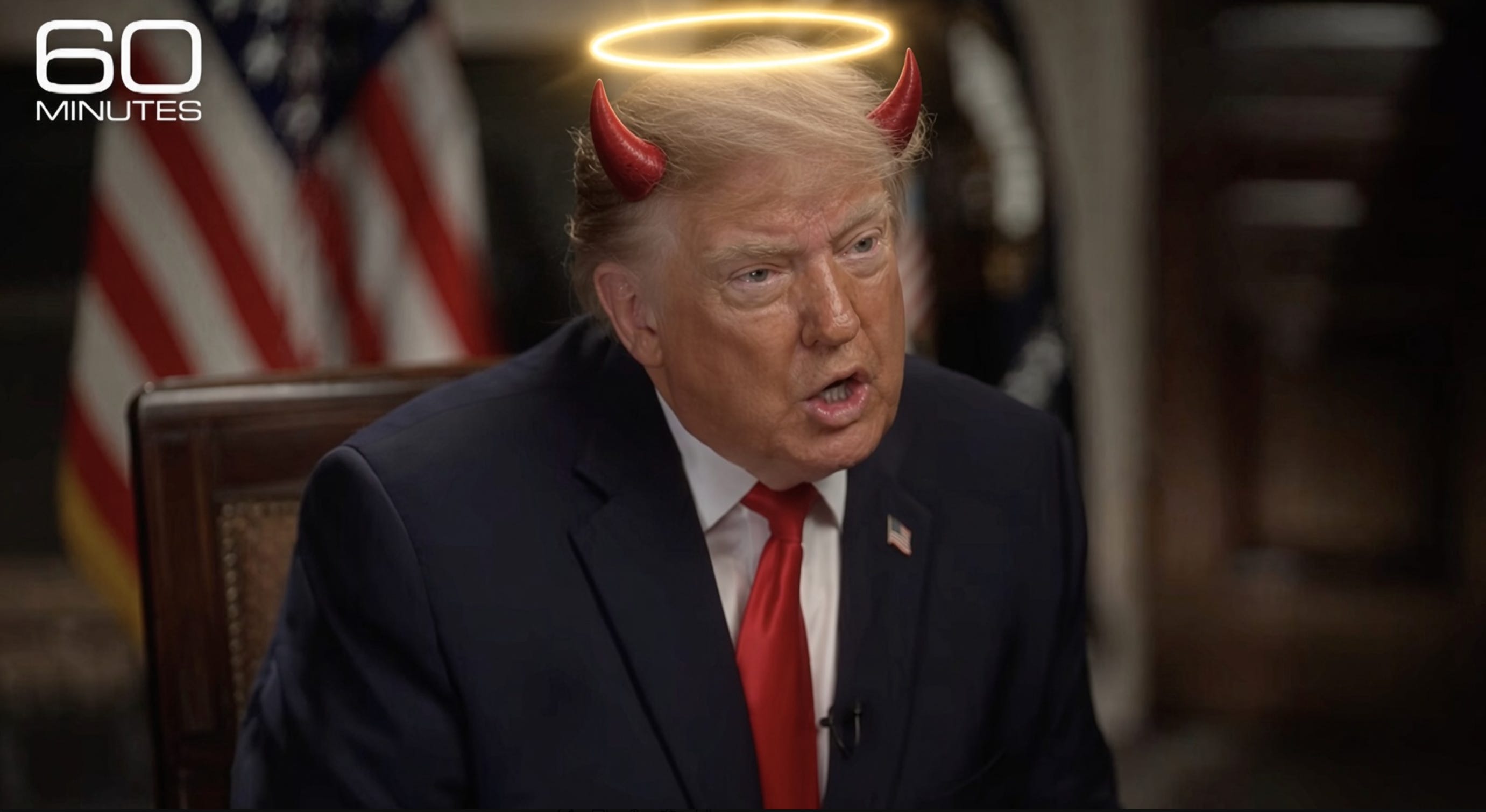
I honestly thought nothing would shock me about Donald Trump anymore. But this answer in his interview last night with Ross Douthat on “60 Minutes” did. And it shocked me in a way that made me feel deep pity for Trump, but fear for what follows him. Watch — I’ve cued it to the exact spot at the end of the interview:
(▶Here is a link to an extended version of the Douthat interview — 51 minutes long.)
If you can’t watch now, Douthat brings up Trump’s remarks at Charlie Kirk’s memorial service, in which Trump followed Erika Kirk’s tearful statement saying she forgives the man who killed her husband by saying that he wouldn’t forgive his enemies. Douthat then asks Trump what he thinks will happen to him when he dies. He says he’s “a religious person,” and “in theory, I go to heaven,” but that he hopes he does. Douthat presses him, asking him — as a believing Christian journalist would — if “all you have to do to enter Paradise is to feel love and forgiveness for … anyone you have expressed hate for over the years, could you do it?”
Trump, after hemming a bit: “The answer is no.”
An incredulous Douthat says, “Mr. President, you have had the most charmed and remarkable life of any person in my lifetime, and you are telling me that before the judgment throne of God, you could not find it in your heart to forgive some of your enemies? After all that’s been given to you?”
Trump: “Ross, can I be honest? I probably cannot do that, no. Because I do hate some of my enemies, and I always will.”
There you have it. If Donald Trump dies in his sleep tonight, barring the extraordinary mercy of God — and I am very glad God makes these calls, not me or you — he will go to Hell. Scripture could not be clearer.
I watch this and I think of the damned in Dante’s Inferno: they are stuck for eternity in their sin, because in life, *they had become their sin. *I feel such pity for Trump. I mean that. This man has been given everything, and still, he loves his hatred — which is to say, himself; he hates the people who have offended against his greatness — more than he fears God’s judgment.
*He loves his hatred more than he fears God. *If Trump had simply said something like, “I hope God gives me the grace to forgive them, and I can accept that grace and do what Jesus told us to do” — ok, fine. If he had said, “Forgiveness is very hard, after what they’ve done to me, but I know God expects it of me, so I pray for His help in forgiving” — that would have been both honest and very human. As Douthat says twice in his exchange with Trump, it’s *not *an easy question to answer!
Earlier on Sunday, I literally asked God to give me the grace to forgive a couple of people who really hurt me years ago. A few weeks ago, a high school acquaintance who later came to hate Christians, and who spent years spreading malicious lies about me on the Internet suddenly died. I forced myself, out of obedience to Christ, to pray several times for God’s mercy on his soul. As horrible as he was to me, I don’t want him to go to Hell. Besides, Jesus told us that we will be judged by God as we judge others. How do I know what cruel things I might have done to others, but of which I remain entirely unaware. I want God to forgive me those sins. Therefore, I must forgive, or at least work sincerely towards forgiveness. None of those men, neither the two living nor the dead man, ever asked for my forgiveness. Yet I know it is my moral duty to try to forgive them anyway, as Jesus forgave his executioners, who never asked for it.
But if, following Douthat’s question, I found myself standing before God at judgment, and I was told all I had to do was forgive those two and I would be let into heaven, of course I’d do it! Wouldn’t you? To refuse to forgive in that scenario is Luciferian pride, isn’t it?
(A theological digression: I am not aware of any Scripturally sound Christian scenario in which we are given the chance to repent and forgive* after* death — though following the Catholic teaching about Purgatory, and C.S. Lewis’s scenario in The Great Divorce, and also some Orthodox teaching, it’s at least conceivable that many of us can end up in some sort of halfway point, if we haven’t fully rejected God in this life. It’s why Orthodox like me pray for our dead; we just don’t know for sure whether anybody is in Hell, or whether God has some sort of middle place for people who have only partially accepted Christ. In Orthodoxy, we reject the Catholic teaching on Purgatory, for theological reasons, while holding, though not officially defined, that there is likely some sort of middle state in which those who have been partly renewed in Christ exist after death, pending further purification to be made capable of being in God’s presence. In other words, the Orthodox position is closer to Lewis’s in The Great Divorce than in Catholic Purgatory, though obviously similar. This has to do with the fact that Orthodoxy does not accept the Penal Substitutionary Atonement model of justification and sanctification, for reasons too complicated to get into here. Many, probably most, Protestants are more confident in their answer, of courrse. Anyway, this is beside the point: Douthat’s hypothetical was not really a theological inquiry, but instead sounded out the depths of Trump’s anger at his enemies — and he found out that Trump would rather reign in Hell, holding on to his hatred, than serve in Heaven by obeying Christ’s command.)
I knew that Trump was an expert hater, but I didn’t expect that. What can you say to that, other than “May God have mercy on your soul, Mr. President”?
This clip is an object lesson. If you are a Christian, sit down with your children — or sit down with yourself, if you need to — watch and listen to the words of the President of the United States, and see someone who is choosing eternal damnation. It’s terrifying to consider any human being doing so, but the President of the United States, a billionaire several times over, and a man whose life was spared from an assassin’s bullet. God literally gave him his life back, I believe, on that horrible day in Butler, PA — and therefore a chance at redemption before death. And this is how Trump thinks about his enemies, and his own eternal destiny!
Trump must not think he’s at real risk of Hell, presumably because he’s never cracked open a Bible, and read the Gospels, and Christ’s teaching on forgiveness. I don’t think he really believes in God. But there can be no doubt to anyone with even semi-serious acquaintance with Scripture that the president, by his words, is, or appears to be, choosing damnation. Let me repeat: Douthat puts it to him if he would hold on to his hatred before the Judgment Seat of God, and if forgiving his enemies was the price he had to pay to enter Heaven, would he still not forgive? No, he says, he wouldn’t forgive. You might laugh at the arrogance of that statement. It’s not funny. If you are a Christian, then you have just seen a rich and powerful man choose damnation over offering those who hate him forgiveness.
He reminds me of the woman in The Great Divorce who has a demonic reptile on her shoulder keeping her from moving forward, towards God. The angel stands in front of her asking for her permission to kill it, but the reptile whispers in her ear that she needs him there, that she couldn’t live without him. So she can’t muster the will to grant the angel permission to deliver her from her demonic tormenter. It seems that Trump’s rage is what drives him, is what defines him. If so, then this is exactly what makes him a figure out of the damned in Dante’s Inferno. They chose their own will, and their own defining sin, over God. And, in Dante, by contrast to the souls in Purgatorio, they never humbled themselves, no matter how deep in sin they were, to confess to God that they were sinners in need of mercy. I hope Trump, maybe in the privacy of his own heart, has at least told God in prayer that he knows he’s a sinner in need of mercy, and asked for it. That’s his only hope for eternal life.
Are there no Christians around Donald Trump who can take him aside and speak to him clearly about the state of his soul? Aren’t there any Christians who love that poor twisted man enough to be honest with him, and urge him to repent while there is yet time? Or are they all pathetic hangers-on and flatterers more interested in protecting access to power than in loving Donald Trump enough to tell him the truth that affects his eternal destiny? I don’t expect a wild heretic like Paula White to do it, but what about Robert Jeffress, or any of the other pastors who have embraced Trump over the years, and prayed for him? What about his sincerely Catholic vice president and Secretary of State?
I’m writing this on Sunday night, minutes after seeing that clip, and honestly, it has shaken me up. Not, I emphasize, with loathing for Trump, but with* true pity* for him. He is exactly the man Jesus was talking about when he asked, “What does it profit a man to gain the whole world, but to lose his soul?” (Mark 8:36) I thought I had Trump pretty much figured out, but honestly, it’s unnerving to know that a man who is so driven by hatred towards his enemies — and God only knows he has enemies — wields so much power.
So that’s Trump. What about the rest of us? Ten years or so ago, Douthat — the hiring of whom is turning out to be the best thing Bari Weiss has done as head of CBS News — famously wrote, “If you don’t like the Religious Right, wait till you see the Post-Religious Right.”
Last night on “60 Minutes,” Douthat revealed the face of the Post-Religious Right: Donald J. Trump’s.
After I watched that clip, I thought of my review three years ago of the Christian Nationalist pastor Andrew Isker’s grotesque book * The Boniface Option. *Isker purported for it to be the “based” answer to my
Because this review is mostly critical, I want to go on record here affirming that broadly speaking, I share Andrew Isker’s disgust with the world as it is. What sets us apart is
mostlywhat to do about it. I say “mostly” because even I, on my angriest days, can’t come close to mustering the rage Isker brings to nearly every page in this book.Isker is a sharp writer, but an undisciplined one. The choleric contempt suffusing
The Boniface Option— henceforth, the Bon Op — is ultimately alienating. For most of the book, I found myself nodding along, saying, “Yeah, he’s right about that.” But over and over, Isker — a young Minnesota pastor who was trained by the ever-combative Douglas Wilson — undermines his case by responding with febrile intensity. Here’s a typical line: “Men with the spirit of holy war within them will be what brings down the idols of this fetid, corpulent, repulsive world.”Gosh. There’s a lot of that in the pages of this short book. The word “disgusting” appears eleven times. The phrase “disgusting world of filth,” three times; the word “hate,” thirty-nine times. You get the feeling that Isker wrote this with trembling fingers, two tics away from a
gran malseizure, and had to summon everything he had to keep himself from agonizing over threats to our precious bodily fluids.
And:
Yet it is striking how over and over, Isker exhorts his readers to cultivate hate. Literally, he does this. “The need of the hour is to teach especially Christians to hate the fake and gay globohomo cinematic universe,” he writes. Of the “fake and gay world,” Isker says, “in order for Christendom to return, it is a world you must learn to hate.” And: “You must teach your children to love the things you love and hate the things you hate. You must overcome your aversion to hate.”
Another Protestant pastor, of an earlier generation, wrote:
There’s another reason why you should love your enemies, and that is because hate distorts the personality of the hater. We usually think of what hate does for the individual hated or the individuals hated or the groups hated. But it is even more tragic, it is even more ruinous and injurious to the individual who hates.... For the person who hates, the true becomes false and the false becomes true. That’s what hate does.Those are the words of Martin Luther King, Jr., commenting on the command of Our Lord to love those who hate us, and to pray for those who persecute us. Is this the Gospel of Globohomo, according to young Pastor Isker?
This is how these self-confessed Christian young male influencers roll — the Iskers, the Webbons, and the like. It is also how the non-Christian, vitalist, will-to-power types (e.g., Bronze Age Pervert) roll. This, I fear, is the future for us all: caught between a post-Christian Left that hates the substance of the Christian faith, and if they profess it, have denatured it to make it fit into a secular progressive mold; and a post-Christian Right that hates the substance of the Christian faith, and if they profess it, have denatured it to make it fit into a vitalist, Nietzschean framework.
Please don’t come at me with “but you voted for him!” I did, in 2020, and would have done in 2024 had I been in the country. I did so not out of respect for him, but because I believed that he was the only thing standing between people like me and the woke fanatics who despise us so much they would stop at next to nothing to ruin us. Because he was the only thing! He really was. America today is not (yet) like Spain in the 1930s, but if you were a Spanish Catholic then, you might have hated what Gen. Francisco Franco stood for, but there was no middle ground: the forces of the Republic — the Communists and Anarchists — were burning down churches and massacring priests and lay Christians. Who or what would you have chosen in that scenario? Again, I’m not saying it was or is so dire here; I’m just using a more extreme example to illustrate a point. A lot of people who voted Democrat last week have no faith in the Democrats (see commentary below about exit polling), but believed that to continue in the direction Trump and his party are leading the country is intolerable.
I wanted Ron DeSantis to be our guy in 2024, but GOP primary voters had other ideas. DeSantis was not on the 2024 ballot. It was either Trump or Kamala. Similarly, this go-around, you could vote Republican or Democratic. Lesser of two evils, and evil of two lessers. You could abstain — I abstained in the 2016 presidential race — but unlike a decade ago, I don’t see a lot of virtue in refusing to choose, in withdrawing in disgust.
We have lived through about two years of the second Trump administration, and seen him accomplish some good things. But his own ego-driven miscalculations — his making decisions based on gut instinct — have cost the Republican Party control of Congress, and left conservatism to face the fact that the last real line of constitutional defense of our freedom and moral sanity — the federal courts, especially the Supreme Court — will have zero chance of getting any conservative judges confirmed until at least 2033, and even then only if everything goes right.
The libs and the Never Trumpers will have seen last night’s interview, and say, “We told you so: character is destiny.” And they will be right, alas, to a great extent. It is not shocking that Donald Trump hates his enemies. It is shocking that he hates them so much that he would choose Hell over forgiving them. A man who sees the world like that has no business near power, much less supreme executive power in the most powerful nation on earth. After that statement, who can doubt that if Trump were not constitutionally restrained, he would stop at nothing to destroy those he hates?
And you know, I entirely believe that should the Democrats regain presidential power, and if they hold Congress at the same time, they will find more sophisticated ways than the crude Trump has employed…