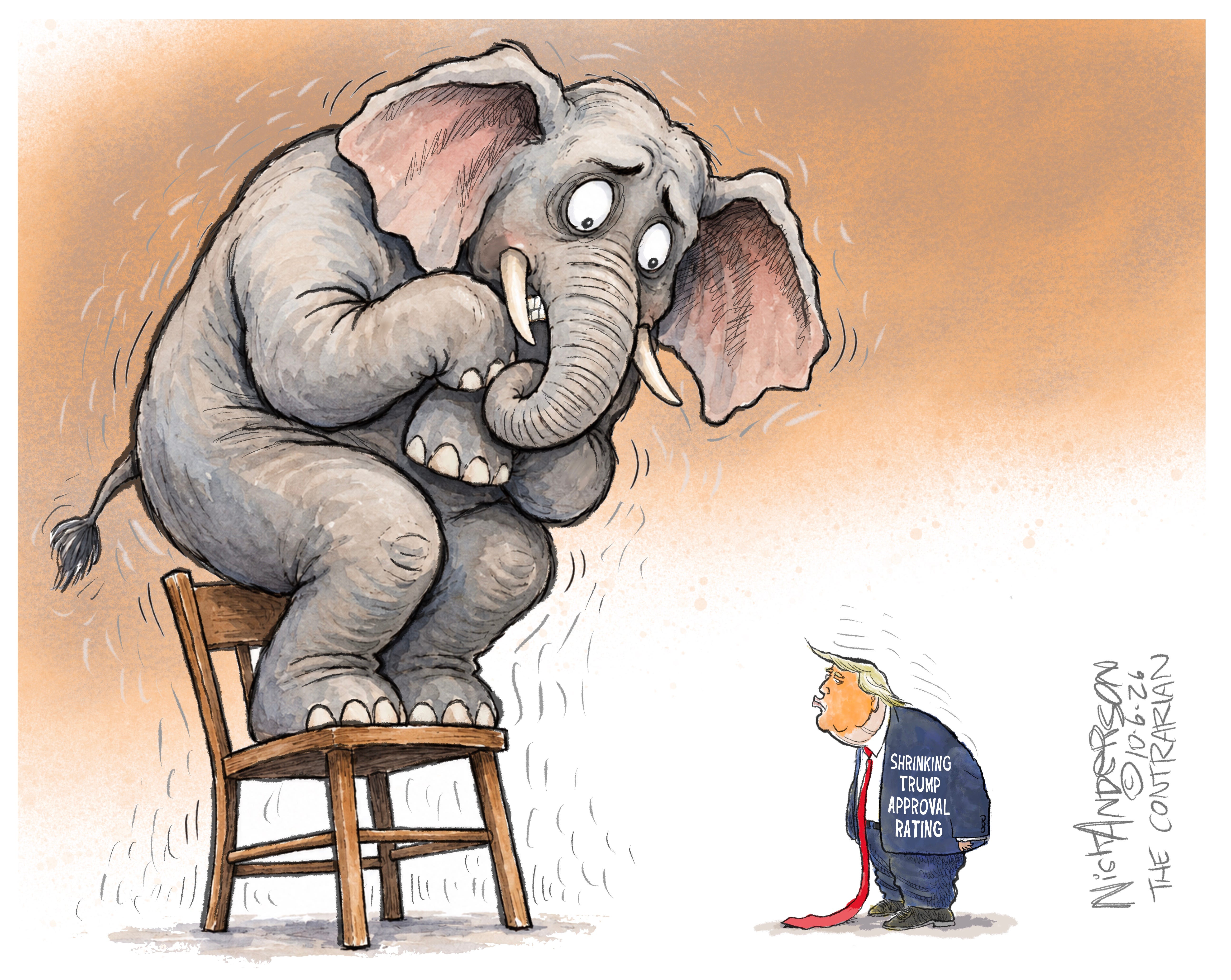
With less than a month until the November midterms, Republicans are confronting an increasingly uncomfortable possibility: the political environment that once threatened their narrow congressional majorities may be getting worse.
The warning signs are coming not just from Democratic campaigns or outside analysts, but from Republicans themselves.
The Associated Press reported Wednesday that Republicans have amassed roughly $1 billion across major political groups to defend their congressional majorities, yet party strategists increasingly worry that even that enormous financial advantage may not be enough to overcome voter dissatisfaction with President Donald Trump, continuing concerns about the cost of living and the economic fallout from the war with Iran.
Longtime Republican pollster Neil Newhouse told AP that much of the party’s advertising money may also be arriving too late to have maximum impact.
“A million dollars of advertising in October is a drop in the bucket,” he said.
Perhaps the clearest indication of GOP anxiety is what Republican candidates themselves are doing.
A Reuters review published today examined 62 competitive House and Senate races and found that 41 Republican candidates—roughly two-thirds—have either broken with Trump on particular policies or deemphasized their connections to him. The distancing generally isn’t a wholesale rejection of Trump’s agenda; instead, candidates are selectively separating themselves from policies that have become politically difficult back home.
Michigan Senate candidate Mike Rogers, for example, is now calling for an immediate end to Trump’s tariff dispute with Canada, arguing that it is increasing costs for Michigan businesses and consumers. Just weeks earlier, Rogers had defended Trump’s tariffs as part of the president’s “America First” agenda. Rogers has also changed his position on the Iran war, urging that the conflict end as a way to reduce gasoline and grocery prices.
That’s an important development because Trump has made himself the centerpiece of the Republican midterm campaign. Beginning a monthlong campaign push last week, he explicitly told supporters: “Pretend I’m running.”
But Reuters reported that some Republican candidates are uncertain whether appearing with Trump helps them, while Trump himself acknowledged concerns about races in states including Michigan and Texas.
The biggest political vulnerability is something much less complicated than Washington’s ideological battles: things cost too much.
An AP-NORC poll conducted Sept. 24-28 found just 17% of Americans approved of Trump’s handling of the cost of living, while 26% approved of his handling of the economy overall. About 65% said Trump’s policies bear at least some responsibility for current economic conditions.
“If you’re not worried, you’re living in a cave,” Republican Sen. Jim Justice of West Virginia told Semafor while discussing voters’ economic concerns.
The war with Iran has compounded the problem by contributing to sharply higher energy prices. Diesel and gasoline costs have become particularly sensitive issues in agricultural and trucking regions, where fuel prices quickly translate into higher operating costs.
And Republicans are discovering the political difficulty of explaining macroeconomics to someone staring at a diesel pump.
Another troubling sign for Republicans is where they’re being forced to spend money. Republican groups are pouring resources into races in places that ordinarily wouldn’t require such attention. Democrats have mounted competitive Senate campaigns in states including Texas, Ohio, Maine, Iowa and Michigan, while Democratic groups are expanding their House targets into traditionally Republican territory including Arkansas and Tennessee.
Republicans also have begun making difficult decisions about where their money can still make a difference. Outgoing Republican Sen. Thom Tillis of North Carolina described the situation bluntly: “In the last month, you pretty much have to place your bets.”
The Republican advantage remains substantial. GOP-aligned organizations have considerably more money available than comparable Democratic groups, and the ultimate composition of Congress will be determined district by district and state by state—not by national polling alone. Democrats also face their own vulnerabilities and fundraising disadvantages.
But the Republican behavior is increasingly difficult to miss.
Candidates are separating themselves from Trump on tariffs and Iran. Party committees are triaging expensive races. Trump is launching an intensive campaign schedule. Republican senators are publicly warning about voter anger over the economy. And approximately two-thirds of GOP candidates in competitive congressional races examined by Reuters have found some way to put daylight between themselves and their party’s president. And with Election Day less than four weeks away, the GOP’s problem is no longer simply that Democrats think a wave may be coming. Increasingly, Republicans are acting like they can see the water rising, too.