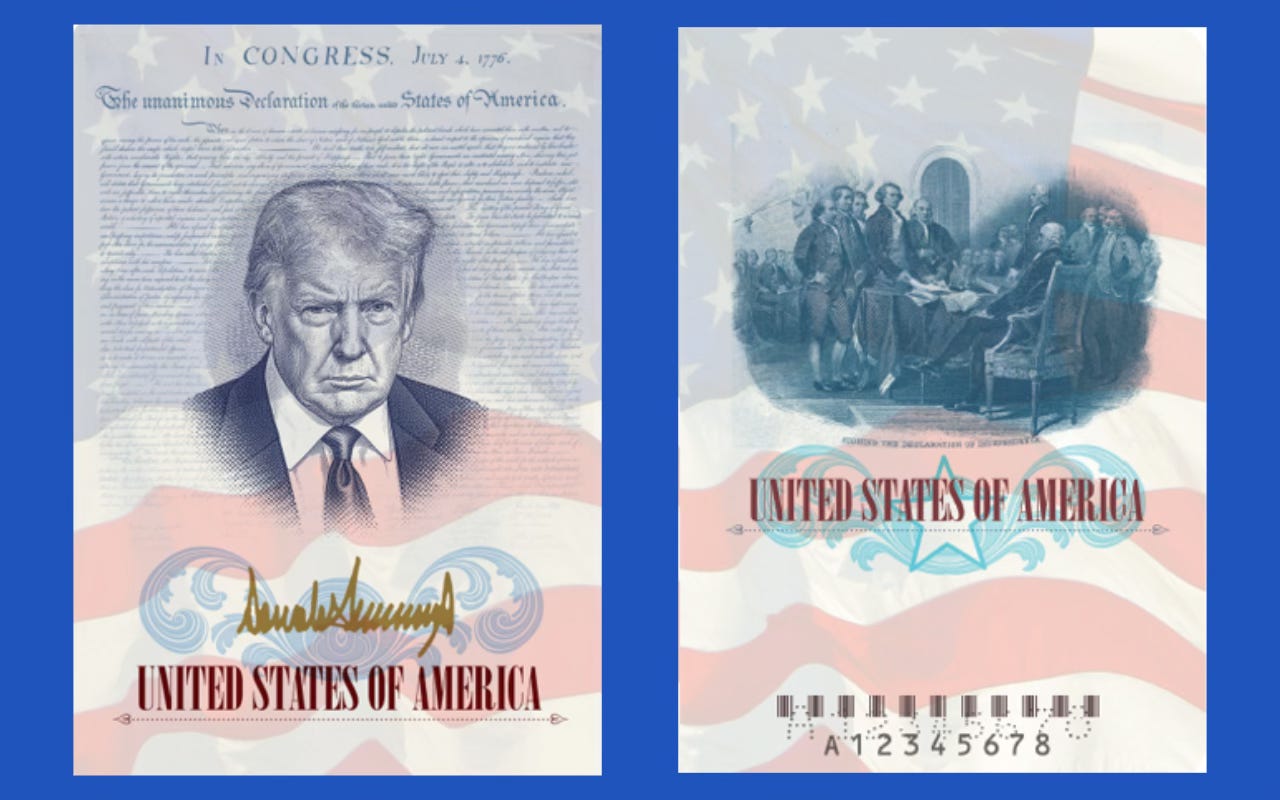
For daily news updates and analysis, be sure to follow us on Instagram. If you are able to support independent journalism, please make a tax-deductible donation to News Not Noise here.
We are living through a period of institutional collapse at superspeed.
This week alone: The Supreme Court effectively gutted the Voting Rights Act, eroding the legal guarantee that voters of color have equal access to the ballot. The UAE announced it’s leaving OPEC, raising immediate questions about oil prices and whether others will follow. The Secretary of Education defended the administration’s decision to divert oversight of elementary school programs to the Department of Labor, which, in a country where some red states are already moving to reduce child labor protections, is not a theoretical concern. USAID is all but gone. The EPA is hollowed out. The Forest Service is being gutted.
I’m not listing this to depress you.
Here’s what I keep thinking: Many of these institutions were already broken. Ossified, deeply flawed, resistant to reform because bureaucratic inertia is its own kind of power. Now they’re being dismantled or corrupted before anyone agreed on what should replace them — and real people are bearing the cost of that gap.
Nothing stays in this condition. People will mobilize — around what, and to what effect, remains to be seen.
Trump has put forces in motion that no one fully controls, including him. Where this lands — for voting rights, for the environment, for the global order — is genuinely unknown. That’s not necessarily reassuring, I know. But it means the story isn’t over. And that leaves me with some hope.
In today’s newsletter: The voting rights exit. New maps, same game. Trump’s speech police are busy. The FCC is taking requests. King Charles brings receipts. Another antisemitic attack. Mothers are skipping meals. Immigration data to keep. Trump signs America’s passport. And in News That Doesn’t Suck, teens take the wheel and bookstores defy the odds.
Dead Letter: The Supreme Court on Wednesday voted 6–3 along partisan lines to “eviscerate” thelast remaining powerful provisionof the Voting Rights Act, which protected the votes of people of color. That’s how Justice Elena Kagancharacterized the ruling in her dissent. After this “demolition of the Voting Rights Act,” she warned, “a state can, without legal consequence, systematically dilute minority citizens’ voting power.” Here’s what that could mean.Blind to Discrimination: Justice Samuel Alito, writing for the majority, claimed courts must not consider race in districting — even when addressing racial discrimination. As Justice Kagan pointed out, ignoring race doesn’t lead to neutrality but instead entrenches discrimination. The Court’s decisioneffectively permits lawmakers to draw voting maps that disenfranchise minority voters. One-quarter of the Congressional Black Caucus and 10% of the Hispanic CaucusThe decision may also affect state, local, and even school board districts.could be affected.Race to the Bottom: The Court’s decision concerns ection 2 of the Voting Rights Act, which for decades ensured that minority voters had the chance to elect lawmakers who represented their interests. In the 1980s,Congress specificallyamended the Act to clarify that a law’s discriminatoryeffectmatters, regardless of intent.Today the Courtfunctionally reversed that, ruling that discriminatoryintentmatters. Critics note that intent isextremely difficult to prove. By creating new hurdles for voters to prove an intent to “harm,” the Court has effectively made the law’s original promise nearly impossible to enforce. Plaintiffs seeking Section 2 protectionsmust now prove that a minority group’s vote is being diluted specifically because of their race and not because of partisan difference.Because race and party are so deeply intertwined, especially in the South, this creates a nearly impossible evidentiary burden, forcing plaintiffs to “prove the unprovable.“Section 2 technically remains, but as Justice Kagan explained, it is now “all but a dead letter.”Immediate Impact: The Courtruled that Louisiana’s Congressional map— redrawn after Black voters successfully challenged it under the Voting Rights Act — was itself an “unconstitutional racial gerrymander.”Democrats will. Within hours of the ruling, the Florida legislaturelose at least oneseat therepassed Gov. Ron DeSantis’s redrawn map, which couldhand Republicans. DeSantis had been publicly waiting for the Court’s decision before moving.four additional House seatsWhat’s next — and what’s at stake:Missouri and Tennesseecould try to redraw their maps before the midterms. Longer term, roughly70 congressional districtsacross the country that Section 2 of the Voting Rights Act historically protected may now be vulnerable to similar challenges. Republicans could use that opening totry to eliminate many more Democratic seats. Democrats aren’t sitting still:California and Virginiahave passed their own redrawn maps, and legal challenges to the Florida map are expected immediately.
Charm Offensive: Lawmakers laughed, clapped, and cheered as King Charles IIIdelivered an historic speechin Congress Tuesday. The speechfocused on the enduring bondbetween the UK and US — one the King noted has survived times of uncertainty and disagreements. The King delivered several similar, subtlerebukes of the Trump administration. He championed NATO, reminded Congress that it was England that gave the US the Magna Carta and a limit on executive power (a line that drew applause from Democrats in Congress), and implored the US not to give up its support of Ukraine. “I pray with all my heart that our alliance will continue to defend our shared values,”he said. “And that we ignore the clarion calls to become ever more inward-looking.” Trumpsaid he was“very jealous” of Charles’ “great speech.” He also found a way to get in a jab at the UK’s prime minister, saying, “When you like the king of a country so much, it probably helps your relationship with the prime minister.” On Wednesday the royal couplevisited the 9/11 memorialand an urban farm community project in Harlem.Another Attack: An attackerstabbed two Jewish menin London Wednesday in what police are calling an antisemiticterrorist incident. Both victims are in a stable condition. It’s the latest in awave of antisemitic attacksagainst Britain’s Jewish community. The mayor of Londoncondemned the attack and promisedto implement “high-visibility patrols” in the neighborhood.Hard to Stomach: Anew surveyby No Kid Hungry finds that 43% of US mothers worry if they can consistently provide their kids with healthy meals.Almost 25% said they took on debt in the last month and 20% ate less or skipped a meal altogether to ensure their kids had enough food. 55% say they could use access to healthy, affordable food; 54% would benefit from access to affordable housing. This is the kind of vital issue that gets very little attention — women and children in poverty aren’t really hot topics in the media.You can read more of this study.hereHolding On: The Federal Reserve on Wednesdayheld rates steady, albeit with four official dissents, the most in over three decades. Fed Chair Jerome Powell announced he willremain a governorafter his term as chair ends on May 15. Hecited the Trump administration’s legal attacksagainst the Fed, which he warned “are battering the institution and putting at risk … the ability to conduct monetary policy without taking into consideration political factors.” Also today, the Senate Banking Committeeadvanced Kevin Warsh, Trump’s nominee to replace Powell. The full Senate votes next.Contributions: Here’s some data to bookmark for your next dinner-table disagreement over Trump’s mass deportation program…. Anew studyby the CATO Institute found that immigrants contribute more in taxes per capita than US-born Americans.**From 1994 to 2023, the average immigrant contributed about $100,000 more in taxes.**Accounting for benefits received — immigrantsuse far fewerthan US-born Americans — immigrants contributed $14.5 trillion. Over that timeframe illegal immigrants paid about $3 trillion in taxes. It’s a study that’s particularly hard to attack; CATO is a right-leaning institute originally founded by the Koch Foundation.Crisis Center: The Supreme Court on Wednesdayunanimously sided with a faith-based crisis pregnancy center, which is being investigated by New Jersey for potentially misleading people about its services. The state of New Jersey had subpoenaed the crisis center to turn over its private donor list. The court found thatthe threat of having to turn over the list could“chill” free speech and ruled it does not have to comply. This will make it more difficult for the state to determine whether the centers are usingscare tacticsandmisinformationto convince vulnerable womennot to seekabortions. The ACLU backed the crisis center on free speech grounds.
**Retribution Roulette:**The Trump administration this week intensified itstargeting of Trump’s political opponents.Fast-Track: The FCC on Tuesday ordered Disney’s ABC TV stations to file for broadcast license renewalsyears before they are due. The agency officially says this is part of an ongoing investigation into Disney’s DEI practices, but the move followedanother outcry by the President and First Ladyover a joke by late-night host Jimmy Kimmel. President Trump has since called for Kimmel to be fired, making the FCC’s move look like retaliation. (Déjà vu anyone?) Anna M Gomez, the FCC panel’s lone Democrat,slammed the moveas a “political stunt” that is “unprecedented, unlawful, and going nowhere.” Here’s a surprise.Even Sen. Ted Cruz (R-TX), saying that “it is not the government’s job to censor speech, and I do not believe the FCC should operate as the speech police.”condemned the moveTry Again: Former FBI Director James Comeyappeared in court Wednesdayafter Trump’s DOJ — now run by his former defense attorney Todd Blanche — indicted him for a second time. This time the DOJ charged him with threatening Trump. Prosecutors cited a post Comey made on social media in 2025, featuring an image of seashells arranged to read “86 47.” The governmentargues this was“a serious expression of an intent to do harm to the President.” Sen. Thom Tillison Wednesday saidhe hopes “there’s more to it than just the picture in the sand.”**COVID Again:**The DOJ is also targeting aformer advisorto then–NIH Director Anthony Fauci, accusing him of skirting public disclosure laws by using his private email for communications about the origins of COVID-19.
AI Fight: Elon Musk’s high-profile, yearslong lawsuit against OpenAI and Microsoft went to trial this week. Musk testified on Tuesday,[arguing he founded OpenAI](https://www.cnn.com/2026/04/29/business/takeaways-elon-musk-sam-altman-o…