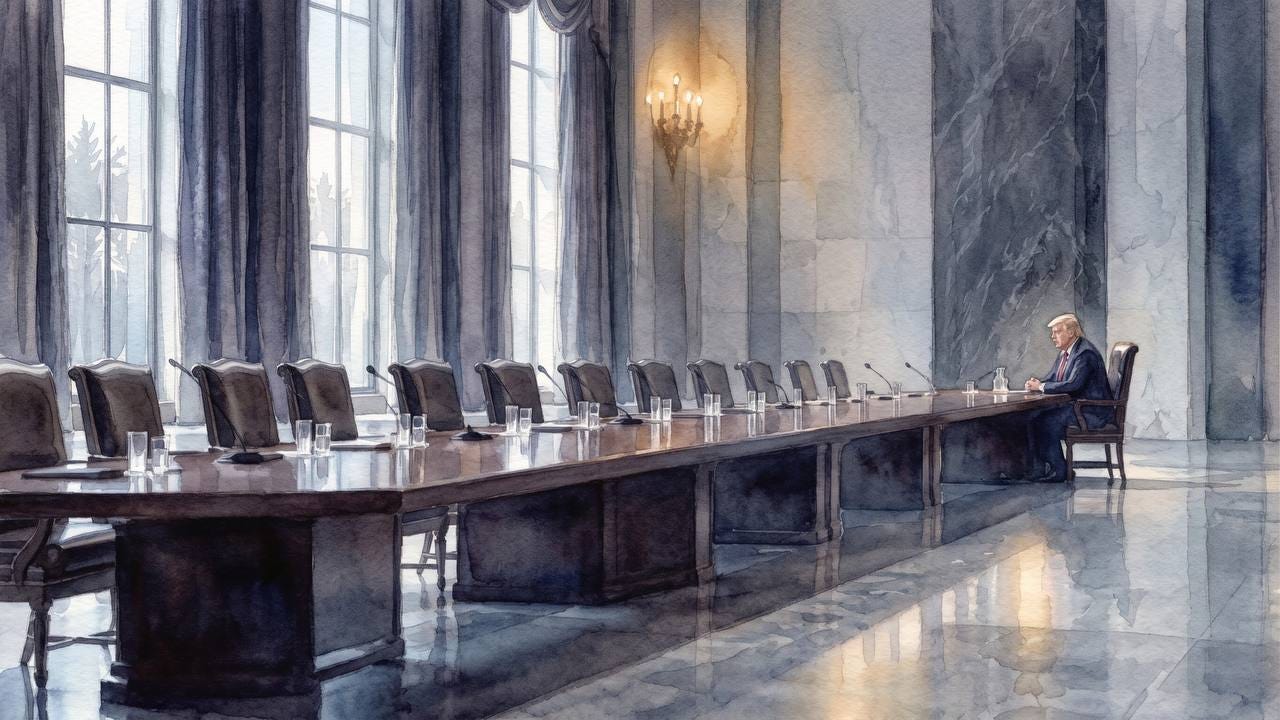
BERLIN—Donald Trump harms America’s already damaged international reputation. He seems ready to divide the world while everyone else waits outside, and at his table he sees places for Vladimir Putin and Xi Jinping, but none for Volodymyr Zelensky, the elected president of a smaller country who commits the intolerable offense of speaking back. Trump may quarrel with Russia and China, but he admires their rulers’ personal power. He has called Putin strong and smart and, after Xi abolished presidential term limits, joked that perhaps America should “give that a shot someday.”
We publish this newsletter every day at 9:05am NYC time / 4:05pm Kyiv.Your subscription fuels our work.
Now he is holding a meeting with Putin and Xi without Zelensky: three rulers above the map while the country whose territory is at stake waits outside. With his erratic leadership style, allies around the globe are left wondering whom they can rely on. And the answer is sadly crystal clear.
Ukraine’s true offense is not that it refuses peace, but that it refuses Trump’s demand for submission. Because Zelensky will not behave like a grateful tenant awaiting the landlord’s decision, Trump attacks his legitimacy. He has called him a “dictator without elections,” falsely placed his approval at four percent, suggested Ukraine started the war, and described him as harder to handle than Putin. He turns Russian aggression into Ukrainian guilt, then presents Putin, who began the war, as the reasonable man with whom business can be done.
Zelensky was elected in 2019. Ukrainian law prohibits national elections under martial law because no representative vote can be organized while territory is occupied, soldiers are fighting, and millions are displaced. Germany, one of Europe’s most stable postwar democracies, would not continue with business as usual during a formally declared state of defense either. Article 115h of the Basic Law extends expiring parliamentary terms until six months after that state ends and prohibits dissolution of the Bundestag while it remains in force. If this creates a dictatorship, Trump must accuse the German constitution of authoritarianism as well. His insult does not defend democracy. It strips Putin’s victim of democratic legitimacy, despite other democracies also providing for the extension of parliamentary terms during war.
Ukraine has
ample reason to fear abandonment. South Vietnam learned that American commitments could survive in diplomatic language long after Washington had lost the willingness to enforce them.
The same inversion governs Trump’s outrage over Ukrainian strikes on Russian refineries. Russia has spent years attacking Ukraine’s power stations and heating infrastructure, leaving civilians without electricity and warmth, yet Trump discovers his conscience only when Ukraine threatens diesel production. The invader attacks the energy system of the country it seeks to subjugate, and the invaded country strikes facilities supplying revenue and fuel for that war. Still, Trump calls Ukraine’s response “a disgrace” and says Russia has been “fine” on Ukraine, although analysts attribute most of the recent diesel-price increase to disruptions caused by the U.S.-led war with Iran.
What is fine about butchered civilians, who lie dead by the wagonload on the streets of Ukrainian cities? What is fine about murdered children, slaughtered by Russian drones and rockets? American Christians and conservatives, natural backers of Trump’s administration, should be outraged at this kind of rhetoric.
Then there are the courtiers conducting this supposed peace: Steve Witkoff, Trump’s real-estate friend who entered government without diplomatic experience, and Jared Kushner, his son-in-law and unofficial envoy, who has no particular expertise in Russia or Ukraine. Their talks have included American-Russian economic projects, while Kushner manages an investment company backed by billions in foreign capital.
Trump did not invent Washington’s temptation to discard vulnerable partners. But
he removed the shameand began marketing betrayal as strength. European governments should understand what follows.
Ukraine has ample reason to fear abandonment. South Vietnam learned that American commitments could survive in diplomatic language long after Washington had lost the willingness to enforce them. Its fate deserves more than a passing reference, particularly when another American administration presents negotiations with an aggressor as the route to lasting peace.
The January 1973 Paris Peace Accords provided for a ceasefire and the withdrawal of American forces, but left North Vietnamese troops inside South Vietnam. President Nguyễn Văn Thiệu had resisted a settlement that allowed his enemy to retain that foothold. Washington secured its exit without removing the military threat to the country it had spent years supporting. Two years later, on April 30, 1975, North Vietnamese tanks entered Saigon. The agreement had ended America’s direct participation in the war. It had not secured South Vietnam’s survival.
Ukraine’s history and political institutions are different, but the comparison regarding the durability of outside support still stands.