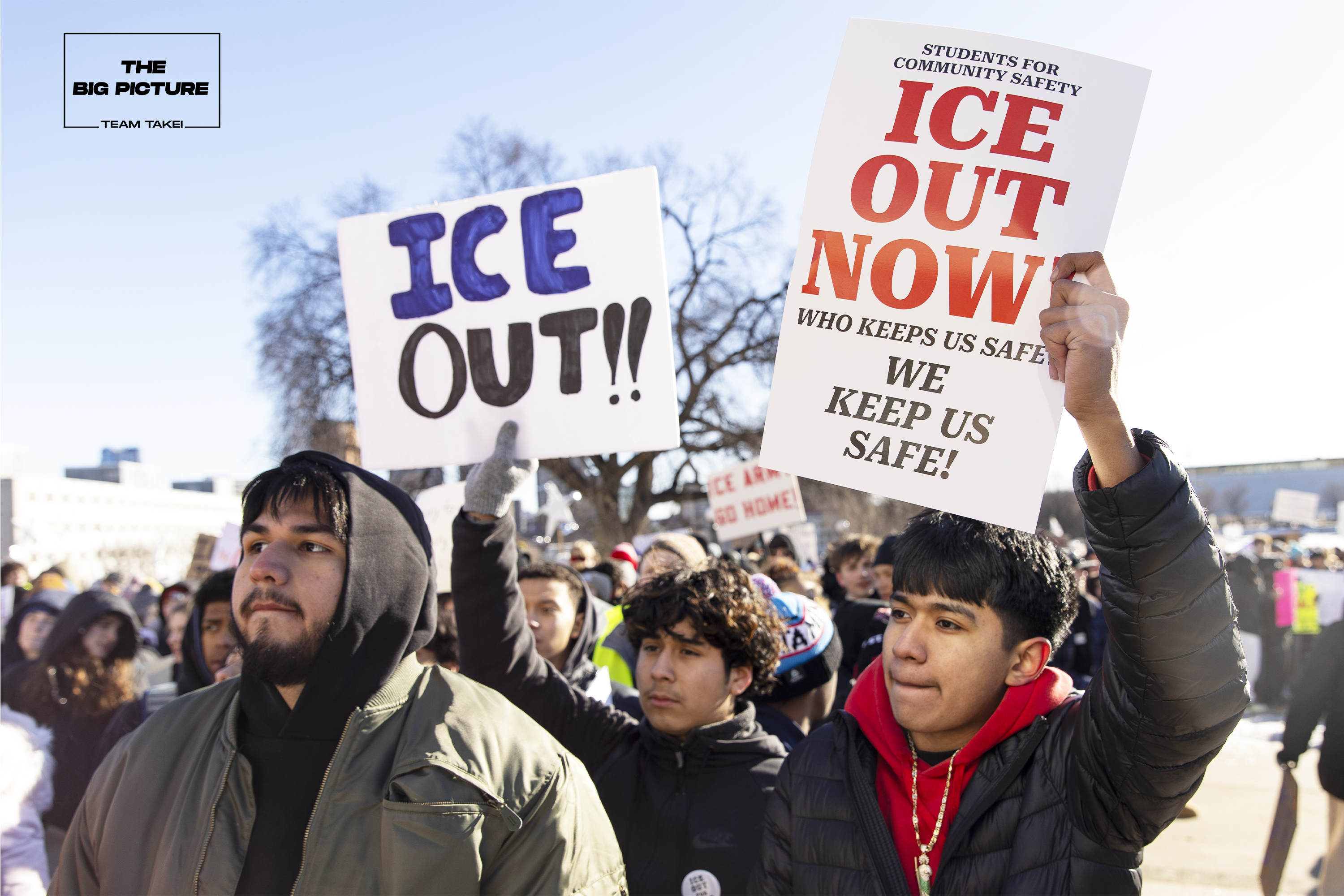
Remember how it felt a year ago?
Trump was on the march.
He had won both the popular vote and the electoral college two months earlier, and despite having not even received a majority of votes, he declared his victory an “unprecedented and powerful mandate” and suggested that “God spared [his] life for a reason.”
This time last year, Trump was heading toward inauguration day with all the vibes on his side. He seemed unstoppable.
And yet, at the same time, it was clear to many that he was high on his own supply, completely misreading the election results, and in all likelihood, as I predicted at the time, headed for a rude awakening due to massive Trumpian overreach. He was bent on imposing an unpopular agenda on a nation that had barely elected him.
And sure enough, a year later, that has largely borne out.
First, Trump’s approval rating has completely inverted since a year ago. According to The Silver Bulletin’s polling average, Trump went from a peak approval of 52.4% on January 23, 2025 (43.2% disapproval,) to just 42.3% approval as of January 14, 2026 (54.5% disapprove.)
Then there were the protests throughout 2025, culminating in No Kings on October 18, which attracted an estimated seven million people at over 2,700 events across all 50 states. By contrast, the Women’s March movement of Trump’s first term maxed out at between three to five million people.
Finally, a blue wave swept through November’s off-year elections. Voters across the country sent an unmistakable message of disapproval by electing Democrats at all levels of government.
But for all these clear signs of the public’s broad-based resistance, Trump’s impact on the U.S. electorate may prove even wider reaching than we thought.
We’ve all read the think pieces about how Trump likes to put his stamp on U.S. culture. That’s undeniable, but perhaps just not in the way Trump intends. What’s remarkable about this moment is just how far Trump is shifting attitudes against his own MAGA agenda.
And it’s happening faster than anyone predicted.
In the minds of Trump and the Republicans, the 2024 elections were a vindication, a signal that American culture had shifted toward them and that they enjoyed majority, or even super majority, support in the country. They would often tout being on the 80% side of multiple 80/20 issues.
Among those was “border security.”
And while the claim that it was an 80% issue for Republicans was wildly hyperbolic, they weren’t wrong about its appeal.
Per The AP a year ago:
More Americans say immigration should be a top focus for the U.S. government in 2025, as the country heads toward a new Republican administration in which President-elect Donald Trump has promised
[the mass deportations of migrants]and[an end to birthright citizenship].About half of U.S. adults named immigration and border topics in an open-ended question that asked respondents to share up to five issues they want the government to work on this year, according to a December poll from
[The Associated Press-NORC Center for Public Affairs Research]. That’s up from about one-third who mentioned the topic as a government priority in[an AP-NORC poll conducted the previous year].The issue of immigration has risen in salience across the board — among Democrats and Republicans, men and women, and adults both young and old.
But as we’ve seen over the past year, Trump’s fall in popular support tracks with a remarkable turnaround on the issue of immigration, where he is now 10 points underwater.
And that’s his best issue.
Per Forbes just this week on the results of a new AP/NORC poll,
Americans’ views of Trump’s handling of immigration—one of his signature issues—have declined sharply throughout his first year in office, reaching 38% in January, down from 49% in March last year.
Notably, while Latino support overall for Trump as of a November Pew poll had dropped 9 points from 36% to 27%, most notable is their disapproval of him on immigration—and why that disapproval has surged.
Two-thirds disapprove of Trump’s approach on immigration.
71% said Trump is doing too much when it comes to deportations, up 15 points since March.
More than half worry that they, a close friend or family member will be deported.
To the surprise of no one, Trump’s mass deportation agenda, which is far more wide-reaching than anything he promised in 2024, is driving this collapse in support. Not content to go after just criminals—”the worst of the worst” as he pledged during his campaign—the Trump regime, using ICE as enforcers, has gone on a spree. It has detained citizens, deported law abiding residents to countries they’ve never known, and, far too often, sown violence resulting in death, as we saw in Minneapolis last week.
Trump thought he was pushing this policy with a “mandate” from the country, but instead has driven a swift and intense backlash, even among voters who helped get him elected.
Take the results of a Gallup poll from last June, which found that Americans’ concerns about immigration have largely abated.
After climbing to 55% in 2024, the percentage of Americans who say immigration should be reduced has dropped by nearly half to 30%. Sentiment is thus back to the level measured in 2021, before the desire for less immigration started to mount. Meanwhile, 38% now want immigration kept at its current level, and 26% say it should be increased.
Even Republicans’ attitudes on immigration have shifted back to the historic average.
And while that could largely be attributed to Trump’s draconian enforcement measures, there is also a dramatic cultural shift happening…and it is not in Trump’s and Stephen Miller’s direction.
When asked if immigration is generally a good thing or bad thing for the country, a record-high 79% of U.S. adults call it a good thing; a record-low 17% see it as a bad thing.
This is consistent with the long-term pattern of more Americans viewing immigration as helpful than harmful to the country. But today’s endorsement is up from 64% last year and represents a reversal of the downward trend seen in this view from 2021 to 2024.
According to an Economist/YouGov poll released last February, just after Trump’s inauguration, ICE enjoyed a +16% favorability rating, including a +53% favorable rating among Republicans and a -13% favorability among Democrats.
Thanks to Trump’s and Kristi Noem’s polarizing weaponization of the agency, turning it into a federal army of masked thugs terrorizing American citizens and law abiding residents alike, it didn’t take long for Americans to sour on it.
By August, according to Pew Research Center, ICE’s favorability was underwater at -9%, with 40% favorable and 49% unfavorable. This shift was largely driven by Democrats, only 13% of whom viewed ICE favorably, while 78% had an unfavorable view of them.
In the wake of the murder of Renee Nicole Good by an ICE agent on the streets of Minneapolis last Wednesday, this trajectory accelerated.
As Peter Hanby wrote in Puck this week,
To say explicitly what is now obvious: Americans do not like ICE. Period. In just a single year, ICE’s reputation has collapsed so dramatically—and so quickly—that it would be a punchline if not for ICE agents’ tragic, real-world behavior. After Trump’s inauguration, ICE had a +16 net favorability rating with Americans, according to YouGov. Now the agency is underwater at –14. That’s a 30-point swing since last January—an unheard-of political collapse.
Trump and his top officials have also repeatedly attempted to gaslight the American people into thinking we didn’t see what we clearly saw with our own eyes.
Among the findings of a YouGov poll taken in the wake of Good’s murder, those efforts are failing:
A majority (53%) of Americans say that Ross was not justified in shooting Good. Only 28% say the shooting was justified.
A majority (53%) of Americans say that Ross should face criminal charges for shooting Good. Only 30% say he should not face charges.
A majority (53%) of Americans say that ICE’s tactics are too forceful, compared to just 12% who say they are not forceful enough.
More generally, about half (52%) of Americans have a somewhat or very unfavorable opinion of ICE. Only 40% view the agency favorably.
Other polls have found similar sentiment.
According to G Elliot Morris at Strength In Numbers,
Quinnipiac University
[released a poll on January 13]showing 57% of voters disapprove of how ICE is enforcing immigration laws, while just 40% approve. Similar to YouGov’s numbers, a majority (53%) said the Good shooting was not justified, versus 35% who said it was.CNN/SSRS
[found on January 14]that 51% of Americans say the ICE agent who killed Renee Good in Minneapolis used an “inappropriate use of force” that “reflects bigger problems with ICE operations,” compared to just 26% who said it was appropriate force. Additionally, 51% of adults said enforcement is making cities less safe — not safer. Just 31% think the agency is improving safety.
You know how obviously bad it has to be when you lose Joe Rogan.
But as Morris noted last week, “the topline really understates the intensity of public backlash to ICE and its tactics.”
Morris elaborated:
In February 2025, just 19% of Americans held a strongly unfavorable view of ICE, per
[YouGov/The Economist]. Today, 40% do. It’s not just that there has been a general move in opinion against the agency.There is a growing and intense, angry opposition to it across America.
As evidence for this, Morris clocked a massive shift on the question of whether ICE should be abolished altogether.
According to
[Civiqs], 42% of U.S. adults now support abolishing ICE entirely, while 50% oppose getting rid of the agency. That compares to 29% in Summer 2018, when the phrase was a rallying cry for progressives, 21% on Election Day 2024, and 37% in mid 2020, during the recent peak of the social justice movement. As of Jan. 8, independents had moved 15 points toward abolishing the agency in the past year, and even Republicans had increased their support by 6 points.
As Morris noted,
The 8-point gap between the share of Americans who want to abolish ICE and the share that wants to keep it is the smallest on record. Even in 2020, the gap between the “yes, abolish ICE” and “do, don’t” camps was 17 points. We are at peak abolish ICE, in other words.
In that same piece, Morris openly wondered if the Civiqs number was an outlier, but now we have confirmation: nope, not in the slightest.
According to the new Economist/YouGov poll taken the days following, it’s actually even worse for ICE, with 46% now in support of abolishing ICE as opposed to 43% who oppose it.
This is a massive shift since June, in which the same poll found that Americans opposed abolishing ICE by a 45%-27% margin. That’s a shift of 21% in favor of abolishing ICE in just six months.
Not so long ago, immigration was seen as Trump’s superpower for which there was no kryptonite. It was the issue that got him reelected, one that Democrats could never go after him on. So they didn’t try.
In the past year, however, thanks to a self-own of historic proportions, that perception, and the reality underlying it, has shifted dramatically.
At the same time, we are seeing a shift in ideological self-identification away from Trump and “conservatism” broadly and toward the “liberal” label.
As Steve Benen noted from the results of a 2025 Gallup poll,
In 1992, Gallup found only 17% of American voters described themselves as liberal. By 1996, that figure had dipped a little lower, sinking to 16%.
But as 2025 came to an end and the number of people describing themselves as moderates and conservatives sank, the number of Americans embracing the “liberal” label climbed to 28% — the highest total since Gallup started asking the question in the early 1990s.
Trump is shifting the culture in unexpected and unintended ways.
But perhaps the largest shift over the past year, where Trump is showing surprising weakness, is in his fabled ability to shape reality.
Ever since Renee Good’s murder, Trump’s kryptonite has lain exposed.
Per Dan Pfieffer:
Trump’s ability to bend reality to his will is the foundation of his political success. It’s how he has survived so many moments that would have ended other politicians’ careers.
But it is not working this time.
The American people have had their eyes opened and the vibe-driven haze from a year ago lifted.
As Pfieffer concludes,
For the first time in a long time, Trump is losing control of the narrative on the issue that once defined his political strength. And when Trump can’t bend reality to his will, his power erodes quickly.
And that offers a prime opportunity for Democrats not just to skate into the midterms on anti-Trump animus, but to remake their own brand from a position of strength. An energized Democratic party that pledges to honor our immigrant heritage, abolish ICE and embrace liberal and progressive ideals could form a solid foundation not just for a 2026 blue wave but for a Democratic return to the White House in 2028.