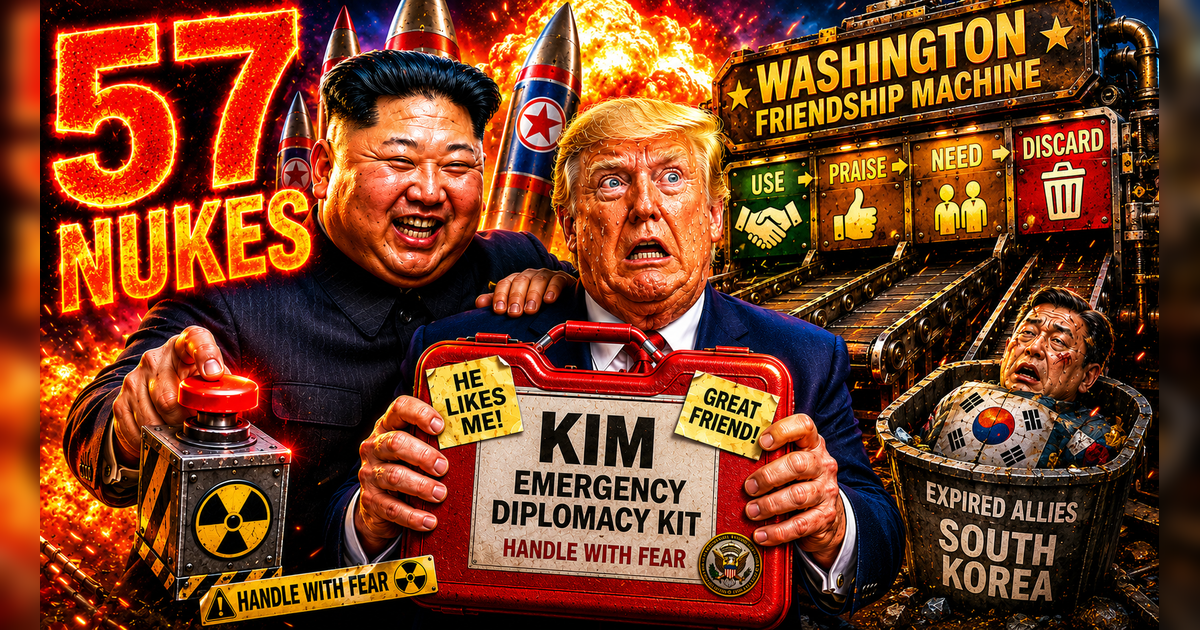
A quiet, almost invisible shift in how America is treating North Korea, South Korea, Pakistan, and the UAE is exposing the one brutal rule every rising nation on earth needs to learn — before it learns it the hard way
There’s a phrase we throw around in geopolitics without ever really stopping to ask who it applies to: “rogue nation.”
Say it out loud, and a very specific set of countries probably floats into your head. The usual suspects. The sanctioned ones. The ones on the watchlists.
But here’s the uncomfortable exercise worth actually doing: strip the label down to what it really means — a state that operates by its own rules, discards its commitments the moment they stop being convenient, and treats every relationship as disposable the instant its usefulness expires — and hold that definition up against the story you’re about to read.
The country that fits it best isn’t the one sanctioned on paper. It’s the one sitting quietly behind the curtain, orchestrating almost every other flashpoint in this story. It’s the United States.
That’s not a rhetorical flourish. By the time you finish this piece, you’ll understand exactly why there’s a strange, old piece of wisdom that applies here better than almost anywhere else in geopolitics: with a power like this, neither friendship nor enmity really serves you. Ally with it, and you’re disposable the moment your usefulness runs out. Oppose it, and you absorb the full weight of its retaliation. It is, in a very real sense, not worth being friends with — and not worth being enemies with either. The only sane posture is clear-eyed, unsentimental distance.
And since Trump returned to the driver’s seat, that pattern hasn’t softened — it’s escalated into territory that would have seemed unthinkable a few years ago. What you’re about to read is one specific, very recent example of exactly how far that pattern now extends. Read it carefully, because by the end, you’ll be doing something most people never bother to do with foreign policy news: connecting the dots. Once you connect them, every other seemingly unrelated headline from Washington over the past few months will suddenly click into place in your mind, one after another, like pieces of a puzzle you didn’t know you were holding.
Here’s where it starts.
Ask yourself the first honest question this story demands: why is the United States, at this exact moment, going out of its way to extend warmth, support, and something close to public endorsement toward one of the most sanctioned, isolated regimes on the planet (North Korea)?
To understand why Trump is being gentle with Kim Jong Un, you have to rewind — not to Korea, but to the Middle East.
The United States recently found itself dragged into direct confrontation with Iran. It’s easy to read headlines about that conflict and move on**. But something happened underneath the headlines that almost nobody outside defense circles is talking about.**
During that confrontation, America’s military hardware — its interceptor missiles, its precision munitions, its broader stockpile of front-line weaponry — took a real and significant hit. Not symbolic. Structural.
The United States entered that fight without properly answering a basic question first.
If we burn through our stockpiles here, can our own military-industrial complex — the vast network of defense manufacturers that’s supposed to be the beating heart of American hard power — rebuild them fast enough to still project power everywhere else we need to?
That question wasn’t seriously war-gamed before the shooting started. And now, after the fact, the answer looks uncomfortable: not really. Not fast enough.
A superpower that projects invincibility to the world quietly discovered, mid-crisis, that its own war chest has limits — and that discovery is now reshaping decisions happening thousands of miles away, in a completely different theater, involving a completely different country: North Korea.
Because once Washington realized its stockpile was thinner than it assumed, a second realization followed immediately: we cannot afford new fires breaking out everywhere at once. Every other flashpoint on the map suddenly needs to be managed down, cooled off, minimized — not because Washington has had a change of heart, but because its ammunition cabinet is not as full as it used to be.
North Korea is one of those flashpoints. So Trump extends a hand.
The specific fear driving this is worth spelling out clearly, step by step, because the original framing —** “we should keep North Korea calm so it doesn’t get involved with Taiwan” **— sounds abstract until you trace the actual mechanics of it.
Picture the map. North Korea sits inside the same broad orbit as Russia and China — geographically close, politically dependent, militarily entangled through the exact weapons-testing relationship we’re about to walk through. If Pyongyang were to become an active, visible participant in a Taiwan-related flashpoint — even indirectly, even just by lending logistics, basing access, or symbolic military backing to Beijing in a moment of crisis — Washington would suddenly be facing a genuine two-front problem, and not a manageable one.
Here’s what **“overstretch” **actually means in concrete terms, not just as a buzzword: **the U.S. military is built to plan around a limited number of simultaneous major contingencies at once — it cannot fight, arm, and logistically support full-scale crises in the Middle East and East Asia and Eastern Europe at the same time without severely compromising its response in at least one theater. **Munitions, interceptors, and trained personnel are finite resources; they can be surged toward one crisis, but not toward three simultaneously without dangerous gaps opening up somewhere.
Now overlay that onto what we already know: the U.S. just discovered, in real time, during the Iran confrontation, that its** own stockpiles are thinner than assumed**. Layer a live Taiwan flashpoint on top of an unresolved Iran situation, and Washington isn’t looking at “difficult.” It’s looking at a scenario where it might **not have enough interceptors, munitions, or ready capacity to credibly respond to all three fronts at once — which is precisely the kind of exposed, overextended position no superpower wants to be caught in, **especially not one whose entire global authority rests on the credible threat that it can respond anywhere, anytime.
There is a third reason sitting underneath the first two, and it’s the one most readers already sense instinctively before anyone spells it out for them:** North Korea is no longer a regional problem that Washington can afford to treat lightly, because North Korea is no longer just a regional threat.** Over the past several years, Pyongyang has developed and tested intercontinental ballistic missiles credibly capable of reaching the continental United States, paired with a nuclear weapons program it has refused, repeatedly and publicly, to abandon. That changes the entire calculus in a way the Taiwan-proxy fear alone does not. This isn’t only about whether North Korea might lend Beijing logistical support in some future Taiwan contingency.** It’s about the far more immediate, far more personal fact that Kim Jong Un now sits on a capability that can put an American city within range — which means every single interaction Washington has with Pyongyang carries a homeland-deterrence weight that no other flashpoint in this story quite matches.** You don’t need a proxy theory to explain why a superpower goes soft on a regime that can hit its own mainland. You just need to look at the map and the missile specs. That reality alone would justify caution. Combined with depleted stockpiles and Taiwan-overstretch fears, it becomes close to overwhelming — and it explains something the other two reasons can’t fully account for on their own: why North Korea, uniquely among every actor in this story, gets courted rather than merely deprioritized. South Korea said no to Washington and got sidelined. North Korea has spent decades saying no, defiantly, in public, including breaking a direct promise to an American president — and gets a handshake and warm words instead. The difference isn’t loyalty.** It’s leverage. North Korea has a gun pointed,** however distantly, at the American homeland. South Korea does not. That asymmetry is the quiet engine underneath everything that follows.
So the calculus becomes brutally simple: keep North Korea pacified now, at relatively low cost, rather than risk it becoming the tripwire that turns a two-front problem into a three-front catastrophe later — or, worse, the actor holding the one card that matters most, aimed at the one place Washington can least afford to leave exposed.
This is not generosity toward Kim Jong Un. It is risk management, executed years in advance of the crisis it’s trying to prevent — while it is still not finished dealing with Iran, and still has not solved the standoff around the Strait of Hormuz, one of the most strategically vital oil chokepoints on the planet — the artery through which a massive share of the world’s oil supply physically passes each day.
Washington entered that Iranian confrontation. It has not figured out how to exit it. And that unfinished business is exactly why it needs to keep North Korea calm — because it simply cannot afford to be managing two unresolved fires on opposite sides of the globe simultaneously, let alone a third one that can reach its own shores.
This brings us to a pattern so consistent, so repeated across eight decades of American foreign policy, that it deserves to be named plainly: the United States has an extraordinary talent for starting wars, and almost no talent whatsoever for ending them.
Say that out loud. Sit with how strange that actually is.
This is a nation that calls itself the most powerful military force in human history — a self-declared superpower, a nation that markets its own supremacy relentlessly on the world stage. And yet, again and again, it walks into conflict zones with an entry plan and no exit plan at all.
Look at the record, one by one:
Afghanistan— a twenty-year commitment that ended in a chaotic, improvised withdrawal, with no coherent plan for what came after.Vietnam— perhaps the most famous case in modern history of a superpower entering with overwhelming force and leaving without ever answering the question of**“how does this end.”**Libya— an intervention that toppled a regime and left behind a fractured state, with no long-term plan for what would fill the vacuum.The Arab Spring era, broadly, across the Middle East — a moment where America repeatedly inserted itself into fast-moving political upheavals without a coherent theory of the endgame.Even
Japan, decades earlier, going all the way back through the historical record — the pattern of decisive, overwhelming entry paired with a startling lack of long-range exit planning shows up again and again, across totally different eras and totally different reasons for engagement.
This is not a partisan critique aimed at any single administration.** It is a structural blind spot — baked into how American military and foreign-policy planning has functioned for the better part of a century.** Entering is the plan. Leaving is an afterthought, improvised under pressure, usually after the political and human cost has already been paid.
And here’s the part that should genuinely unsettle you: this is a nation that spends more on its military than the next several nations on earth combined. It has the most sophisticated weapons programs, the most advanced intelligence apparatus, the most elite strategic planning institutions money can build. And yet, decade after decade, in conflict after conflict, it walks in with total confidence and walks out — or fails to walk out — without ever having answered the most basic question a military planner is supposed to ask before the first shot is fired: how does this end, and when do we leave?
That isn’t bad luck repeating itself five times across eighty years. That’s a structural blind spot. A kind of institutional carelessness hiding behind the loudest confidence in the world.
Keep this pattern in your mind as you read everything that follows, because it is the hidden thread that ties this entire story together. A superpower that cannot cleanly exit its own wars is a superpower that is structurally forced to manage risk by controlling other people’s conflicts before they start — which is exactly what’s happening with North Korea right now.
There is a second reason Washington is reaching out to Pyongyang right now — separate from the stockpile problem, and, if anything, even more consequential. Here is where the story becomes genuinely fascinating, and where mainstream coverage almost never goes.
Russia and China have not simply “supported” North Korea diplomatically over the years. They have done something far more calculated: they have transformed North Korea into an industrial testing ground — a laboratory for weapons development that operates almost entirely outside the reach of Western sanctions and Western intelligence oversight.
Here’s how the pipeline actually works, step by step:
Weapons systems and munitions are manufactured, at least partially, with North Korean industrial involvement.
Before being deployed at scale, these systems are first tested at a smaller, contained level inside North Korea — effectively a closed testing environment, shielded from prying eyes.
The data gathered from those smaller tests — performance, reliability, weaknesses — feeds directly into weapons that are then deployed at full scale on active battlefields elsewhere.
The clearest, most concrete example of this pipeline in action is the Russia-Ukraine war. A significant portion of the munitions Russia has been firing into Ukraine are not entirely produced through Russia’s own domestic manufacturing capacity. Some of that production runs through North Korea. And crucially, some of those weapons systems are first refined and miniature-tested inside North Korea before being scaled up and fired in Ukraine at full operational intensity.
That full-scale deployment generates three distinct, valuable outputs, all flowing back to Moscow and Beijing: real combat data on how the weapon actually performs under fire, real-world intelligence on enemy countermeasures and battlefield conditions, and — perhaps most importantly — rapid weapon improvisation, meaning the systems get redesigned and improved in near-real-time based on what the battlefield reveals. North Korea supplies the deniable, low-visibility testbed. Ukraine supplies the full-scale proving ground. Together, they form an R&D loop that no Western sanctions regime has managed to touch.
This is not charity. This is not ideology. This is industrial-scale weapons R&D, disguised as an alliance of convenience, running in plain sight.
So when Washington reaches out to Kim Jong Un, what is it actually trying to do?
It’s attempting to execute a strategy as old as empire itself, the kind every colonial power has run at some point in history: divide and rule.
If North Korea can be pulled even slightly away from its dependency on Russia and China — through gestures, through eased tension, through the appearance of a diplomatic opening — the theory goes that the broader Russia-China-North Korea axis weakens as a result. Isolate one leg of the triangle, and in theory, the whole structure wobbles.
Most serious strategic analysts think this plan is close to hopeless. And the reason why is genuinely elegant, once you understand it — and darkly ironic, once you sit with it for a second.
Before this pattern of quiet coercion makes full sense,…