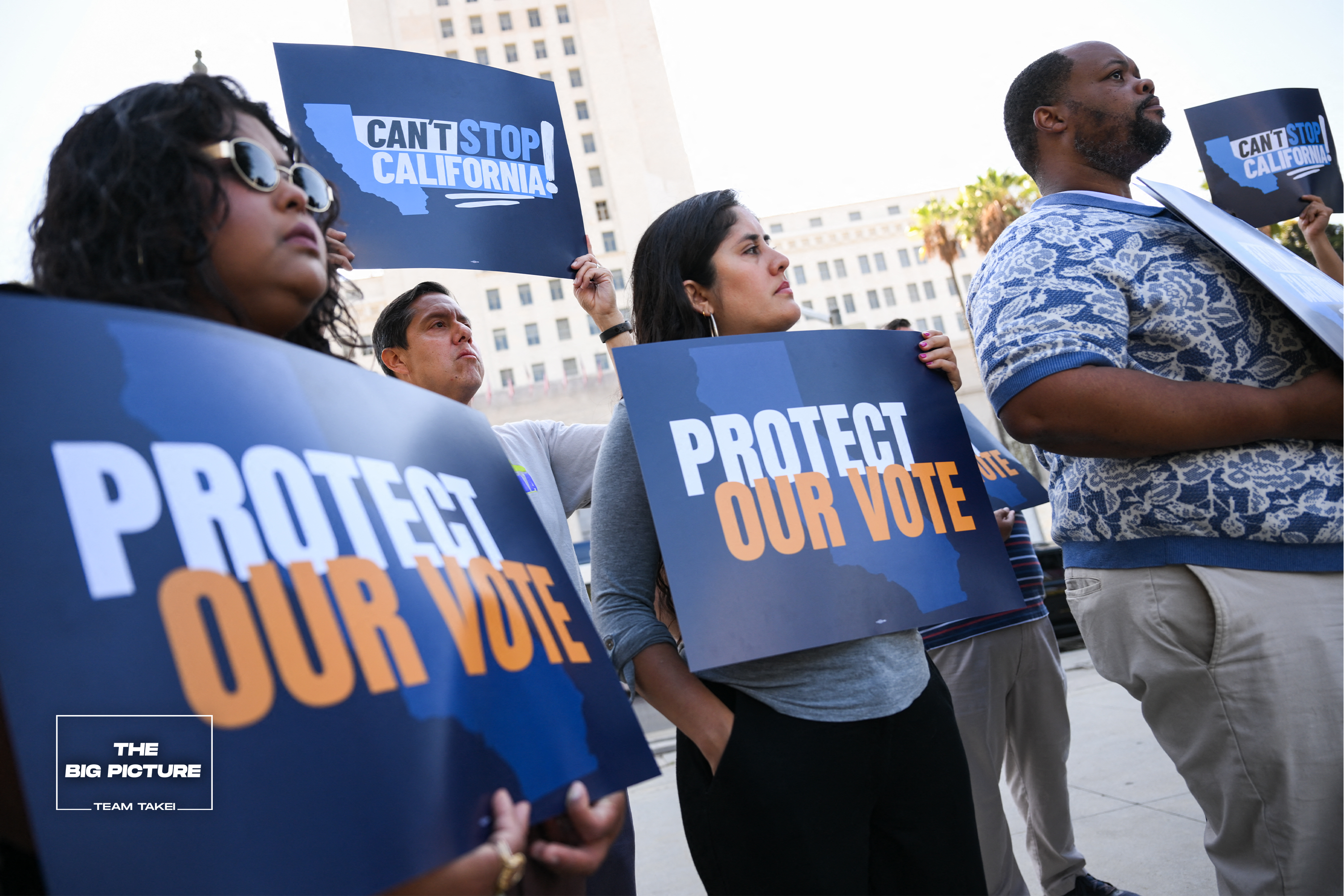
Last Tuesday, eight days after California began mailing ballots to every active registered voter in the state, a letter from the Department of Justice reached Los Angeles County Registrar-Recorder/County Clerk Dean Logan. It arrived with a computer thumb drive holding the names of people the federal government claims to suspect are noncitizens. The password was handwritten on a note.
The letter, signed by acting Deputy Attorney General R. Trent McCotter, asked for something astonishing. It gave Logan and California Secretary of State Shirley Weber 48 hours to agree to set aside the ballots of anyone on the list whose citizenship they could not confirm.
Logan did not open the drive. He said doing so would conflict with his office’s privacy and data security protocols and that removing a voter requires verifiable information, “not assertions of unconfirmed data matching.”
Two days later, the Justice Department sued. The complaint, filed in federal court in Los Angeles, put a number on the list: more than 20,000 people the government calls “likely noncitizens.” DOJ wants a judge to order California not to count their mail ballots until their citizenship can be verified.
Californians have already started voting. There’s no time to verify that many voters’ citizenship, even if California wanted to. And the law doesn’t give the federal government the power to demand it. UCLA election law professor Rick Hasen put the suit’s prospects bluntly: “I expect this lawsuit to go nowhere.”
As I’ll explain below, DOJ and Trump may not even care whether the suit succeeds in court. They hope to have already made their point and prepared the ground for challenging the midterm results.
*“I chose to support your work with a paid subscription because your expertise and thorough analysis of complex fast-moving events have been indispensable during this national nightmare. I have no idea how you have the energy to do everything you do day in and day out, but please keep doing it. You are a bright light in the darkness.” — Lisa, Paid Subscriber. *
The Big Picture is a reader-supported operation. To receive new posts and support our work, consider becoming a free or paid subscriber.
The list started with California’s own voter roster, which the state makes available for purchase.
Homeland Security Investigations, the investigative arm of ICE, says it “reasonably believes” that around 20,000 noncitizens are registered to vote in California. The complaint does not allege, however, that any of them has returned a ballot.
So is a “reasonable belief” enough to force California officials’ hands?
The Trump regime’s legal theory is simple but deeply vulnerable. Federal law makes it a crime for a noncitizen to vote in a federal election, and under the Constitution’s Supremacy Clause, federal law trumps state law. So far so good. But DOJ goes further. It argues that California, now that it has been handed the names, would be knowingly helping people break federal law if it counts their ballots, so the court should override the state’s usual procedures for these voters.
That’s eyebrow-raising. “Preemption” ordinarily means a state law clashes with a federal one. But California has no law letting noncitizens vote in federal elections. The complaint effectively concedes the point, arguing only that “If California passed a law that allowed noncitizens to vote” in congressional races, that law would conflict with federal law.
California already takes measures to ensure this doesn’t happen. It requires every registrant to attest to citizenship under penalty of perjury, and state law requires that only U.S. citizens register and that ineligible registrants be removed.
DOJ nevertheless wants California to set those ballots aside and verify each voter’s citizenship before counting them. That verification would have to go far beyond the statement of citizenship every voter makes to register.
The department calls this “commonplace election relief when a ballot is called into question.” DOJ also maintains that it is not asking California to purge its rolls or cancel anyone’s vote—just “set aside” ballots from more than 20,000 registrants. Attorney General Todd Blanche framed the case in sharper terms: “State-facilitated voter fraud is unacceptable in the United States of America.”
But it’s hardly clear how this is “state-facilitated voter fraud” in any sense of the phrase. And by now, no one should just take DOJ’s word that these are actually noncitizens, given its history of making such wild claims.
Paragraph 60 of the complaint admits how little the federal government itself can do:
“To be sure, the United States actively investigates and prosecutes incidents of unlawful voting. But it is not practicable or feasible for the United States to investigate before the 2026 election concludes thousands, let alone tens of thousands, of individuals that two federal investigative offices identified on the California voter roster as likely being sent vote-by-mail ballots.”
Two days before filing, DOJ gave California officials 48 hours to agree to withhold ballots pending citizenship checks. Hasen singled out that paragraph as the tell. “Always pay attention to the ‘to be sure’ paragraph for an oblique reference to the weakest part of the case,” he noted.
The admission also cuts against DOJ’s legal theory. The claim rests on California “knowingly” facilitating unlawful voting, while the government’s own description of the people on its list is “likely” noncitizens. California cannot “know” something the federal government says it cannot establish before the election.
The numbers have also shifted. Trump regime officials have claimed that as many as 190,000 noncitizens are on California’s rolls, yet the lawsuit now relies on about 20,000.
State officials also know that Nevada has already been through this. DHS first claimed up to 16,000 noncitizens were registered there, then lowered its estimate to 185. After reviewing the list, state election officials determined that all 185 were citizens. “You have provided nothing of substance to suggest otherwise,” Greg Ott, a Nevada deputy attorney general, wrote to DHS.
The timing raises its own questions. In July, Weber asked DHS to explain its methodology and how it had obtained California’s voter list, and gave the department until Aug. 3 to answer. According to David Becker, executive director of the Center for Election Innovation & Research and a former DOJ voting rights attorney, California never got that information before ballots went out. “They could have done that three months ago, and didn’t,” Becker said. “Instead, waiting until eight days after ballots had gone out.”
DOJ is seeking an injunction to force California to set aside ballots, but it helped create the very time crunch it now cites to support its claim.
The law isn’t on DOJ’s side here either.
For starters, the Constitution lets states set the “Times, Places and Manner” of congressional elections, subject to laws Congress passes. And the Supreme Court has held that setting voter qualifications “forms no part of the power to be conferred upon the national government” by that clause. On Oct. 9, U.S. District Judge Sparkle Sooknanan made the same point in striking down DOJ’s nationwide voter-roll program: “Congress has left that authority where our Constitution has always placed it: with the states.”
The statute DOJ relies on, 18 U.S.C. § 611, makes it a crime for a noncitizen to vote in a federal election and sets out penalties for the person who does it. Hasen reads that statute alongside the National Voter Registration Act and draws a clear line: The federal government can prosecute individuals who vote illegally, “but it cannot force states to purge voters from the rolls in violation of the NVRA.”
Even the statute itself is on shaky ground. On Oct. 1, U.S. District Judge David Leibowitz in Miami ruled that the federal law criminalizing noncitizen voting is unconstitutional, because only states can set voter qualifications, and dismissed the case against a Jamaican national living in Florida. The ruling does not bind the California court.
The Supreme Court has also ruled on how much proof of citizenship a state may demand for federal voter registration. In Arizona v. Inter Tribal Council of Arizona (2013), it held that the NVRA preempted an Arizona law requiring documentary proof of citizenship beyond the sworn statement on the federal registration form. DOJ now asks a court to make California verify citizenship “beyond relying on unverified statements of citizenship necessary to registering.”
The NVRA also bars states from running systematic programs to remove ineligible voters within 90 days of a federal election, with limited exceptions. That protection exists because hasty purges sweep up eligible voters who then have little time to fix the error. DOJ insists it seeks only to set ballots aside. “We didn’t ask you to remove them from your list,” Bill Essayli, the top federal prosecutor in Los Angeles, 𝕏posted on X on Oct. 17. “We asked you to sequester their ballots so a judge can decide whether they may be counted.”
A ballot set aside still goes uncounted until officials verify the citizenship of a voter the government itself calls a “likely” noncitizen. Democracy Docket’s Jacob Knutson argues that the practical effect is a purge: The federal government hands over a list of people it says should not vote and demands the state act on it before ballots are counted. And California Attorney General Rob Bonta argues the Trump regime is pressing the state to conduct exactly the kind of last-minute purge federal law prohibits.
DOJ also runs into the Supreme Court’s own caution about late changes to election rules. In Purcell v. Gonzalez (2006), the Court warned that “Court orders affecting elections, especially conflicting orders, can themselves result in voter confusion,” and that “As an election draws closer, that risk will increase.” DOJ wants a judge to change how California handles ballots voters already have in hand, with just two weeks to go before Election Day.
DOJ’s best hope is a line in the Supreme Court’s September order reviving the expanded SAVE citizenship database, which said “individualized inquiries” into particular voters remain “permitted under federal law during this period.” DOJ can argue that handing California specific names makes each check individual.
But even that footing is thin. The Court was addressing the federal government’s help with states’ own SAVE checks, and DOJ’s complaint says its California list was built “independent of SAVE.” The Court also left the reach of the 90-day provision for a case it will hear later this term, Republican National Committee v. Mi Familia Vota.
Bonta argues the demand also defies Sooknanan’s ruling, which found that DOJ ignored the risk that citizenship records “known to be unreliable” would lead it to demand that states remove U.S. citizens from their rolls. The California list rests on federal immigration records run through third-party software.
DOJ also comes to court with a dismal record. It has suffered more than two dozen defeats in its campaign to obtain state voter rolls. And in this case, it bypassed the Civil Rights Division, which lost those cases, filing through the deputy attorney general’s office instead. Justin Levitt, a former deputy assistant attorney general in DOJ’s Civil Rights Division, called the suit “a press release masquerading as a lawsuit,” adding, “it’s going to be difficult for a judge to get through this document without laughing.”
On Oct. 16, a day after filing suit, DOJ raised the stakes. In a letter to Los Angeles County’s lawyers, copied to Weber and Logan, McCotte…