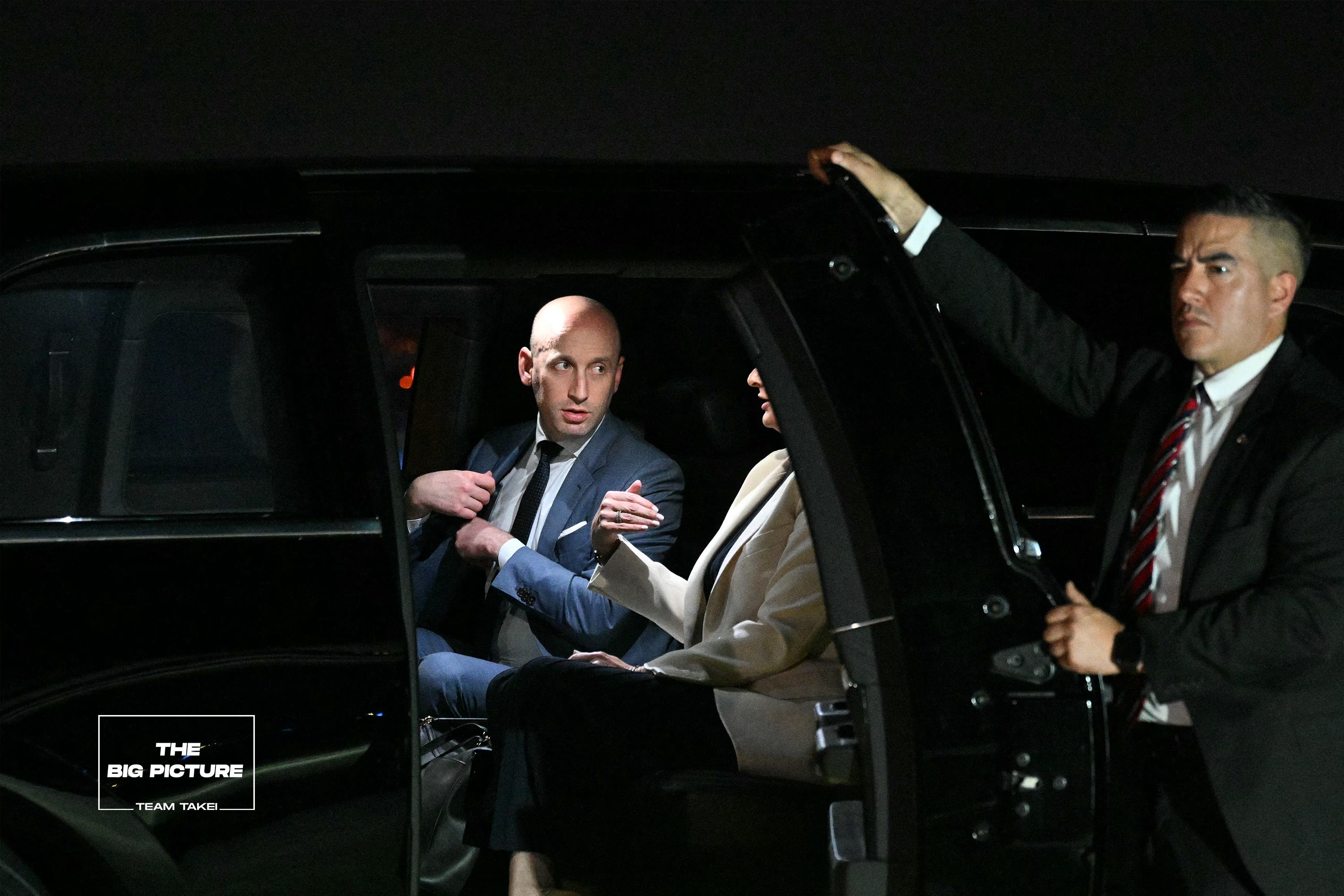
Three days after getting routed in the midterms, Donald Trump put a new person in charge of his White House. He had told reporters Wednesday, “I’ll get along, probably, with the Democrats, unless they want to be destructive.” Yet on Friday, he announced that White House chief of staff Susie Wiles was moving to his political operation and that Stephen Miller, “one of my most trusted advisors,” would replace her come Monday.
A collective shudder ran through much of the country. Asked why he’d elevated Miller, Trump said, “Sometimes in life you have to make moves.”
This is quite the move. Miller, 41, has been with Trump since the 2016 campaign. He is the white nationalist senior aide who planned and operated the mass deportation campaign that soured many voters, including large blocs of Hispanic voters, against his party in the midterms.
Condemnation of Miller’s promotion came from both sides of the aisle. House Democratic leader Hakeem Jeffries 𝕏called Miller “a dangerous xenophobe and reckless extremist who has American blood on his hands.” Republican Sen. Thom Tillis labeled the promotion “a colossal mistake.” At The New Republic, Matt Ford wrote that Trump “may have just handed Democrats the White House in 2028 as well.” On the other hand, Sen. Bernie Sanders, asked whether he could work with the new chief of staff, said, “I’m not worried about Miller.”
But on what the move says about Trump himself, almost everyone agrees: He is picking a fight and has signaled no plans to change course. The Wall Street Journal editorial board expects no pivot, and his longtime allies describe Miller as a “wartime” pick.
But there’s a real split on what will happen next. Does a new title really add anything for a man who already ran much of the government? And does his promotion help Republicans rebuild or finish them off?
Nobody disputes the basic message. Trump looked at the catastrophic election results and decided to change nothing. His critics say it, his allies say it, and so do the reporters covering him.
Presidents who get clobbered in midterm elections usually make a show of changing course. Barack Obama brought in a centrist chief of staff after 2010. George W. Bush fired his defense secretary after 2006. So promoting Miller, Slate’s Ian Prasad Philbrick writes, is “the opposite of what most presidents would do after an overwhelming electoral beatdown.” Instead, we saw “a president determined to learn nothing from his mistakes,” wrote The Nation’s Jeet Heer.
The far-right, xenophobic, mass deportation agenda stays in place for Trump’s second act, and it may get even harsher. The Washington Post called it “a gamble on reinforcing Trump’s policy agenda and perhaps moving further to the right.” Shaking their heads, the Wall Street Journal’s editorial board wrote that “what Mr. Trump seems to want is more MAGA cowbell.”
With nothing moving through Congress, Trump will likely lean even further on executive orders—Miller’s specialty. “They are not going to slow down on executive power, executive orders, and regulations,” said Joe Grogan, who ran the Domestic Policy Council in Trump’s first term. Miller’s allies say that’s exactly why he’s right for the job.
Former acting chief of staff Mick Mulvaney noted that a president who wanted to build bridges with Democrats would have picked someone else. It also signals more scorched-earth political warfare. Roger Stone once called Miller Trump’s “wartime consigliere.” One person familiar with Trump’s thinking told The Atlantic that
there was no need for a chief of staff who could work the Hill to pass legislation, because nothing was going to get done.
The source predicted that “the next two years are going to be nonstop political warfare.” Indeed, a red hat on the Resolute Desk carries a single word: VETO.
People also agree on something about Miller himself: He had the power long before he had the title. Miller’s allies and enemies alike, one account reported, “privately refer to him as ‘the prime minister.’” The Atlantic’s Jonathan Chait observed that Miller was “already the administration’s most powerful figure, arguably including Trump himself.” Marc Short, chief of staff to former Vice President Mike Pence, agrees. “Most of the shots are being called from Stephen’s office in the West Wing,” he noted.
Miller’s impact is clearest on immigration, but his reach goes well beyond it. He runs a daily call with senior officials across the government. He has shaped the strikes on boats suspected of drug trafficking in the Caribbean, the campaign against universities and White House policy toward Latin America and Greenland.
On mass deportations, his influence is everywhere. One report found that he “has already been operating as a de facto chief of staff for the Department of Homeland Security.” He directed immigration officials to make 3,000 arrests a day, a quota the White House and DHS deny exists.
He also survived one of the term’s most damaging controversies. After federal agents killed Renee Good and Alex Pretti in Minneapolis, Homeland Security Secretary Kristi Noem lost her job and the SS-attire-wearing Border Patrol commander Greg Bovino was sent packing.
Miller had defended the operation, too. Mere hours after Pretti’s killing, Miller labeled him a “domestic terrorist,” echoing false rhetoric Noem had first leveled at Good after she was shot to death.
Good’s family has since sued Miller and other officials in a federal civil rights conspiracy lawsuit over Operation Metro Surge in Minneapolis.
Much of the public debate over Miller’s future impact rests on some misconceptions about the responsibilities and powers of the White House chief of staff.
The position isn’t established in the U.S. Constitution, and it requires no Senate confirmation. The president alone hires and fires the chief of staff, who serves at the president’s pleasure, as Wiles just learned. The modern version of the role dates to Dwight Eisenhower and Sherman Adams, with Richard Nixon’s H.R. Haldeman setting a template for his successors.
In practice, the chief of staff oversees three things.
Access: who gets into the Oval Office, who gets on the phone and how the president’s day is spent. Political scientist David Cohencallsthe chief “a very important gatekeeper of the president’s time.”Information: which decisions reach the president, what options he sees and in what form. With someone like Trump, who is easily swayed by the information spoon-fed to him, this is perhaps the chief’s greatest power.Staff: The chief runs the White House staff and issupposed to make surethe president “is well served by aides” and that the agencies stay on the same page.
In one model, the chief of staff is an honest broker, giving every side a chance to be heard before the president decides. In another, the chief becomes the final and, as we’ve often seen with Trump, the only voice in the room. Miller arrives in the role having already run the deportation campaign from his deputy’s office. As chief, he adds control over Trump’s schedule, the flow of information and oversight of White House staff to his power.
Even with these new responsibilities, it isn’t clear how much will change. One side says Miller was already calling the shots, so today looks a lot like last Friday. The other says the last person who could constrain Trump—Wiles—just left the building, while her replacement is an accelerant poured on a fire.
The people who think the title matters point to one thing: Miller now controls the room. On immigration, Trump had recently told people close to him he was thinking about changing his emphasis after hearing from business owners about how deportations have affected their workforce. On “60 Minutes” on Sunday, Trump said he had been hurt politically by deporting people with good jobs and floated a deal with Democrats. But the man who built the policy now gets to referee the argument over softening it.
Wiles had been a guardrail of sorts, making sure Trump understood the risks of a decision. She never saw herself as a roadblock, though, and by this fall she was telling associates she had “less sway than ever.” The Wall Street Journal mourned her as the adult who “kept the schemers in line.”
Two things could change right away. Wiles reportedly pushed back on talk of arresting journalists to make them give up their sources, an idea Miller reportedly favored. The Justice Department has called that account false, so we’ll have to see whether the pressure on journalists now builds. Wiles was also one of the internal critics of Defense Secretary Pete Hegseth, whose job looked shaky after the election. Miller, by contrast, is his ally and neighbor.
Then there are the looming investigations. Rep. Robert Garcia (D-CA), in line to chair the House Oversight Committee, said Miller “should lawyer up.” The New York Times reported that Miller “was already preparing for a fight over congressional subpoenas and investigations.” As chief of staff, he may resist congressional testimony by invoking executive privilege. But that protection is not absolute, and he could have raised similar objections as a senior adviser and deputy chief of staff.
Some pundits warn that the situation is about to deteriorate rapidly. Former Trump press aide Sarah Matthews argued that a president wrapped up in his building projects leaves Miller as “the de facto president.” And Heer predicted “a constitutional crisis much larger than the impeachment battles of Trump’s first term.”
Others, like Sanders, are less alarmed. He explained that Trump is “a good politician” and may still want credit for popular legislation. Indeed, White House officials, Miller among them, have held high-level conversations in recent days about where they might work with Democrats.
What Miller’s elevation means for the Republican Party depends on why people think it lost in the first place. At least three theories are floating around, and they lead to very different places.
Trump’s allies think the base walked away. The way they tell it, MAGA voters stayed home, or even voted Democratic, because they were angry about the Epstein files and the Iran war. Miller is supposed to be the fix, a way to “reenergize the president’s populist base.” Steve Bannon called him “a perfect pick.” One Homeland Security official was even happier: “Trump got his MAGA mojo back.”
But other Republicans think voters didn’t like what Trump was doing, especially on immigration. They’ve got numbers to back this up. In the NBC News exit poll, 58 percent of voters said Trump’s immigration enforcement went too far, and 90 percent of those voters backed Democrats. Counties that are at least 80 percent Hispanic went Democratic by 40 points. “It looked bad on us, the deportation effort,” said Rep. Marlin Stutzman of Indiana. Rep. Don Bacon of Nebraska said Miller “cost us many seats on Tuesday.” Even Trump’s own political advisers privately [blame](https://www.theatlantic.com/politics/2026/11/stephen-miller-susie-wiles-w…