When Donald Trump announced his broad-based, unilateral “Liberation Day” tariffs last April, the stock markets didn’t like them one bit. As CNN reported at the time,
The market freakout — both in stocks and bonds — was so intense that it convinced Trump to back down. He abruptly
[froze those “reciprocal” tariffs for 90 days], setting off an[epic market recovery]that continues today.
Then in August, upon the 90-day deadline Trump had imposed, well, the markets didn’t freak out quite as much. They had actually begun baking in the expectation that he would back off his threats again.
“TARIFFS WILL START BEING PAID ON AUGUST 1, 2025,” Trump
[wrote on Truth Social]. “No extensions will be granted.”But investors aren’t buying it.
No extensions — “until further notice,” Ed Yardeni, president of Yardeni Research, said to CNN.
Yardeni said there is “far less panic” in markets today than in early April because investors are betting Trump doesn’t want to sink the US economy and hurt his own political standing.
This became known as the “TACO trade,” short for “Trump Always Chickens Out,” a term coined by Financial Times reporter Richard Armstrong. It succinctly described the ability of some traders to price into their trades the expectation that Trump won’t actually go through with his most extreme threats.
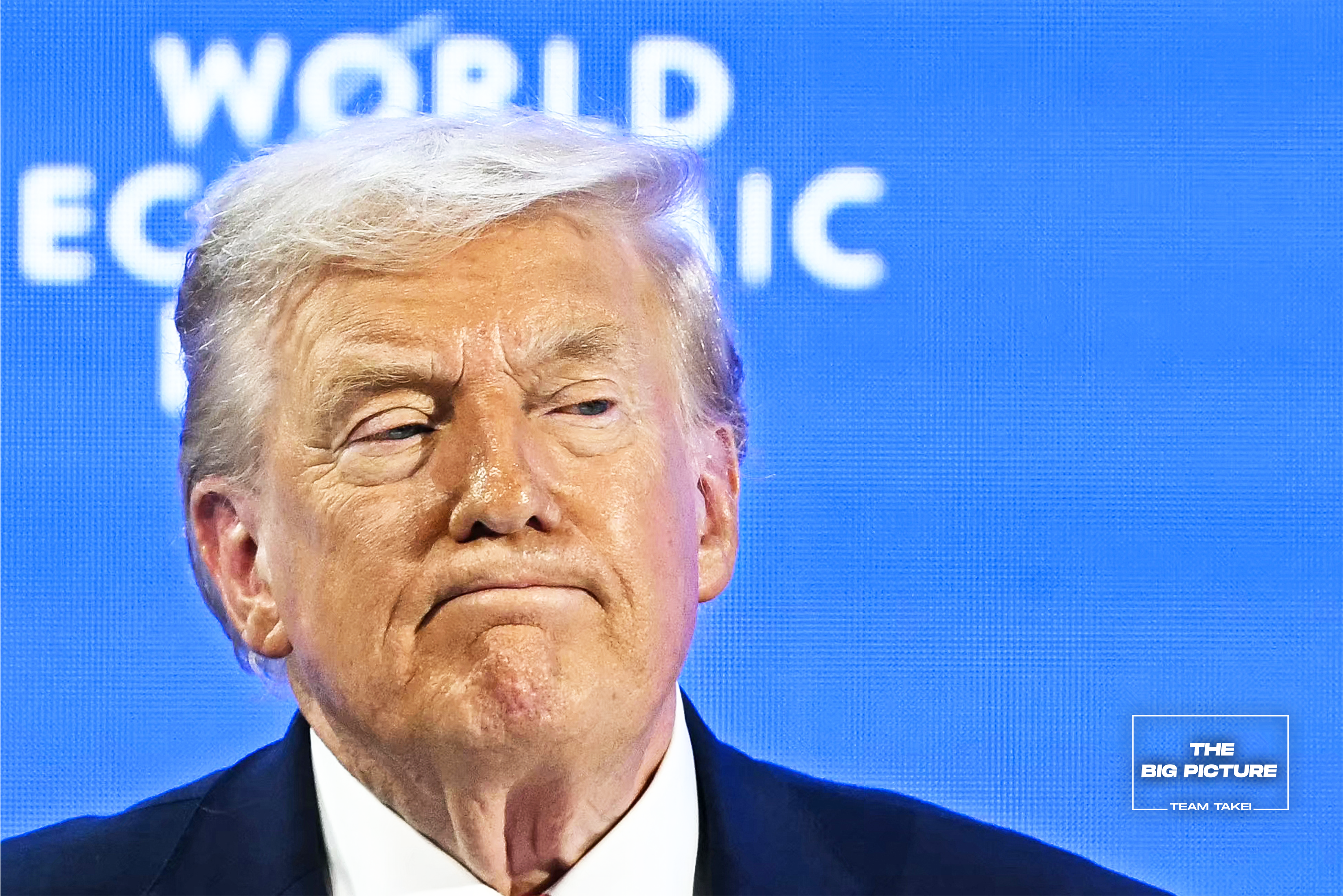
We just saw the same cycle play out once again. As Trump’s threats to take over Greenland “whether they like it or not” escalated to new levels of derangement, his TACO moment came yesterday during his World Economic Forum speech at Davos, where he retreated from his most extreme military threats over Greenland. This happened only after, once again, the markets had tanked the day before.
But this time something was different. Even as the world exhaled in relief, there was something more unsettling lingering in the air. Trump had gone further with his threats, the market backlash was slower to take shape, and despite his changing course, lasting damage had been done.
So, did Trump chicken out? Sure. But what was left in his wake?
President Trump, somewhat bafflingly, had been escalating tensions with Europe for weeks over his desire to acquire Greenland.
He repeatedly refused to take the use of military force off the table when asked, instead threatening “to do something in Greenland, whether they like it or not,” and saying, in full mob boss mode,
“I would like to make a deal the easy way but if we don’t do it the easy way, we’re going to do it the hard way.”
When confronted with the fact that the United States already has a security agreement with Greenland, Trump scoffed, insisting that “ownership gives you things and elements that you can’t get from just signing a document” and made clear that “anything less” than U.S. control of the island nation would be “unacceptable.”
This past Saturday, when it became clear Europe was taking his threats both seriously and literally, with nations including France, Germany, and Norway sending dozens of military personnel to Greenland, along with Denmark, which increased its military presence there, Trump pulled the tariff card out once more.
As The New York Times put it,
“Denmark, Norway, Sweden, France, Germany, The United Kingdom, the Netherlands, and Finland have journeyed to Greenland, for purposes unknown,” President Trump posted on Truth Social on Saturday, before announcing 10 percent tariffs on those nations, kicking in next month and increasing to 25 percent in June.”
Then like clockwork, on Tuesday, the first trading day since Trump made his renewed trade threats, the stock market plummeted, erasing all gains from the beginning of the year.
US stocks got clobbered on Tuesday in Wall Street’s worst day since October, returning to the kind of tariff-fueled routs that plagued markets last spring after President Trump
[reignited trade-war tensions with Europe]over his ambitions to take control of Greenland.The Dow Jones Industrial Average (
[^DJI]) sank 1.8%, or over 800 points. The S&P 500 ([^GSPC]) fell by about 2%, while the Nasdaq Composite ([^IXIC]) retreated over 2.4% as investors fled riskier bets on the heels of a[losing week]for Wall Street stocks.
Turns out the crash was well-timed, coming just a day before Trump was set to appear on the World Economic Forum stage. And because a tanking stock market seems to be the only thing that moves Trump to retreat, that’s exactly what he did.
For part one of his reversal, Trump announced during his speech at Davos that he would not use force to acquire Greenland after all.
And then, following that, hours later he claimed he had reached “the framework of a future deal with respect to Greenland,” and was taking tariffs against European allies off the table.
When pressed on details of the so-called deal, particularly whether U.S. ownership was part of it, Trump was predictably not forthcoming.
And sure enough, Mark Rutte, the Secretary General of NATO whom Trump claimed he arrived at a the deal with, confirmed ownership of Greenland wasn’t even discussed.
In fact, as CNN reported, no actual written agreement exists. It was simply a conversation.
“Trump and Rutte agreed to further discussions about updating a 1951 agreement between the US, Denmark and Greenland that governs the US military’s presence on the island… The deal framework also guarantees that Russia and China will be barred from any investments in Greenland and lays out an enhanced role for NATO in Greenland.”
For all the chaos he sowed, Trump got nothing he claimed to want. Mr. “Art of the Deal” simply did what he does best: create a crisis and then claim to save the day once he steps back from the brink.
Trump did get at least one thing he wanted, however: His announcement sparked a rebound with the Dow Jones closing up 600 points (+1.2%) on Wednesday and up another 500 points today.
So, yay, right? Not so fast.
This conflict over Greenland represents a perfect storm of Trump derangement, touching on the three key elements that we know drive Trump’s actions. They make this episode feel far more unhinged and perilous than his “tariff TACO” moments last year.
Personal grievance
If there’s one thing we know about what drives Trump and his entire MAGA movement, it’s the notion that Trump has somehow been been wronged, that he is the victim and is due restitution.
On Sunday, in a deranged message to Norwegian Prime Minister Jonas Gahr Støre that many assumed at first must be a hoax, Trump raised the fact that he was passed over for a Nobel Peace Prize by the Norwegian-based Nobel Committeee as grounds for him to assert “complete and total control” of Greenland.
Even in his speech at Davos, during which he retreated from his overt military threats against Greenland, he whined about Europe considering him “a terrible human being” and over Denmark not paying its fair share for Greenland’s security.
For Trump, grievance is so central to how he views himself, especially in light of his “enemies” who have wronged him, that it is crucial to understanding his lust for Greenland. As he admitted to The New York Times, ownership of Greenland is “what I feel is psychologically needed for success.”
Owning The Libs
Trump’s constant desire to “own the libs” also drives his behavior over Greenland. He isn’t motivated so much by ideology as he is by the desire to do whatever offends the left the most. This is evident from how he loves to troll online with AI-generated memes.
This isn’t just fun and games. It’s actually how Trump keeps MAGA in line. Foreign conquests such as Trump’s fixation on Greenland run exactly counter to his “America first” campaign pledges. And yet MAGA remains on board because, as Meghan McCain famously put it, “He hates who they hate.” And Trump knows it.
For so many MAGA faithful, Trump’s bluster is, to paraphrase their Trump 2.0 mantra, exactly what they voted for.
Tariffs
Finally, as Trump likes to say, “tariff” is his favorite word. And as soon as he was able to justify wielding them in his campaign to take Greenland, he uttered it, announcing 10 percent tariffs beginning on February 1 on products from Denmark, Norway, Sweden, France, Germany, the United Kingdom, the Netherlands and Finland, which would rise to 25 percent on June 1 if no deal for America’s “Complete and Total purchase of Greenland” had been reached.
These tariffs were the things that once agains spooked the markets, but given how unhinged his threats had become by the time he threatened them, shouldn’t the markets have reacted much earlier?
That’s the thing about TACO. As traders keep baking in the expectation that Trump is going to chicken out, it takes more extreme words and actions to produce a market reaction, which in the end is the only force that will pull him back from the brink.
Economist Arin Dube laid out the dilemma on BlueSky this week:
In other words, as Bob Elliot, CEO of alternative investment firm Unlimited, 𝕏observed, “Trouble is, without the pain of falling markets, he won’t chicken out.”
The problem for the world is that the later in the process he chickens out, the more damage he will do.
Implied in the whole “TACO” framing of Trump’s actions, whether during last year’s tariff debacle or this year’s Greenland retreat, is the idea that so long as he chickens out, we’re good—when really, his chickening out is only avoiding the most extreme outcomes. Trump still leaves in his wake tremendous damage and destruction.
As ▶Chris Hayes laid out on All In on Wednesday, let’s look back at how those “Liberation Tariffs” worked out for us.
“Trump backed off his worst tariff threats but not before doing huge damage to international alliances, driving up inflation, squeezing American consumers and small businesses, taking a sledgehammer to the American auto industry, pushing China to make a deal with Canada.
We are worse off than when he started the tariff day crisis and then solved it. Definitely in every single way. So backing off the worst case scenario isn’t hardly comforting.”
Such is the case with Trump’s Greenland adventure, particularly as it pertains to the role of the United States in the world.
As Hayes put it,
“This whole screechingly stupid affair has fundamentally altered and some would say I think rightly destroyed, the American-led rules-based global order that has held since World War II.”
Hayes echoes Canadian Prime Minister Mark Carney’s warning on Tuesday during his remarkable speech, in which he declared the post-WWII world order all but decimated.
Per Politico,
Canadian Prime Minister Mark Carney, addressing Davos on Tuesday ahead of Trump’s arrival, was emphatic in
[declaring that there is no going back]. “Every day we are reminded that we live in an era of great power rivalry,” Carney said. “That the rules-based order is fading. That the strong do what they can, and the weak suffer what they must.”Calling for democratic nations to take steps to lessen their reliance on the U.S. and their vulnerability to pressure from this White House, Carney urged other leaders to accept a new reality that, in his view, the longstanding postwar order was already gone. “Let me be direct: We are in the midst of a rupture, not a transition.”
The abandonment of our allies has already begun.
With persistent threats of higher tariffs from the White House even after Trump backed off his saber rattling over annexing the country, Canada has looked to rebalance its trade relationships with other countries, including China, to reduce its economic dependence on the U.S.
In Europe, leaders may be following suit. Just last week, Brussels
[approved a landmark free trade agreement with the Mercosur bloc]of South American countries, a long-sought deal that took on greater urgency in recent months to provide Europe with a bulwark against Trump’s protectionism and coercive economic measures.
And that is hardly the end of the damage Trump is likely to inflict on the world. As many have observed, even during his Davos speech, in which he took the use of force against Greenland off the table, he managed to make even that sound menacing and threatening.
In short, just because Trump TACO’d, the threat did not dissipate. Because as Hayes observed,
“What we know from experience is Trump will push as far and as hard as he can until he meets resistance. He doesn’t understand consent. He will just do what he can to people until he meets some force resisting him.”
Or as Anders Fogh Rasmussen, former Danish prime minister and secretary general of NATO, wrote in The Economist,
“Mr. Trump, like Vladimir Putin and Xi Jinping, believes in power and power only. Europe must be prepared to play by those same rules.”
Yes, Trump has made us the bad guys now.
Which points to an important takeaway and perhaps the one bright spot from all of this. As Chris Hayes put it plainly last night,
“The fundamental lesson here is the crisis isn’t over until the Donald Trump regime is no longer in power. Because he will keep pushing every day for whatever he can get away with. He will do that until he’s really opposed, which means you have to have unified resistance on the other side.
And I think if there’s one silver lining from this whole despicable mess, global leaders now understand that in a similar way it took a while for American institutions to grasp, you can not just price in that he will back down on his own because sometimes he does go all the way.”
Even though the Trump administration and its maddeningly supplicant media and right-wing influencers try to spin this as a victory for the “negotiator in chief,” the fact is that, from any objective measure, this shows Trump as weak, pathetic, and cringe.
“An utter humiliation.”
As Dan Pfieffer put it at The Message Box, in a piece titled “Trump Is a Pathetic Loser,”
Beneath all of the bluster and bullying, Donald Trump is a huge fucking loser.
And Democrats should say that more often.
Nothing Trump did with Greenland achieved for the U.S. anything it doesn’t already have. He didn’t win new territory. He didn’t gain concessions. All he did was further destroy the very thing that has kept America prosperous and sa…