Donald Trump has spent six years refusing to accept an election result he did not like, and the run-up to the 2026 midterms has been shaped by his stubborn and baseless claims of election fraud. He has ordered raids on local election offices, demanded state voter rolls through an executive order and tried to end mail-in voting completely. In a February podcast interview with former FBI deputy director Dan Bongino, he told listeners Republicans should “nationalize the voting,” meaning put it all in the hands of his people.
Not a chance. Blue states and voting rights groups have pushed back hard, filing dozens of lawsuits and taking the fight all the way to the Supreme Court. Seven weeks from Election Day, the record so far is good for anyone who cares about free and fair elections. But real risks remain.
Since May, the Justice Department has sued 30 states and Washington, D.C., for refusing to turn over their complete voter rolls, including driver’s license numbers and partial Social Security numbers. While many GOP-controlled states went along with the demands, Democratic-controlled ones resisted. After all, the administration of federal elections isn’t an executive branch function. Under the U.S. Constitution, it’s left to the states or Congress. It’s not the purview of the White House.
Federal judges have unanimously agreed. So far, they have dismissed 23 of those lawsuits, according to a running tally kept by the Brennan Center for Justice, with one court after another finding the demands unsupported by any statute the department has cited. A California judge went further, writing that the department’s stated purpose of “voter roll maintenance enforcement and compliance” did not match what its own officials had said elsewhere, and that the broader campaign “paints an alarming picture regarding the centralization of Americans’ information within the Executive Branch.”
Then there’s the saga of the USPS and its asserted role in our elections. That storyline ended with a loss for the White House on Monday at the Supreme Court, which issued a single-paragraph ruling on its emergency docket denying the regime’s request for a stay of a lower court’s injunction and emphasizing that it did not think the defendants would prevail on the merits.
The road to Monday’s ruling was a winding one that had bounced up the Supreme Court with a far less positive result. In late August, a majority of the justices sided with the administration in a related case, Trump v. California, lifting an earlier district court injunction. Let me clear my throat before reciting the legal grounds, which are admittedly confusing: The Court lifted the injunction on narrow standing and ripeness grounds, rather than on the merits, briefly clearing the way for the rule to take effect and prompting the district judge to vacate her own block, only to reimpose a new injunction once the Postal Service actually finalized its rule and voting-rights groups sued again.
Monday’s SCOTUS decision closed that door, thank goodness. The justices declined, presumably 7-2 (though as Georgetown law professor Steve Vladeck noted, it could be 6-3 because we only saw two public dissents), to let the Postal Service enforce the rule, leaving standing the district court’s finding that it likely violated the Constitution’s grant of election authority to the states and a federal appeals court’s separate warning that it would likely disenfranchise millions of voters while doing little to combat actual fraud.
To no one’s surprise, Justices Samuel Alito and Clarence Thomas wrote a public dissent, arguing that the White House was likely to prevail eventually on the merits. At least a few, if not all, of Trump’s appointees disagreed.
With this ruling, we are seeing a familiar pattern. It’s one that held in 2020 whenever the Trump campaign’s claims about elections actually reached a courtroom. Inside courthouse walls, Trump repeatedly lost before judges appointed by presidents of both parties, until the Supreme Court finally declared it also wasn’t going to put its finger on the scale for Trump.
Our judiciary continues to function, however battered by the bad faith of the Justice Department and the appointment of cynical partisans. But the courts are only a check on claims already made and challenges already filed. They have no say over claims not yet raised or maneuvers built to never reach a courtroom at all.
For anyone who has followed Trump’s threats around this election cycle, the dangers he and the executive branch pose fall into four basic buckets: federal seizure of ballots, data and even voting machines; a declaration of national emergency over election fraud; armed federal agents or even troops stationed at polling places; and local officials engaging in shenanigans, including refusing to certify election results.
The seizure threat is already real, just as it was in 2020 when Trump reportedly regretted not having troops take possession of voting machines after his electoral loss. This election cycle, he has not held back. In January, the FBI raided a Fulton County, Georgia, election warehouse and physically removed the 2020 ballots, an operation former Director of National Intelligence Tulsi Gabbard was somehow present for. And in California, the Riverside County sheriff similarly confiscated ballots from a 2025 redistricting referendum. Obtaining state or county election records does not always take the form of a raid, however, as we saw in Arizona, where a federal grand jury subpoenaed digital election data tied to the state Senate’s discredited 2021 Maricopa County audit. The data was quietly obtained through paperwork after the state Senate president complied and handed the records to the FBI.
A national election emergency is something Trump’s allies, including former adviser Steve Bannon, have pushed him to declare, despite the fact that there is no law authorizing one. A 17-page draft executive order, reviewed in full by PBS News, has already circulated among his allies. It claims foreign interference in the 2020 election as grounds to impose national mandates such as hand-marked paper ballots counted in public, nationwide re-registration with proof of citizenship and new voter ID requirements. Rather alarmingly, Trump has declined to rule it out, telling an interviewer as recently as August who asked about such a declaration that “stranger things have happened.” To be clear, the U.S. Constitution gives states, not the president, authority over federal elections under Article I, Section 4, and no statute grants the executive branch power to override that during a declared emergency. Hofstra law professor James Sample called the idea that Trump could simply declare a national emergency “legally baseless”—and he is right about that.
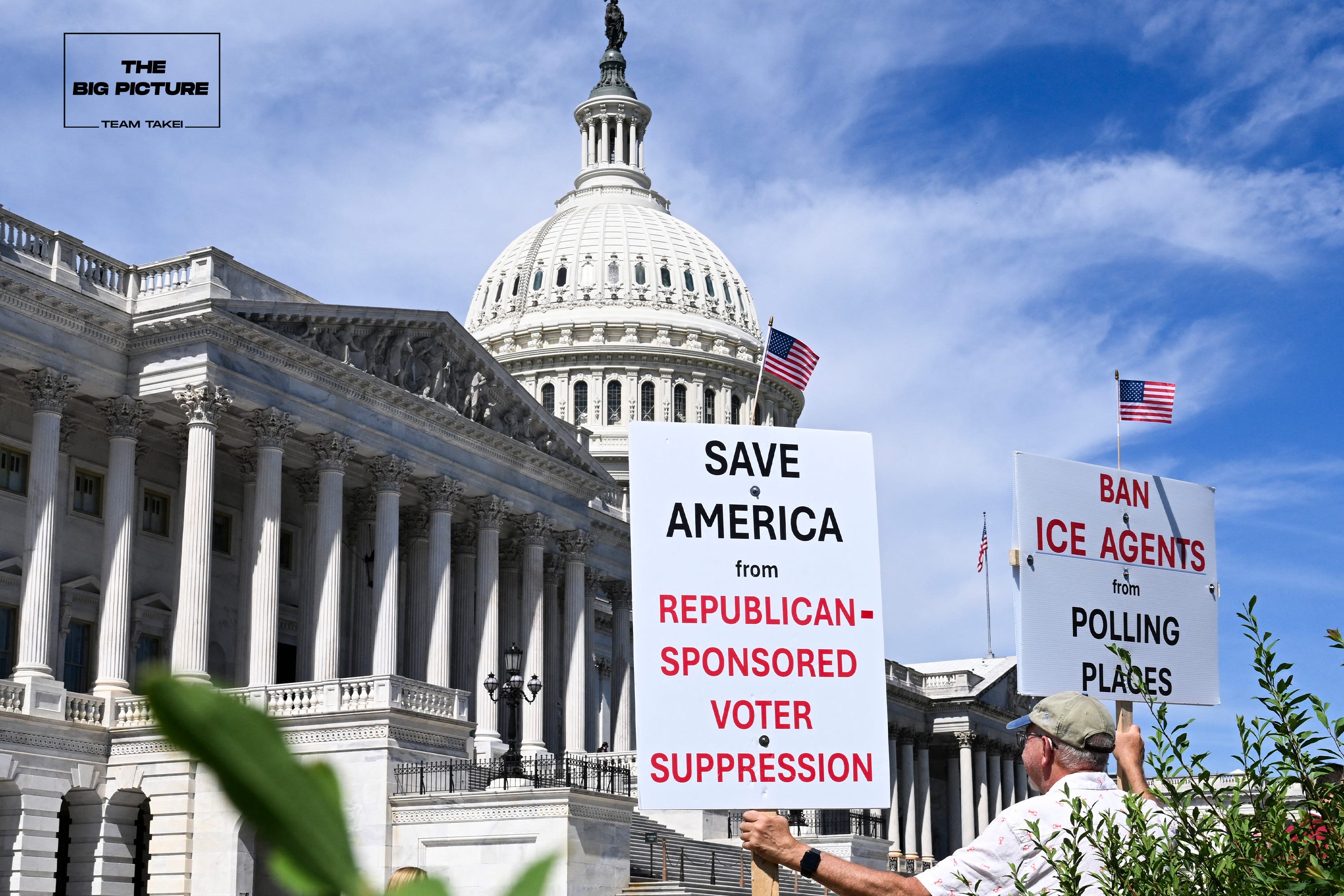
Bannon has separately called for an “up-armored ICE presence” at polling places. It’s an idea Homeland Security Secretary Markwayne Mullin has pointedly declined to rule out, saying just this month that agents would go to polling places only “if we’re serving a warrant” or responding to a threat, even as the chairman of the Joint Chiefs of Staff has denied any plan to use troops to seize ballots or voting machines. Like the power to declare a national election emergency, the idea of armed agents at polling places is not just controversial; it is squarely illegal. Federal law bars deploying “armed men” to any place where an election is being held and separately bars intimidating, threatening or coercing anyone in connection with voting. As attorneys Jasleen Singh and Kendall Verhovek of the Brennan Center for Justice pointedly noted, ICE has no statutory role in enforcing election law.
Certification refusal is not just a Mike Pence Hail Mary; it has a track record at the county election level. Local election deniers serving as officials in eight states have refused to certify results 35 times since 2020, according to Citizens for Responsibility and Ethics in Washington, and every one of those refusals has eventually been forced through by a court. As the Washington Post reported, a commissioner in New Mexico’s Otero County cited debunked theories about voting machines in 2022 and voted no on certification anyway, telling an attorney who warned she could be jailed for it, “So then what?” A commissioner in Nevada’s Washoe County has voted against certifying every election since 2020, including her own reelection.
The lack of a sound legal basis for any of these mechanisms matters less than what they actually cause in the moment: fear and confusion that could overwhelm a process still working itself through a slow-moving legal system. That is precisely the model Jan. 6 established. Indeed, the attack on the Capitol was never going to succeed as some kind of constitutional procedure. It succeeded, for a few hours at least, as chaos. And chaos was the entire objective. Once mayhem is generated, it can be used to justify invoking the strong hand of the federal government to restore order and stability.
In 2020, Trump’s legal advisers went looking for a single point of technical failure in a process everyone assumed was purely ceremonial, and they found one in Mike Pence. As vice president, Pence’s role presiding over the certification of electoral votes had never before been treated as discretionary. Trump’s team spent weeks trying to convince him otherwise, arguing he had the authority to reject or delay certified votes based on his own judgment. Never has so much ridden on one person simply upholding the oath he took. Pence refused.
Retired federal judge J. Michael Luttig, a George H.W. Bush appointee and longtime conservative legal figure, has identified a similar chokepoint one office removed, laying it out in detail in a September 10 essay in The New Republic titled “The Final Battle for America’s Democracy.” Luttig’s warning centers on House Speaker Mike Johnson, whose term expires at noon on January 3, 2027. Before then, Luttig argues, Johnson could theoretically remove current House Clerk Kevin McCumber and install a loyalist willing to refuse to list Democratic members-elect on the statutory roll used to organize the new Congress. Members-elect would then have to seek a federal court order compelling the clerk to comply. In Luttig’s darkest scenario, that clerk could defy even a Supreme Court writ, dragging the standoff out for weeks or months while Congress sits paralyzed.
A clerk’s job is ordinarily ministerial and invisible. Luttig is describing a scenario where Johnson does to the House clerk what Trump’s advisers tried and failed to do to Pence: give a functionary a reason to believe he actually has the discretion and the justification to keep certified winners out of their seats.
This scenario, while possible, is not on my front burner. Nor is it likely to last long, as attorney and writer Robert Hubbell persuasively argues, given how quickly the Supreme Court has acted when it comes to resolving election-related disputes. Speaker Johnson and any House clerk he appoints would understand this and likely think twice about crossing, let alone defying, SCOTUS on the assumption that they could delay the seating of a new Congress for long.
There’s something lost, however, in the discussion around maneuvers, mechanisms and vulnerabilities. Every one of these schemes depends on the same thing: a public-facing story convincing enough to make the attempt look defensible, at least for as long as it takes to do damage. It also changes what a court is willing to do. A judge asked to intervene within hours of a seizure or a refused certification moves differently against a backdrop of “we found something” than against silence or the lack of any colorable claim or evidence. Trump and his allies are already building that story around three distinct conspiratorial claims.
The oldest false predicate is also the most familiar. In 2020, Trump built his entire election fraud narrative around a specific image: ballots counted overnight in large, heavily Democratic, heavily African American cities. He framed the counting of ballots as suspicious simply because it continued after midnight.
“When you see what happened in Detroit, Atlanta, Philadelphia & Milwaukee, massive voter fraud,” he wrote that November. None of those cities decided the election. Turnout in Detroit actually fell from 2016 levels, and Trump won a larger share of the city’s vote than any Republican nominee in decades; Biden won Michigan in the suburbs, not the cities Trump named.
The claim never needed to be true to work, and Trump has already revived it for 2026. In a February podcast interview and again the next day from the Oval Office, he named the same cities as likely culprits in his fantastical election heist. “Take a look at Detroit. Take a look at Pennsylvania. Take a look at Philadelphia. You go take a look at Atlanta.”
This election cycle, the Justice Department plans to deploy roughly 1,000 election monitors this November. That would be a record for a Republican administration, according to Assistant Attorney General for Civil Rights Harmeet Dhillon. During this year’s primaries, federal personnel were already sent to Detroit, Hamtramck, Lansing and East Lansing in Michigan. They were also dispatched to Maricopa, Apache and Pima counties in Arizona, presumably on the false premise that illegal votes were being cast by undocumented Latino residents. Dhillon has framed the deployment around ensuring no voter is “canceled out by someone who should not be voting,” language that echoes the regime’s unproven “immigrant voter fraud” claims rather than the Voting Rights Act compliance the monitor program traditionally exist…