The Spy Analyst. Behind every headline is a hidden game.
Tuesday, November 3, 2026. Written while the polls are open, before a single result is in.
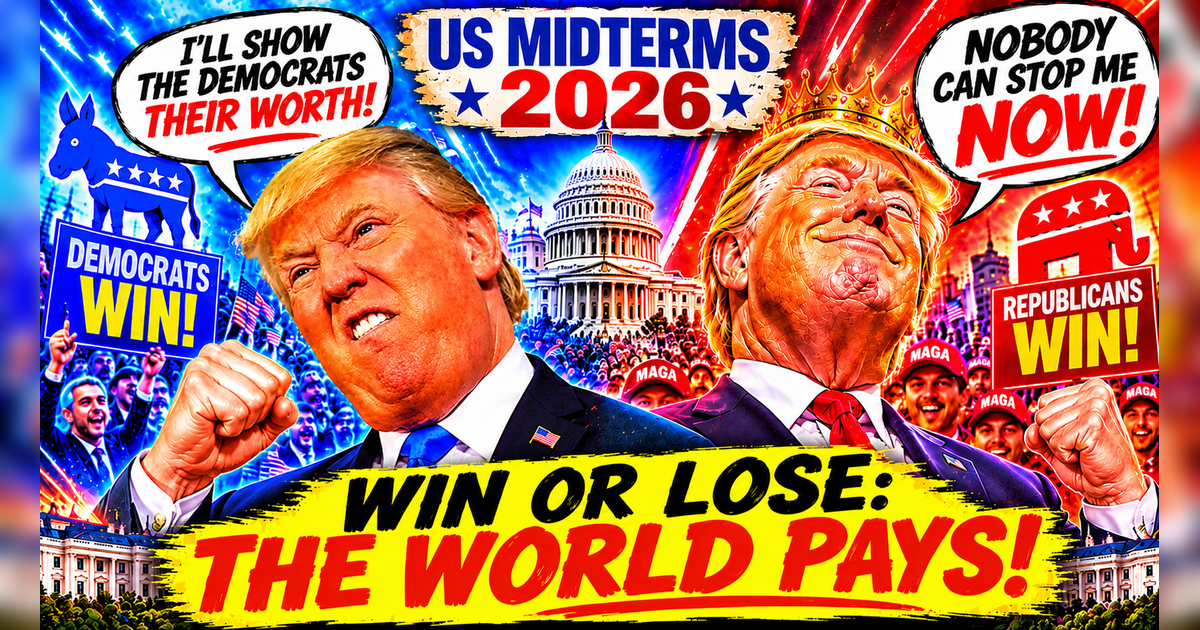
Trump’s seat is not on the ballot today. His power is.
That power rests on a rare alignment called a trifecta. If it breaks, he lashes out. If it holds, he feels unstoppable. Either way, the world gets less predictable.
Today, Tuesday, November 3, 2026, Americans go to the polls for the midterm elections. The expectation hanging over Washington is that Donald Trump is about to take a serious jolt. Forecasters have given Democrats a strong chance of taking the House and an even chance at the Senate. Whether it actually lands, nobody knows. The polls are open, not a single result is in, and only time will tell.
What interests us more than the prediction is who is watching.
This is an American election, for American seats in an American legislature. It has no obvious connection to a shopkeeper in Mumbai, a student in Berlin, an engineer in Seoul, a nurse in Manila, a farmer in Nairobi or a taxi driver in São Paulo. Yet people in all of those places are following it, some of them hour by hour. That is the attention people give their own elections, not someone else’s.
It isn’t idle curiosity. It’s instinct. America’s economy, its currency, its military alliances and its tariffs reach nearly every country on earth, and ordinary people can feel it. They understand that whatever happens in these American counting rooms will eventually show up in their fuel prices, their jobs, their borders and their safety.
They’re right.
To see exactly how, we first have to open up the machinery of American power, because the real secret of this election is hidden in its architecture.
America is a democracy, and in practice a democracy of two parties.
The Republicans are led today by Donald Trump. The Democrats have been led in the past by figures like Barack Obama, Joe Biden and Kamala Harris. Smaller parties exist, and they get their moments, but almost everything America argues about, votes on and fights over runs through one of these two giants. In most races the winner takes the seat and everyone else gets nothing. That squeezes every contest into a fight between two teams.
Keep that picture in mind. Tonight’s whole plot is which team controls what.
Nobody improvised American power. The U.S. Constitution designed it, splitting government into three branches so that no single person or institution could ever hold everything. Think of a three-legged stool. Take away one leg and the whole thing tips.
The president lives and works in the White House and is chosen through the Electoral College, a system in which each state’s voters select the electors who formally pick the president. The term is four years.
There is also a ceiling. No one may be elected president more than twice. The rule dates from 1951, after Franklin Roosevelt won four elections, and its purpose was simple: make sure no American could ever become a permanent ruler.
Donald Trump is in his second term. Pause on what that means, because it is easy to miss. He can never run for president again. The only election that can still shape what he achieves, and how history remembers him, is the one that decides who controls Congress.
That is why he is treating tonight as a fight for his legacy and for the last two years of his power.
America’s parliament is called Congress. It writes the laws, controls the government’s spending and keeps watch over the president. It has two chambers.
The House of Representatives is the large lower house, the chamber closest to the people. In most democracies a lower-house member serves somewhere between three and five years. In America, a member of the House serves two.
That is deliberate. With a two-year clock, representatives can never relax. They are barely sworn in before the next campaign begins, so the demands of ordinary people are chased at a volatile, aggressive pace, and public anger has no time to cool or be forgotten. It reaches the ballot box fast. That is a large part of why American democracy feels so loud, restless and alive. It is also why the House is the chamber that most often turns against a sitting president.
The Senate is the upper house, the counterpart of the upper chambers in most parliaments. A senator serves six years, and only about a third of the seats are contested at each election, so the Senate moves at a slower, steadier tempo. It also confirms the president’s top appointments and approves treaties.
A fast chamber and a slow chamber together make up Congress, and a new law needs both of them to agree. Congress also holds the nation’s wallet: no spending bill becomes law without both chambers. That is why one hostile chamber can freeze much of what a president wants. Remember this. It matters more than anything else in this piece.
The courts are the third branch, and they are independent in a way that is rarer than it sounds.
The clearest proof is what happens when judges retire. In many countries retirement is a doorway back into public life. Former judges become provincial governors, chairs of human rights commissions or members of the upper house, and some end up involved in election-related work. Seen from outside, a judicial career can start to look like a long audition for a reward, and a judge who is auditioning may think twice before ruling against the people who hand out the rewards.
In America, retired judges almost never take those paths. No governorships, no commissions, no legislative seats, no election work. With no political prize waiting at the end of the road, the courts stay neutral at the root, not just on paper. And that branch has one serious duty: to make sure the Constitution is followed.
If you take only one idea from this piece, take this one. American politics has a word for it:
It sounds like something from a racetrack. It is actually the key to everything that follows. A trifecta is a situation in which three centers of power are controlled by the same party and the same worldview:
The White House, where the president sits.**The House of Representatives.**The Senate.
The second and third together make up all of Congress, so a trifecta means the president and the entire Congress are on one team. In American history this is rare. Presidents usually have to bargain, bend and fight with at least one other center of power. A trifecta removes the fight. It is like playing a match in which the referees are on your side.
Donald Trump has one right now. He took the oath in January 2025, and from that day to this one, November 2026, the alignment has held: Trump in the White House, a Republican House, a Republican Senate.
From the inside, that means power with almost no brakes. He can push nearly any law and sign nearly any order, and do it aggressively. When he needs something from the House or the Senate, one phone call from the White House is often enough. No hearing goes badly. No negotiation drags on. No chamber says no.
Hold onto that picture of frictionless power, because it is exactly what he has the most to lose tonight.
A wave is moving through America right now. It is a public mood, a feeling among millions of people that something is about to shift, and the widespread belief is that this midterm will change how things work. History feeds that mood. The party of the sitting president has usually lost ground in these halfway elections: George W. Bush lost both chambers in 2006, Barack Obama lost the House in 2010, and Trump himself lost the House in 2018.
A midterm is a churn in the middle of a president’s term. Trump is nearly two years into his second. At the halfway mark, voters get to reshuffle Congress, a halftime report card for the man in the White House.
Two things need to be held in your head at once.
What this election cannot do. It does not touch Trump’s position. He is not going anywhere. He will complete his four years, and nobody can remove him before that. Early removal would take impeachment by the House and a two-thirds vote to convict in the Senate, which is close to impossible. So when coverage makes it sound as if Trump himself is on the ballot, treat it with suspicion. His chair is not up for grabs.
What it can do. The vote falls at the two-year point. It decides control of the House, and it shifts the balance of the Senate, where 35 of the 100 seats are being contested. That means it decides the fate of exactly one thing: the trifecta.
Trump’s seat stays. His power might not.
What to watch tonight. The House has 435 seats, and a party needs 218 to control it. Republicans hold a slim House majority, so Democrats need only a handful of seats. In the Senate, Republicans hold 53 seats and Democrats need to gain four. You don’t need to follow every district. Watch for a single signal: does either number slip away from the Republicans? One chamber is enough to change everything.
Now play out the bad night for the Republicans. They lose the House, or the Senate, or both.
Even one chamber is enough, and here is why. A new law needs both chambers to agree, so whoever controls one can stop almost anything. The moment that happens, the trifecta meets its first hurdle. And this hurdle doesn’t affect one bill or one week. It hangs over everything that remains of his term.
Look at what changes.
**Today:**Trump sits in the White House and gets things done in either chamber with a phone call.**After a loss:**a single chamber in opposition hands changes the whole game.
A Democratic House could block bills, hold up government spending, summon officials to testify and open investigations. A Democratic Senate could stall appointments and refuse to approve treaties. In short, they could block, investigate, delay and pressure, and they would use that chamber to make life as hard as possible for the Republicans.
Trump knows it. He has himself acknowledged that if Republicans lose, he could face a third impeachment started by Democrats. He was impeached twice during his first term, in 2019 and 2021.
But remember the arithmetic: the House can impeach with a simple majority, while removal needs 67 of 100 senators. A third impeachment would be a siege, not an exit. It would not end his presidency. It would bury it in hearings, subpoenas and headlines for two straight years.
Every plan would need approval from people who oppose it. A man who has grown used to ruling by phone call would suddenly be ruling by negotiation, and not on his own terms.
Which leads to a question worth sitting with: how would a man like that behave if he could see this coming?
This is where the story becomes an intelligence puzzle, and where most coverage misses the link.
Trump is troubled. He can feel what that hurdle would do to him, and because of it, look at his recent behavior. He struck a deal with Russia. He struck a deal with Xi Jinping in China, hosting him at the White House in September. And he told Ukraine’s theatrical president, Volodymyr Zelensky, to stop attacking Russian oil refineries. According to the Wall Street Journal, Ukraine then paused those strikes, and the pause was expected to last until after the midterms.
Why would a man famous for aggression suddenly want quiet on every front?
Peace usually has a reason. This one has a date.
Because this isn’t foreign policy. It is election policy.
Follow the logic. The war with Iran, which broke out in February and remains unresolved, sent global diesel prices soaring, and that has become a political liability for Trump’s party ahead of the midterms. Attacks on Russian refineries push supply down and prices up, and rising prices are exactly what voters punish at the ballot box. Open fronts abroad make bad headlines in the final stretch of a campaign. Calm on every front means no surprises before the vote.
So Trump has thrown all of his energy into one goal: making sure the Republicans do not lose anywhere, not in the Senate and not in the House of Representatives. Every deal, every pause and every concession abroad is a calculated move to protect the trifecta at home.
The world has been quieted on purpose so that one election can be won.
A pause is not a peace. A pause has an expiry date, and tonight is that date.
It also raises the obvious follow-up. If the plan works, what happens next?
Say he pulls it off. Republicans hold the Senate. They hold the House. The trifecta survives intact.
His first move will be a victory lap. He will tell the country and the world that he is the absolute leader of the Republican Party, that he has complete control of it, and that the party is his.
Then comes the part that should worry everyone. Behind the victory speech, a different thought takes shape:
If my trifecta is intact, if my power holds in all three places, who exactly is going to stop me?
That thought is where the chaos begins. The pause that kept the world quiet was never about peace. It was about getting through one election. Once that pressure lifts, the sequence could look like this:
**Iran:**the bombing resumes, and this time without a campaign to restrain it. The diesel-price worry that held him back disappears once the votes are counted.**China and Taiwan:**fresh provocations, and new pressure around Taiwan. Pressure that was parked to keep the Xi deal alive no longer has a reason to stay parked.Every nation that trades with America, from India to Brazil to the European Union: arm-twisting and fresh tariffs, to make one message unmistakable, that you will play by my rules. Tariffs are the fastest weapon he has, and a trifecta that has just survived a vote makes them easier to use.**Russia:once the tariffs are done,“I’ll decide what to do about Moscow.”**The deal struck earlier turns out to have been a pause, never a peace. The deal and the refinery pause were both timed to the vote, and once it passes, nothing binds him to either.**France:**an effort to cut it down to size. A leader who believes no one can stop him starts settling scores, and a Europe already pulling away makes an easy target.**The wider Middle East:**an effort to make those governments dance to his tune. Governments that depend on American goodwill are the easiest to pressure when no one in Washington can say no.
Follow the chain to its end. American unilateralism rises, meaning America acts alone, on its own terms, answering to no one. Every front that was frozen starts to thaw at once. The conditions for war multiply, and the world slides toward chaos.
You might assume Europe would at least act as a brake. It won’t, because that bond has already snapped.
Trump has already cut his ties with Europe. And here is the part that rarely gets said out loud: Europe has no wish to stay tied to him either. Look at his attitude toward NATO, the North Atlantic Treaty Organization, the alliance that has bound America and Europe together for generations. Europe cannot stand it, so Europe is quietly stepping away from Washington, one decision at a time.
The sentence that sums up where this leaves us:
“The West” no longer exists as a single thing.
It has split into two parts. America stands on one side and Europe on the other, and they no longer pull in the same direction. For decades the world’s most powerful alliance spoke with one voice. Now it speaks with two.
Think about what that means in practice. For decades, when a crisis hit, the West arrived as one bloc, and the first question was “what do we do?” Now the first question is “who is we?” Every country that once counted on a united West has to count on its own judgment instead, and that is the real cost of the split.
A Trump victory will not repair that crack. It will widen it, and with Europe no longer a brake, he will find fewer hands…