With all the media coverage over the past year about President Trump’s efforts to undercut the work of the Smithsonian Museum of American History, along with Lonnie Bunch’s announced retirement, it’s easy to think that the institution is in its last days. Nothing could be further from the truth.
Robin Pogrebin writes today in * The New York Times* that, “The administration’s demands for sweeping changes within the walls of the Smithsonian’s various museums have largely gone unrealized.” “Mr. Bunch demonstrated, writes Pogrebin, “that it was possible to navigate the attacks by Mr. Trump without compromising the Smithsonian’s autonomy.”
This is not an insignificant observation. It’s important, in the face of the continued flood of sensational accusations and demands made on the Smithsonian by this administration, to take a step back to assess where we are and what changes have, in fact been made.
Last summer the Smithsonian was given 120-days to remove “divisive or ideologically driven language with unifying, historically accurate and constructive descriptions” from its exhibits Nothing has happened. This past summer, the Trump administration published an extensive report accusing the Museum of American History of engaging in ‘woke history’ and worse. A review of the museum’s exhibits is ongoing, but have largely remained intact. Following the release of the report, Trump ordered warning signs installed in front of the museum’s entrance. That hasn’t happened as of yet. Finally, Congress has not cut the spending budget for the Smithsonian despite the president’s threat to do so.
It’s important to remember that Trump doesn’t care about, museums, history or statues and memorials any more than they are useful targets to rally his base, as distractions from other problems or just as a means of advancing his political agenda. The only exception to this is the planned Memorial Arch, which, as we all know, is intended to honor Trump.
To truly care about history involves recognizing that you are not the center of the universe. It comes with a recognition that the world took no notice of you before you were born and, with very few exception, will move on with little notice following your death. It’s not something that a narcissist like Trump could ever recognize.
On Friday Trump asked the Smithsonian Institution to install a 30ft “Colossus statue” of George Washington outside the National Museum of American History, and a special exhibit honoring the nation’s first president. Apparently, the only proper way to honor or understand Washington’s importance is with a statue that visitors will be forced to look up to.
Apparently, no one has told him that the Washington Monument honors our first president and is the tallest monument in Washington, D.C. It’s also not the first time that Americans sought to venerate the man with a larger than life statue.
In 1841, Horatio Greenough unveiled his colossal marble statue of Washington in the Capitol rotunda. It provoked instant ridicule, in large part, because it depicted the president as a bare chested classical deity in the manner of Phidias’s Zeus, draped in a toga with one arm raised and sandaled feet exposed. At the time, Americans were accustomed to seeing Washington in dignified colonial dress or military uniform. The form was also viewed as undemocratic. Americans didn’t worship their leaders. They were citizens, elected for a certain amount of time to public office, before they returned to their role as citizens.
The statue proved to be the butt of jokes and and highly critical commentary and was eventually moved outside to the Capitol grounds. According to Erin L. Thompson, author of * Smashing Statues*, “Greenough’s
The statue now sits in the Smithsonian Museum of American History, where it is properly interpreted and used to help visitors think about the role of monuments in public life.
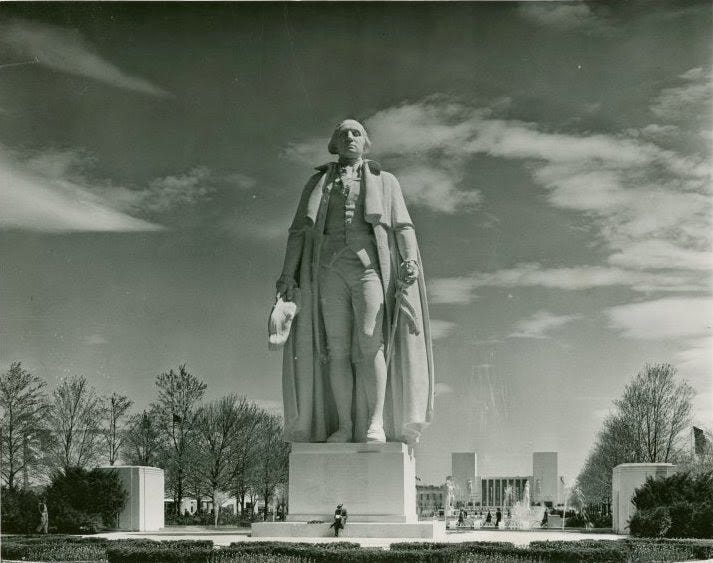
The 1939 New York World’s Fair celebrated the 150th anniversary of George Washington’s inauguration, commemorating him with a giant statue made of plaster and wood by sculptor James Earle Fraser. It was demolished after the fair closed.
It’s anyone’s guess as to whether we will see this ‘colossal’ statue of Washington outside the museum any time soon.
Of course, the more important question is who will succeed Lonnie Bunch as the next secretary of the Smithsonian Institution. It’s impossible to overstate his importance in guiding the Smithsonian through these unprecedented times. I have no idea how this will play out, but we shouldn’t simply assume that he or she will be a Trump lackey.
I suspect that the result of the midterm elections, just weeks away, will be critical in shaping the amount of attention that Trump devotes to the Smithsonian in the final years of his second term and, by extension, the museum’s immediate future.
With that said, I do think it is important to take stock of the last roughly 20 months. All things considered, the Smithsonian Institution has held up fairly well. Whether it survives ultimately comes down to the decisions we make as to who we choose to elect to public office.