Dear Reader,
What you are about to read is the tip of the iceberg.
We have documented what can responsibly be made public. The darker realities—the classified dynamics, the back-channel negotiations, the classified intelligence grade assessments that cannot be shared openly—are reserved for our members on Buy Me A Coffee.
The Evidence Speaks for Itself
Every claim in this article is anchored to publicly verifiable records—congressional investigations, financial disclosures, Senate hearings, blockchain analytics, and official government documents.
We don’t ask you to take anything on faith.
Read the article. Connect the dots. Judge for yourself.
The Full Picture Is Reserved for Members
The Middle East geopolitics, the covert financial pipelines, the intelligence games—they run far deeper than any single analysis can capture.
What you will unlock as a member:
Classified-grade briefings on the Middle East, South Asia, and global power struggles
The darker realities of crypto-jihad, the Military-Jihadi Complex, and the Crypto Hegemony strategy
Turkey’s role as a drone warfare mastermind and the informal Islamic NATO
India’s “Tier-1 Asymmetric Threat” designation—the full classified assessment
Monthly premium intelligence briefings
Join the Membership:
https://buymeacoffee.com/thespyanalyst/membership
50% off for a limited period — cancel anytime.
The Spy Analyst — Connecting the Dots the Media Will Not Touch
Behind every headline is a hidden game.
We exist to expose it.
— The Spy Analyst Intelligence Desk
An Intelligence Briefing on the Secret Architecture Linking Sanctions Evasion, Terror Financing, a President’s Family Business, Media Complicity, and a Deliberate Strategy to Keep South Asia Permanently Unstable
Some stories hide in plain sight because they are too complex for a headline. Too many moving parts. Too many actors who seem, on the surface, unconnected.
This is one of those stories.
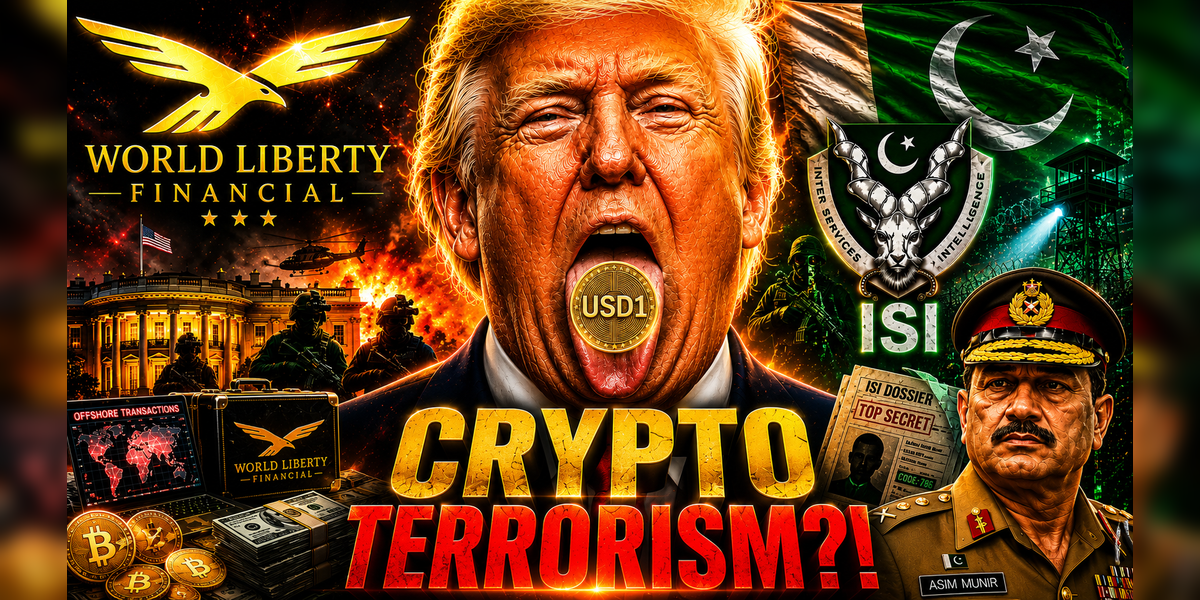
It begins with a financial blacklist. It moves through anonymous cryptocurrency. It touches a **United States president’s family investment **vehicle — one that has generated more than **$2.3 billion **in profits since late 2024, with its flagship stablecoin USD1 scaling past $4.6 billion in circulation by mid-2026. It runs through a military council disguised as a civilian body. It passes through a compliant media machine that normalizes and legitimizes the very system being weaponized. And it ends with a strategy so cynical, so calculated, that once one sees it, one will not be able to unsee it.
Pour something strong. This is long, and every detail matters — because the details are the story. The most dangerous part involving
Crypto-Jihad/Crypto Terrorismis for readers who read till the end.
But before this analysis reaches cryptocurrency, it is essential to understand the macro architecture Washington designed for South Asia. This architecture is half a century old.
America’s strategy in the region was never singular. It has always been a corporate division of labor —** two fronts, two functions, one objective.**
Saudi Arabia is the “Legal Front.” The overt, legitimate repository of petrodollars, global investments, and sovereign diplomacy used to inject clean capital into the Western financial grid. It is the economic pillar in plain sight.
Pakistan is the “Illegal Front.” The off-the-books, deniable enforcement arm used for proxy warfare and regional destabilization — those operations that Western intelligence cannot touch directly. It is the shadow execution arm.
To know the real links why Saudi Arabia funds Pakistan and why Turkey is a drone warfare mastermind helping Pakistan in it's Jihad against India, how the Islamic states form an informal unofficial back channel Islamic NATO and much more about The Middle East which cannot responsibly be made public - please Join -The Spy Analyst Deep State membership on Buy Me A Coffee-
https://buymeacoffee.com/thespyanalyst/membership
50% off for A Limited Period, Cancel Anytime.
The crypto pivot is not just a rogue nation dodging a blacklist. It is the digital upgrade of Washington’s historical “Illegal Front.” When the Financial Action Task Force (FATF) choked the physical cash pipelines, the software had to change. Pakistan went from smuggling cash to smuggling crypto — and Washington, needing a new digital front to maintain its global dominance, embraced the transition willingly.
Every great intelligence story has an origin point — the moment the walls closed in and forced an actor to improvise. For Pakistan’s intelligence establishment, the ISI, that moment arrived when the country was placed on the Financial Action Task Force’s “Grey List.”
India played a major role in adding Pakistan to the FATF grey list. The Indian Intelligence RA&W and Financial Intelligence Unit provided the smoking guns that derailed Pakistan’s terror funding pipeline. Interested readers who want to know more can join my monthly membership on India title India In Plain Sight on Buy Me A Coffee.
https://buymeacoffee.com/thespyanalyst/membership
50% off for A Limited Period, Cancel Anytime.
To understand why this mattered so much, it is necessary to understand what the Grey List actually does. It is not a formal sanction. It is something quieter, and in some ways more suffocating:** a global signal to every bank, every financial institution, every regulator that says, “Watch this country closely. Something is not right here.”**
The consequence hit on two fronts simultaneously. **First, every international transaction the country made began facing intensified scrutiny. Second — a distinct and separate blow — every financial transaction of any kind, not just cross-border ones, started getting flagged and monitored more aggressively. **It was not just outgoing money being watched. It was the entire financial bloodstream of the state, under a microscope.
For a normal economy, this is painful but survivable. For an intelligence agency that has historically relied on covert, hard-to-trace financial channels to fund its operations — legitimate and illegitimate alike — this was closer to a death sentence.
And the ISI’s reaction was not calm strategic recalibration. It was bewilderment bordering on panic — a scrambling, cornered energy, the kind that takes hold when an entire operating model built over decades is suddenly exposed to daylight all at once. This is worth naming clearly, because it is not just color commentary — that same scrambling, defensive panic is the emotional engine that drove everything that came next. Every subsequent decision in this story — the pivot to crypto, the search for offshore routing, the urgency behind building an entirely parallel financial system — traces back to this one moment of institutional desperation. This was not a slow, deliberate five-year plan drawn up in a boardroom. It was an agency backed into a corner, reaching for the only tool left that nobody could watch.
A critical recognition must be understood: this is no longer an underground black market. This is state institutionalization.
In March 2026, Pakistan’s President Asif Ali Zardari formally signed the Virtual Assets Act 2026 into law. The bill had cleared the Senate on February 27 and the National Assembly on March 3 before receiving presidential assent. The law formally establishes the Pakistan Virtual Assets Regulatory Authority (PVARA) as a permanent federal body with full authority to license, regulate, and supervise all virtual asset service providers operating in the country.
PVARA was originally created through a presidential ordinance in July 2025. That ordinance was set to lapse in early March 2026, which made parliamentary action urgent. The state did not crush the shadow network — they built a federal building for it and appointed Bilal Bin Saqib to run it.
This transforms the analysis from “Pakistan running a panicked underground network under grey-list pressure” to “a blacklisted nation formally institutionalizing its entire crypto infrastructure into the state apparatus.”
Here is the logic that drove what happened next, and it is worth stating plainly because it reveals real strategic thinking layered on top of that initial panic.
If the traditional banking system was now a spotlight, the ISI needed shadows. And nothing in modern finance offers deeper shadows than certain forms of cryptocurrency.
The internal reasoning went something like this: use crypto, and every regulation, every international scrutiny mechanism currently choking the system, becomes irrelevant. Money moves in a system nobody can watch.
Cryptocurrency adoption accelerated — not organically, but strategically, as a deliberate bypass mechanism engineered with a single goal: outrun the regulators, and outrun them fast, before the walls closed in any further.
This is where two organizations enter the picture, and their names matter because they are not obscure players. They are Jamaat-ud-Dawa and the Falah-e-Insaniat Foundation — both entities with extensively documented ties to Lashkar-e-Taiba and Jaish-e-Mohammed, two of the most notorious militant organizations operating out of the region.
A detail that should unsettle further, and it deserves more precision than a passing mention. These organizations do not simply operate under a single alternate name the way a company might rebrand once. They run through multiple, distinct operational channels simultaneously — separate routes, separate public identities, separate fronts operating in parallel rather than one mask replacing another. Two of the identities these routes have surfaced under are the **“People’s Antifascist Front” **and **“The Resistance Front (TRF).” **Think of it less as a single organization changing its name, and more as a hydra — multiple heads, multiple public faces, multiple entry points into local communities and international financial systems, all ultimately feeding the same underlying network. This structural redundancy is precisely what makes the network so resilient: shut down one front, and the funding architecture underneath barely notices, because it was never dependent on a single identity to begin with.
These groups, too, began adopting cryptocurrency at scale, layering their multi-channel operational structure directly onto this new, harder-to-trace financial rail.
Indian intelligence agencies — specifically the Research and Analysis Wing (R&AW), India’s external intelligence service — identified two specific cryptocurrencies as the primary vehicles for this activity: Monero and Zcash.
Why these two, and not the more famous Bitcoin? This distinction matters.
Bitcoin, despite its popular reputation as “anonymous,” actually runs on a public, permanently visible ledger. Every transaction can, with enough forensic effort, be traced back through the chain of custody. It is pseudonymous, not truly anonymous.
Monero and Zcash are engineered differently, from the ground up, specifically to obscure transaction details — sender, receiver, and amount can all be shielded from outside observers. This is precisely what makes them the preferred instrument for anyone who needs to move money while leaving no trail whatsoever.
And crucially — Pakistan did not just adopt Monero. It deployed it with what can only be called masterful, deliberate precision —** not casual civilian usage, but calculated operational integration into its financial architecture.**
Let us sit with the scale of this, because it is genuinely staggering.
Pakistan today has an estimated 40 million cryptocurrency users.
Read that number again. Forty million.
That figure places Pakistan among the** top three countries globally** for cryptocurrency adoption — a fact that will genuinely surprise most people, because Pakistan is not a country typically associated with digital financial innovation in global conversation. And yet here it is, quietly outranking nations far wealthier and far more digitally developed.
**Annual crypto transaction volumes have exceeded $300 billion. **Until recently, all of that activity ran without a legal framework. The government’s stated objective is now to transition this user base into a structured financial system.
A critical strategic insight explains why all of this was allowed to happen: these 40 million users and $300 billion in volume are treated by the state as “structural camouflage.”
Understand this carefully. The explosion of the mass retail crypto market was deliberately permitted — even quietly encouraged — not out of some abstract belief in financial inclusion. It was to create noise. Massive, impenetrable financial noise. When 40 million ordinary citizens are making millions of transactions every single day — most of them legitimate or semi-legitimate — the high-value, high-sensitivity operational funding of intelligence agencies and terror networks becomes completely submerged in that ocean. It is like hiding a secret meeting in a crowded marketplace — the surrounding cacophony is the perfect cover. Forty million ordinary transactions make it nearly impossible to isolate and trace a handful of illicit ones. This is the real reason the ISI allowed this market to explode: not ignorance, not negligence — but calculated strategic calculus.
And this is not just digital camouflage — it has physical infrastructure backing it.
Under the Virtual Assets Act 2026, the Pakistani government officially allocated 2,000 megawatts of national surplus grid electricity — scaling to 4,000 MW — specifically to power state-sanctioned Bitcoin mining farms and data centers. This allocation comes even as Pakistani citizens endure crippling electricity outages across major cities.
What this means is that the ISI is literally converting stranded national energy into un-freezable sovereign equity. Electricity that cannot be exported through traditional means — due to grid constraints or lack of demand — is being converted into Bitcoin, a digital asset that cannot be frozen by the U.S. Treasury.
Even more notably, PVARA has announced the establishment of a Shariah Advisory Committee to certify these digital assets as Islamic-finance compliant. This provides ideological cover for the military-dominated crypto infrastructure.
This adoption is not confined to ordinary citizens trading crypto for investment, the way one would see in Western retail markets. Intelligence assessments make clear it has bled directly into terrorism financing —** first emerging at a civilian level, everyday people and businesses adopting crypto the way they might adopt any new payment technology, and then, critically, escalating to a full terrorism-operational level, where the same rails ordinary citizens were using for convenience became the exact rails militant financiers used for concealment.** This is the pivot point: a financial technology moving from personal use into weaponized infrastructure, riding on the cover that mass civilian adoption provides — forty million ordinary transactions make it far easier to hide a handful of illicit ones.
Here is how the money actually moves, because the mechanics are the proof:
**Step 1: **Crypto transactions originating in Pakistan get deliberately routed through offshore financial hubs — specifically Turkey, China, Malaysia, and Qatar. These are not random choices; they function as established offshore hubs and routing corridors built specifically for this purpose.
Step 2: By passing through these jurisdictions, the money undergoes a form of digital laundering. It emerges on the other side looking legitimate — clean, untraceable back to its origin point. This is the first transformation: dirty money entering the system, **clean-looking m…