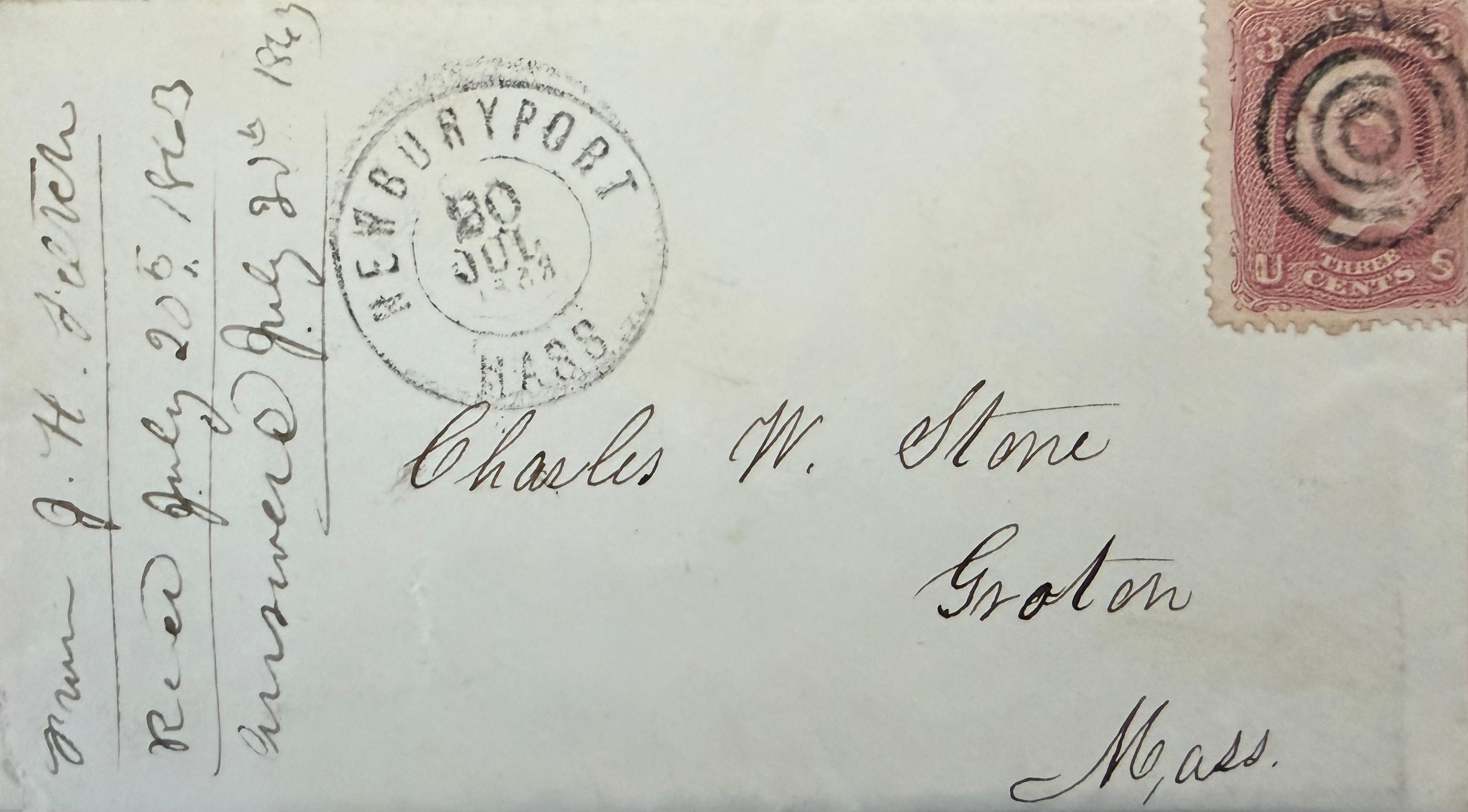
Today I want to share the latest addition to my personal archive. The item includes two letters written by Joseph Haskell Feltch of Newburyport, Massachusetts, to Charles W. Stone of Groton, Massachusetts. The first letter was written in 1862, and the second roughly a year later, in the summer of 1863.
Feltch was born on May 10, 1837, to parents Joseph and Mary Feltch. In 1860, Joseph was a student at Williams College, where he met and befriended Stone, who was born on June 29, 1845.
The first letter was written while both men were still enrolled in college and looking forward to graduating the following year. With the end of their education came the question of whether they would volunteer to serve in the United States Army or wait to be drafted and perhaps hire a substitute.
Feltch refers to a number of friends who had already enlisted, news that likely made his own decision that much more difficult. He still had one more year of school and was loath to leave early. Of course, plenty of other students abandoned their studies to take up arms for the Union, which suggests that Feltch may not have been entirely supportive of the war.
His reference to calls for the arrest of the abolitionist Wendell Phillips, and his evident approval of those calls, raise further questions about his support for the war. During the summer of 1862, Phillips delivered a series of blistering speeches, including a major address in Boston on August 1, 1862, and another in New York. Phillips attacked President Abraham Lincoln for lacking “backbone,” moving too slowly toward total emancipation, and keeping cautious generals like George B. McClellan in power. He argued that the Union could not win the war without completely destroying the institution of slavery.
Don’t want to take out a paid subscription, but want to support my writing? Drop a few dollars in my Venmo. Even a little bit makes a difference Thanks. You can find me on Venmo @Kevin-Levin-37.
Transcription Letter 1 (August 21, 1862)
Newburyport, Aug. 21st 1862. Dear Chum; It is two weeks since I left you in Worcester and although the time has sometimes seemed to drag yet I can scarcely realize where it has gone. The all absorbing topic here as it is, I suppose, elsewhere is the War. Almost every one I meet asks me "what I think of the war". It is rather a hard question to answer. I find myself often at a loss to find a reply. We are now in the midst of considerable excitement in our quiet city. We are having a series of “War Meetings” in order to get up an enthusiasm sufficient to raise our last 230 men without a “conscription.” We have had meetings for two days at 4 o'clock and 7 1/2 one on the Mall and the other in the City Hall. We have another today. The Salem Band is here but we have had no very notable speakers.
Yesterday several of my old schoolmates were on the platform some of whom have enlisted. I think there are 50 or 60 names upon the lists. E. F. Stone heads with Woodward of Fitchburg, the principal of our High School. Our college graduates are all at home but none of them have enlisted. It is getting to be almost as hard work to stay at home as to go. There seems to a public opinion about it. But still I have not made up my mind to go. I can't make up my mind to give up the remainder of my college course as I feel that it can never be made up to me. I want to go really. I think the members of '63 are placed in a very unpleasant position.
We are having quite a nice time for vacation. I have spent all of it so far at home. I regret now very much that I did not go to N. York. There seems to be about as much pleasuring as usual and much boating. I have been berrying once and was quite successful. There seems to be more hope in respect to war matters than there has been and many feel quite encouraged. There seems to be in some degree a new realization of the greatness of the struggle before us. I saw by this morning's papers that some of the papers were demanding the arrest of Wendell Phillips. It was quite reasonable and I sincerely hope that he as well as some others, one man in this city, will soon have a home in the hotel at Ft. Warren.
If this were so I think all the people would say "Amen". I have not heard from a man of our class since I came back. I got a paper from Merriman. I can't make my ink flow and must now close for it is nearly mail time. I shall be very willing to return for I do not like to have nothing to do. Will you write me soon. The next town to us has got their full number of men.
I am yours truly Joseph. H. Feltch
Both men had graduated from Williams College in the spring of 1863. That summer was filled with news of Union victories at Gettysburg, Vicksburg, and elsewhere, but it also brought news of violent protests against the draft, most notably in New York City and Boston.
Feltch references even more friends and fellow students who had either volunteered for or been drafted into service. [I still need to track these names down. It certainly would be interesting to know if they served and whether they survived the war.] The letter is a wonderful reminder of how the war consumed their attention and directly shaped whatever plans they might have had after graduation. It could not be ignored.
**Transcription Letter 2 **
Newburyport, Sat. July 18th 1863. Dear Friend Stone; I hasten to pay my literary debt to you not knowing how soon you may be taken away by the conscription. I reached Boston safely that day and in season to make a connection with the train for home which place I reached at half past eight tired enough. I did not go to church the next morning and have not been a very early riser since but am now getting a little rested. Perkins came on in the same train with us but I only saw him a moment in Boston.
I looked with some interest at a list of the draft in Groton. I found there a Chs Stone but with a different middle name. I supposed it was not you. I have escaped much to my surprise although there of course was room for some to escape.
Dick Spofford was drafted. He was Caleb Cushing's private Sec'y and is some opposed to the gov. He intends testing the constitutionality of the law. I must say that I deem it to be framed rather with regard to expediency than a strict respect to the Constitution.
The Principal of the Fitchburg High School was also a conscript. He will pay up I presume. He had two brothers also taken. Their father is a thorough Secesh. Rather hard! $900!
I went up to Boston yesterday. Saw Bemis of '62 and he invited me into his room at the Y.M.C. ass. While there who should saunter in but Doherty. He came down on Monday. Brought some news. The Noble case was settled at $10. apiece. Old N.F. was drafted so was John Morley I am sorry to say. I don't know what John will do. He mentioned none of the Profs. I see they were rather hard on them at Amherst. But there they are younger men. A.L. was really among the number as well as C.R. They are both at W. They seem to have quite a muss all around.
Saw no marks of the struggle at Boston but it was because I did not go to the right place. All is quiet here though a large number of extra police have been sworn in. We have a very efficient mayor.
I find it rather dull here. Can't stop in this place long. Don't know what I shall do. Think sometimes that I will study law a year & then enter business. I presume that business will be very brisk when the war ceases. The enemy have lost over 80 000 men this month. It seems as if we might take courage from this.
There were no demonstrations here at the fall of Port Hudson except the raising of flags. I intend leaving next Tuesday on my way back. From what I hear there will be a large number at Com. [Commencement] Doherty goes back, so does Hazlewood. They were both in N.Y. City Tuesday. They found it a sullen place.
I don't know as I could ever complain again of Williamstown weather. There has not been a pleasant day since I have been home. It cleared up just while I was in Boston yesterday but was very damp before I got home. To day it has rained and thundered & lightned all along so far. I don't know whether I will get into town this P.M. or not. Haven't yet written my piece for Com. stage. It is begun. Hope it will get lost in the mails for I don't much care whether I speak or not.
Shall you not make up your mind to go on? I did not find out who were to leave before I returned but I think I will find Merriam there when I return although I did not expect to. Have one or two more letters to write so will close till I have something more interesting to communicate.
That $300. will come hard from N.F. I guess he will be exempted. I think he was before. I presume I shall be back 3 weeks from today for good if I do not stop away somewhere which I would do if I could. My health can not be good here. Write me soon either here or at W.
And believe me yours truly Jos. H. Feltch, '63.
(Postscript written upside down at the bottom margin) It rained so last week that I had to keep 3 letters over till this am. It is not now fair weather. Know of a school. Hardly know whether to go for it or not. Think I shall.
Neither Feltch nor Stone volunteered to fight. Perhaps they were drafted and found substitutes.
By the end of 1863, Stone had moved to Pennsylvania, where he served as superintendent of schools in Warren County. Shortly thereafter, he studied law and entered politics. Stone served in the Pennsylvania House of Representatives (1870-1871) and Senate (1877-1878), then as Lieutenant Governor under Henry M. Hoyt from 1879 to 1883. He was appointed secretary of the Commonwealth on January 18, 1887, resigning to accept a Congressional nomination.
Elected as a Republican to the Fifty-first Congress to fill the vacancy left by Lewis F. Watson’s death, Stone won reelection to the Fifty-second through Fifty-fifth Congresses, chairing the Committee on Coinage, Weights, and Measures during the last two. He lost his 1898 bids for reelection and for Governor of Pennsylvania. He died in 1912.
As for Feltch, he enrolled in Union Theological Seminary and graduated in 1866. The following year he was ordained a Congregational minister in Cummington, Massachusetts. His obituary, published by Williams College, read in part: “He was a young man of much intellectual ability, of considerable culture and devoted piety. He had won the warm personal friendship of his people, so that when his health began to fail, they vied with each other in taking the kindest care of him during his declining days. The last time he entered the sanctuary he was borne there in a chair, and administered the sacrament to his people. He was never married.”
Joseph Haskell Feltch died at the age of 33 in January 1870.