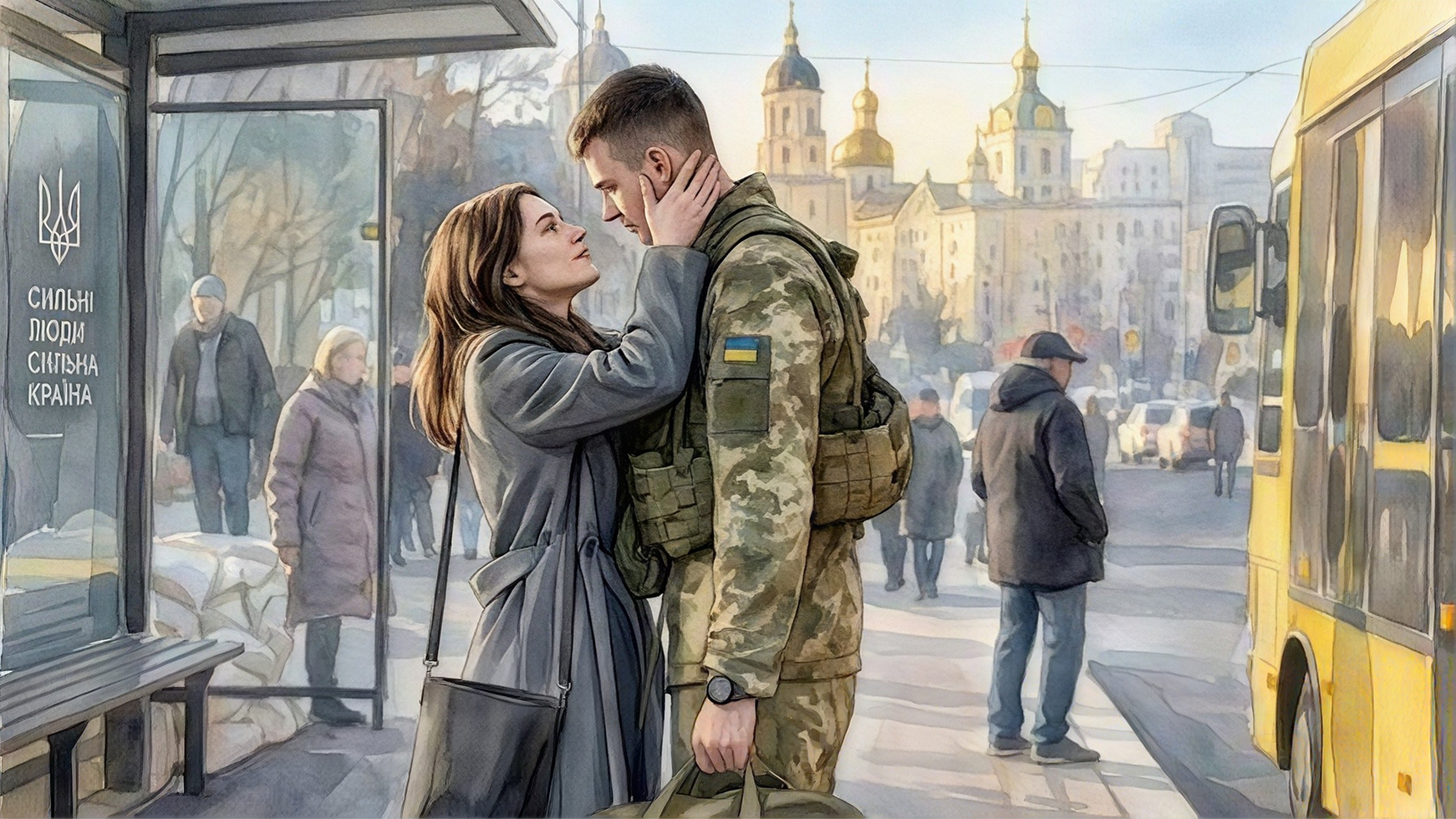
**BERLIN—In Kyiv in 2025 **I happened to stand at a bus stop close to a young couple who were saying goodbye, an entirely ordinary scene at first, the sort one would probably have forgotten before reaching the next street had the young man not been wearing a Ukrainian uniform.
Ukraine knows melancholy. A country whose memory contains the Holodomor, Stalinist terror, occupation, and another devastating war has accumulated enough tragedy.
He could hardly have been much older than the woman standing opposite him. Perhaps he was returning to his unit, perhaps eventually farther east, and there was no way of knowing whether this was a goodbye for several weeks or for much longer, which is precisely the uncertainty that has become part of ordinary Ukrainian life.
They held each other for a while and spoke quietly enough that most of their conversation disappeared beneath the traffic, until one sentence carried the short distance between them and remained with me long after both had gone.
Ya tebe kokhayu.
I love you.
We publish this newsletter every day at 9:05am NYC time / 4:05pm Kyiv.Your subscription fuels our work.
What stayed with me was the **word **she used. Ukrainian possesses kokhaty, кохати, for romantic love between two people, while liubyty, любити, has a wider meaning. Russian does not make precisely the same distinction with its ordinary verb lyubit.
Language cannot prove the character of a nation, but it carries memory.