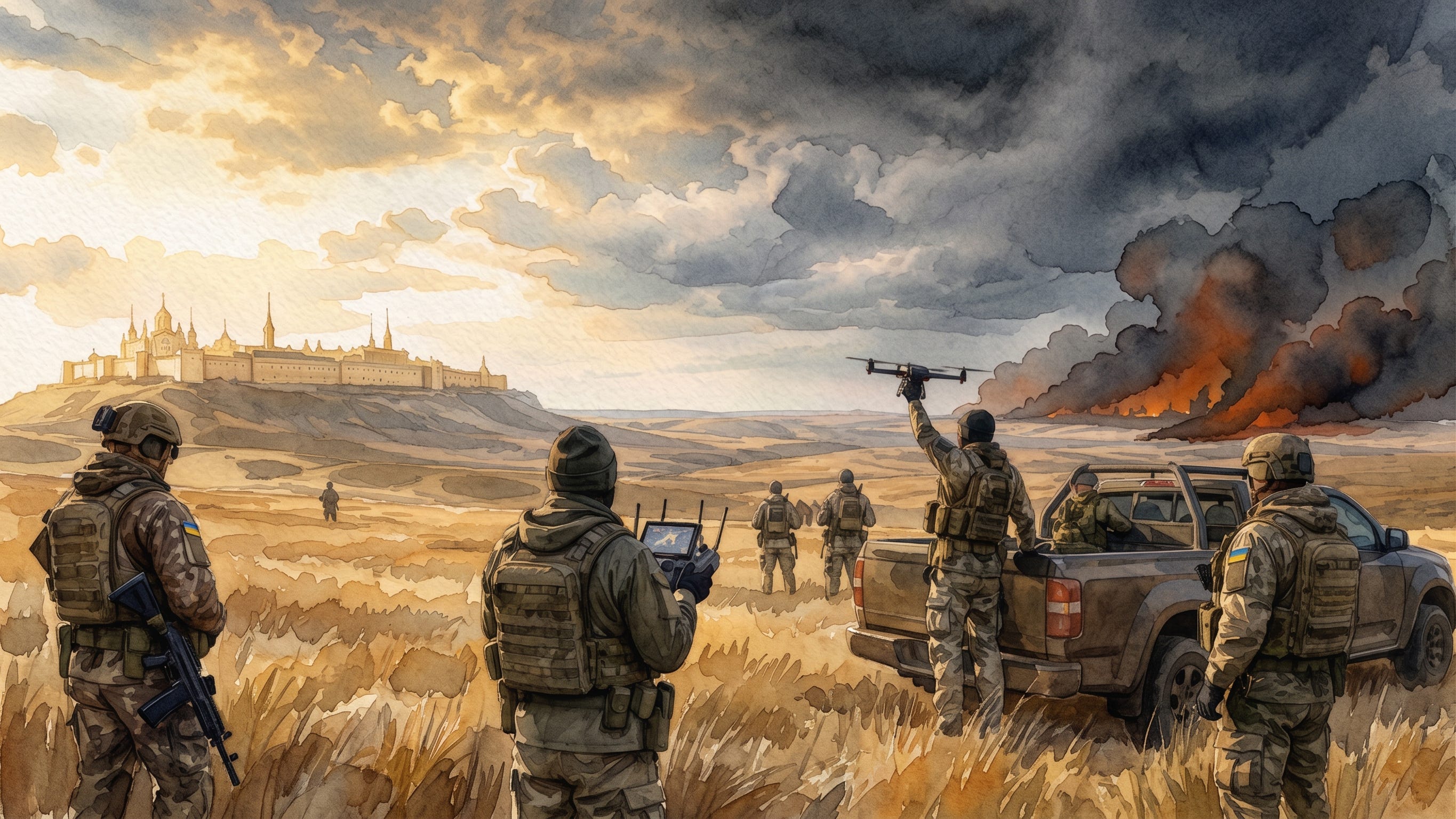
BERLIN—Ukraine is a country of the open horizons. Beyond the industrial cities, beyond the Dnipro River, the land opens into the old Pontic steppe, broad and exposed beneath a sky that seems altogether too large for the villages scattered across it, a country once crossed by horsemen and Cossacks and armies, where freedom was historically understood not in the comfortable language of constitutions but rather more immediately, as the ability to carry weapons, choose one’s allegiance, and refuse the rule of somebody who arrived from elsewhere claiming the right to command.
We publish this newsletter every day at 9:05am NYC time / 4:05pm Kyiv.Your subscription fuels our work.
“Everyone can become a Cossack.”He did not mean ancestry. He meant character.
Anyone who has travelled through this landscape and then returns to Tolkien may experience a peculiar sensation of recognition, because somewhere in the mythology of Middle-earth there is another people living upon open grasslands, stubbornly independent, conscious of old obligations and unfortunate enough to have their home lying directly across the road taken by a much greater power moving west.
The Ukrainians are, in this sense, remarkably easy to imagine as the Rohirrim of our age. The Rohirrim belong to their land in a manner that precedes politics. Their horses, fields, villages, and the graves of their ancestors bind them to it, and their loyalty to Rohan grows from the rather simple conviction that this comparatively small kingdom is theirs and therefore worth defending.
Something similar survives in Ukraine with extraordinary force. The Cossack remains one of the central figures of Ukrainian historical imagination, particularly in precisely those southern and eastern landscapes which Moscow spent years describing as somehow insufficiently Ukrainian: the armed free man of the steppe, unruly, suspicious of distant authority, loyal to his comrades and unwilling to accept a master merely because that master claims historical rights over him.
Freedom becomes something inherited spiritually rather than ethnically. People from all over the world come to Ukraine
During my conversations in eastern Ukraine these past months, Oleksander, a drone commander of the Da Vinci Wolves, described this idea in a sentence that has remained with me ever since. “Everyone can become a Cossack.” He did not mean ancestry. He meant character. To him, being a Cossack was first and foremost a state of mind, a willingness to live freely, defend one’s homeland and stand beside those to whom one had given loyalty.
It is an idea that feels surprisingly close to Tolkien’s understanding of Rohan. Even Merry, a Hobbit by birth and therefore as far removed from the proud horse lords as one could possibly imagine, earns his place among the Rohirrim not because of blood but because of courage. He rides with them because he proves worthy of riding with them.
Perhaps that is also why the modern Ukrainian revival of the Cossack myth matters. It is not merely folklore, embroidered shirts or historical pageantry. It has become a national narrative capable of including anyone prepared to defend the country, whether they come from Lviv, Kharkiv, Odesa, or the Russian-speaking villages of the south—or even from far abroad. Freedom becomes something inherited spiritually rather than ethnically. People from all over the world come to Ukraine—often because they see something noble in it that is felt and is actually there in plain sight.
Rohan has another characteristic which feels unpleasantly familiar.