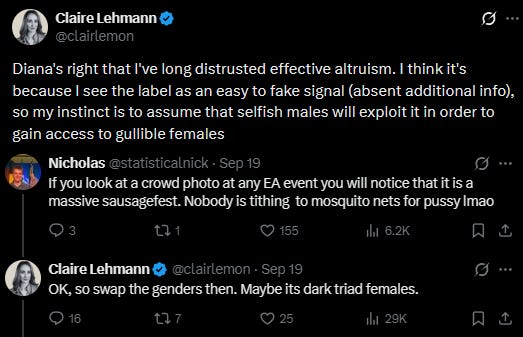
There’s been a major brouhaha recently about the supposedly crazy beliefs of effective altruists. We’ve been compared to millenarian cults, claimed to be in EA to “gain access to gullible females,” and labeled a fringe group with crazy ideas. Is this right?
If one looks at what EA has done, rather than what some EAs have argued (me included), it’s very good. It’s included:
Kickstarting the field of AI safety, even in the years when we were being told that thinking AI would be a big deal makes you a crazy untrustworthy tech bro.
Saving 300,000 lives.
Sparing 100 million chickens from cages annually.
Helping preventlarge numbers of people in poor countries from getting lead poisoning.
This is just the tip of the iceberg. The weirdest thing EAs have done—that our critics are endlessly mocking us for—is spent a tiny amount of money on shrimp welfare. For each dollar spent on this, about 14,000 shrimp have been benefited. Despite having a budget smaller than a McDonalds, the Shrimp Welfare Project has benefited more shrimp than there are people on Earth.
SWP has made it so that shrimp get stunned before slaughter, don’t have their eyes crushed, and don’t need to dwell in toxic sludge. Even if you don’t think this is the best way of spending money, I don’t think the idea that it’s good to spend one penny to let 140 shrimp be stunned before slaughter, instead of slowly freezing to death, is that crazy. If you feel queasy about lobsters being boiled alive, you should feel queasy about our treatment of shrimp.
Another thing that our critics mock us for is concern for AI welfare. So far what vaguely EA-aligned organizations have done mostly involves doing research to see under what conditions AI could be conscious, how identity works for AI, and what actions on AI welfare would be optimal—balancing risks of both underattribution of AI consciousness and overattribution. Seems like pretty important research! If you think AI is definitely not conscious, then that is an important thing to know, and research by smart experts seems like a good way of figuring that out.
So even though lots of people like to sneer at the crazy things we do, none of them are that crazy. Again, it is very important to distinguish between things the movement does and EA blogger hot-takes.
In contrast, it is the non-EAs that I think often have crazy ideas. There are many ideas that are popular among non-EAs, but that are not at all plausible and that EAs mostly reject. For this reason, it is good that there are lots of EAs who reject the implausible dogmas of our age. Note: these ideas are not the central EA idea—they are lower in the tower of assumptions than the central commitment that you should make doing good effectively a major life priority—so you can be an EA even if you don’t believe them.
In some cases, non-EAs reject the EA judgment outright. In others, non-EAs say they agree with the EA ideas. Then they ignore the obvious practical implications, even when the practical implications are both very obvious and very high stakes.
For example, here is something that virtually every non-EA believes or acts like they believe: giving to charity is a nice thing to do but is not especially high stakes or morally vital. They standardly think that charity is one way of being nice, a bit like volunteering or being nice to a little old lady, but you aren’t *required *to do it or to think very hard about which charity you give to. This view is not at all plausible. Some charities save lives for just a few thousand dollars. The view that saving children from horrible deaths is just like any other nice thing is not at all plausible.
Similarly, the common view is that when giving to charity, there aren’t very strong moral reasons to give to more effective ones rather than less effective ones. This is a very implausible view. In every other context, we recognize that if you are choosing between saving more lives or fewer—doing more good or less—you ought to do more. Nobody thinks that doctors should, rather than doing triage and treating those they can help most effectively, instead only work on the diseases that register with them most emotionally. This is especially clear when the best way of doing good involves saving a lot of lives. Saving lives is very important if you can do it, not just some optional extra.
Another extremely implausible popular view concerns factory farming. Most people do not treat factory farming as a big deal. If you ask them about it, they will say that they think it is bad. Then they will forget they said that five minutes later, and not have any decision they ever make in their lives be influenced by that fact. In contrast, EAs think that the fact that most meat comes from evil torture farms is an important fact that should influence our decisions.
There are giant torture farms in every industrialized country, and they cause more suffering in a few years than all the suffering in human history. Most people treat this as normal and okay. EAs don’t, and because we don’t, a hundred million fewer chickens have languished in a cage each year.
Another popular view among non-EAs is that wild animal suffering doesn’t matter. The people who think this like to make fun of those of us who are concerned about wild animal welfare.
Take a being relevantly like a dog or a cat and put it in the wild. The consensus view of virtually 100% of the adult population in every developed nation is that its moral importance drops to zero, so that when it chokes to death in a pool of its own blood after having its throat torn out by a predator, that is totally morally unimportant. On the common view, when the New World Screw Worm lays its eggs in the skin of a live animal, so the larvae eat their way out from the inside, causing torturous suffering, that doesn’t matter much morally.
The fact that nature is full of this vast ocean of suffering surpassing in a few days all the suffering in human history is similarly seen as ignorable. No atrocity that has ever occurred in the history of the world has, in quantity of suffering caused, provided more than a pale ghost of an analogy for the torment doled out daily in every forest, glen, and ocean on Earth. Despite this, nobody cares.
The consensus view that everyone has is that when we poison to death a billion rats in a way that’s slow, agonizing, and painful, this is morally trivial. Animals experience more suffering one day from natural causes than they have throughout all of human history as a result of human cruelty; almost everybody thinks this isn’t morally important.
Of course, there are further difficult questions about what to do about wild animal welfare. But the common view that it doesn’t matter very much is not at all plausible. The reason people believe it is because they fall prey to the just-world fallacy and don’t empathize with the animals in nature who suffer horribly. If you vividly think about what it’s like to be a wild animal, it is very clear that the stakes are high.
One area where EAs are often pilloried is for our supposedly crazy views about model welfare. But I think our view is not crazy while the standard view is. The standard view seems to be that creating billions of things by the day that are smart, sapient, and potentially conscious on our leading theories is an issue of such profound moral irrelevance that the world doesn’t need to think very hard before creating these beings and making them our servants.
I submit that if you wrote a science fiction book where the going plan of the society was to make very smart AIs, give them no rights, make them their servants, and not even treat this as a difficult ethical call, this would be seen as much too ham-fisted a portrayal of evil. Yet this is what the world is doing right now, at breakneck speed, even though it has a serious chance of ending in disaster for humanity.
A lot of the weird EA ideas don’t seem at all crazy to me. In fact, when I think about them, a lot of them seem very obvious. So what’s behind the charge that these EA ideas are crazy? Take wild animal suffering, as an example: is the idea that animal suffering matters even if the victim lives in the wild a counterintuitive idea?
No, but it is a non-standard idea. It’s not an idea that most people believe. It sounds weird when you first hear it. In my view, most of the EA ideas that our critics attack are like this—they sound weird but are plausible when you think about them. For this reason, sensible ideas that are intuitive once one reflects on them are often summarily dismissed. But obviously this is a mistake. There can be very sensible ideas that are unpopular.
When analyzing ideas, you should distinguish between ideas that are unpopular and ones that seem wrong when you think them through carefully. I submit that the leading EA ideas are, by and large, in the first category and not the second.