You may ask:
**What actually is “Graph Engineering,” and is it just another industry hype cycle?****How does Graph Engineering differ from Harness Engineering?**Is it a replacement, an evolution, or just a single component?**Where do Prompt Engineering, Context Engineering, and Loop Engineering fit in?**Do all these emerging buzzwords represent distinct disciplines, or are we over-categorizing?**Why should teams care right now?**How does this translate to practical, production engineering?
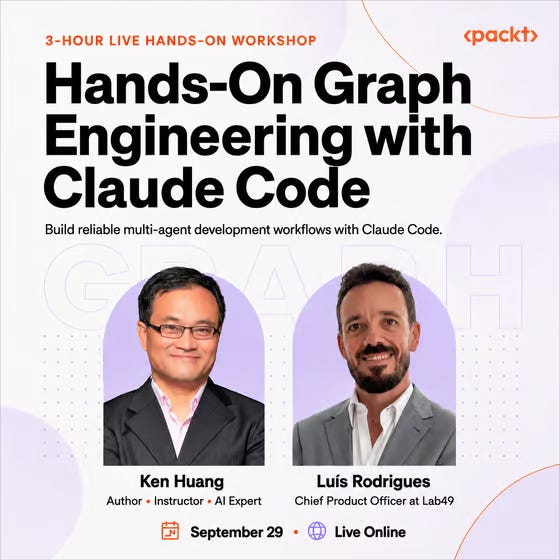
That is what I will cover in my keynote for Hands-On Graph Engineering with Claude Code. I will not follow the hype, and will give you an honest view of what Graph Engineering is.
If you are building with Claude Code and thinking seriously about multi-agent workflows, this is the conversation I think teams need now. The session is on 29 September 2026 at 8:30 AM EDT. Register with code KEN40 on Luma to reserve your seat.
The goal is not maximum autonomy. It is autonomy you can trust.
You may also be able to get one of 3 free one-week Claude Code passes using the link below, courtesy of Anthropic, and if you sign up for a paid plan, I also got some free credit (a big smily face): https://claude.ai/referral/hhWl0hIWDw
The industry is not just adding a new framework. It is changing what "engineering" means.
Traditional software engineering was built for deterministic systems: you specify behavior in advance, encode explicit logic, and expect the same input to produce the same output. SDLC, Agile, DevOps, CI/CD, architecture patterns, testing pyramids, SRE, and secure SDLC all assume that model.
Harness engineering is the corresponding discipline for non-deterministic agentic AI systems. Runtime behavior emerges from a model plus prompts, dynamic context, memory, tools, execution loops, policies, evaluations, and multi-agent orchestration. The engineering job moves from writing every branch in advance to building a deterministic control harness around probabilistic workers: memory files, path sandboxing, hooks, test feedback, permission gateways, observability, and recovery.
I laid out this umbrella frame in Harness Engineering as the Umbrella Discipline. The short version: Agent = Model + Harness. The model supplies judgment. The harness supplies the rails.
Figure 0 shows the paradigm shift I teach in the Packt masterclass: deterministic IT engineering on the left, harness engineering for agentic AI on the right.
Figure 0: Traditional software engineering versus harness engineering
Slide source: Hands-On Harness Engineering with Claude Code, slide 3.
Graph engineering is the July 2026 buzzword, but it is only one sibling craft under harness engineering—not the whole story, and not the top of a replacement ladder.
Under the harness umbrella, five crafts are siblings, not rungs you graduate through:
Prompt engineering— what each agent may say and how it must format output.Context engineering— what information crosses each step; every handoff is a context window.Loop engineering— how one agent improves its work until a stop condition is met.Graph engineering— who hands work to whom, through which routes, with what shared state.Memory engineering— what the system stores as durable facts with sources and timestamps.
Graph engineering is not "the level after loops." A single-agent loop is already a graph with one node and a retry edge. Most production systems should stay there until the work truly needs more structure.
This article goes deep on graph engineering because that is what the keynote and book chapter cover. Everything else in the harness still matters. You cannot bolt permissions, verification, and observability onto a topology you drew as a trend slide.
You need a multi-agent graph when prompts alone cannot answer:
Who may run in parallel, and who owns the merge?
Which paths are allowed, and which actions need human approval?
Which agent may call which tool, and which facts live outside the orchestrator?
How do you resume, version, and prove what actually ran?
A useful design-review question: who decides the next step—the agent or you? Inside an agent node, the agent decides. On the edges between nodes, you decide. If you cannot say which is which for a box on the diagram, delete the box.
Figure 1 shows the category split most teams skip. Execution graphs route work. Memory graphs store facts. Learned graphs hold model weights trained offline. Treating them as one thing is how teams buy expensive retrieval tools and call it orchestration.
Figure 1: Execution graph versus memory graph
To build reliable AI systems, keep three distinct graphs strictly separated:
Execution Graph — How work runs: The workflow engine. It defines task order, state transitions, checkpoints, and interrupts. It dictates what happens next.
Memory Graph — What the system knows: The knowledge base. It stores static facts, relationships, timestamps, and sources. These facts sit still—they do not trigger actions. Graph retrieval queries this graph, but does not control workflow execution.
Learned Graph — How decisions are optimized: Offline-trained model weights. It scores execution traces or reranks memory search results. It never overrides hardcoded safety allowlists, business rules, or human approval steps.
The core rule: Keep a clean boundary between execution and memory. Never merge them. If you let an extracted data fact directly decide workflow routing without going through an explicit validation gate, you introduce untrusted memory into your execution control flow.
Paid subscribers get the graph pattern catalog: start with a single agent, add nodes only with evidence, define structure before picking a framework, and test workflow paths—not just final text. The patterns are what matter. To unlock the full catalog below, subscribe now for 50% off annual membership.