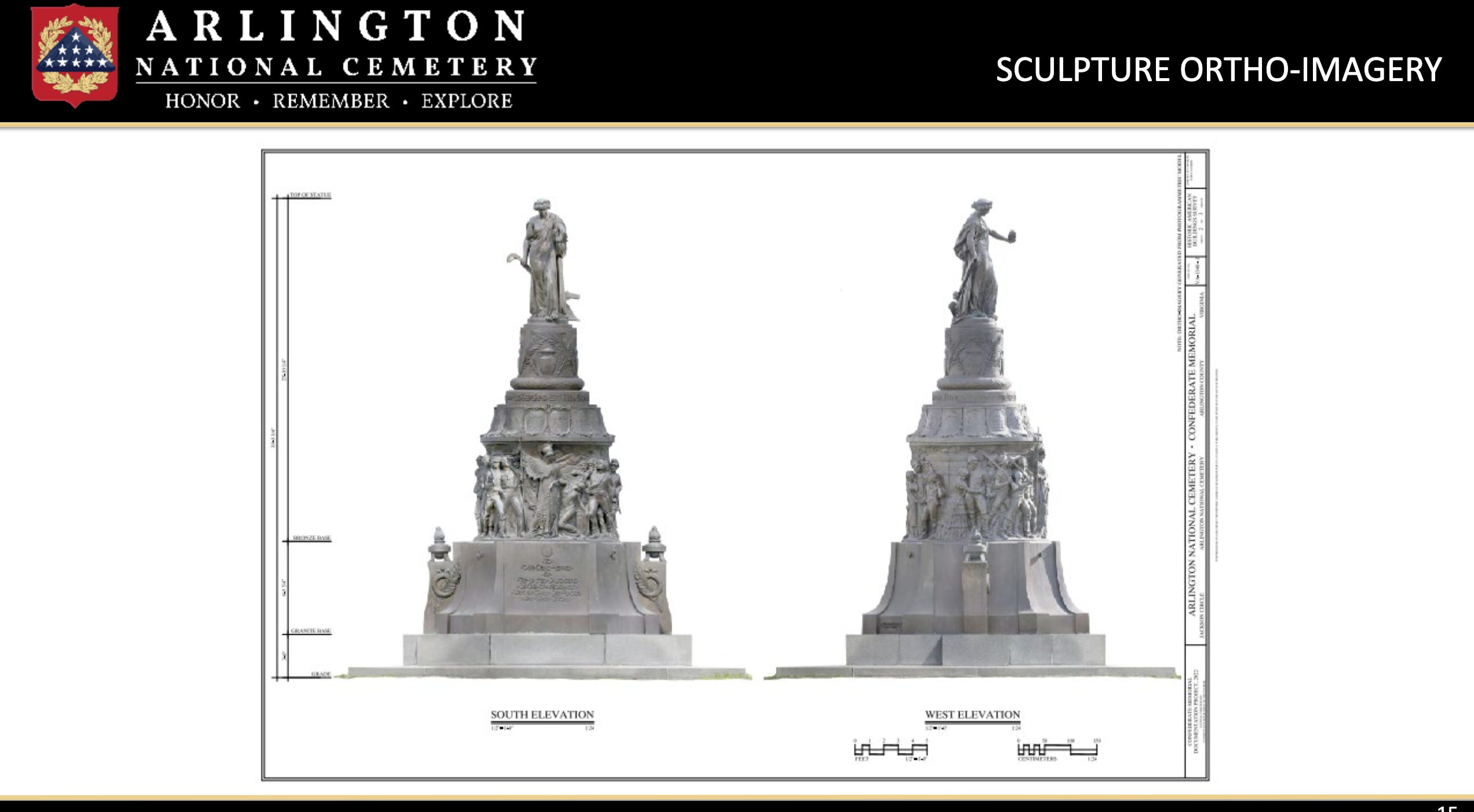
The U.S. Army has released plans for the planned reinstallation of the Confederate monument in Arlington National Cemetery, which was removed by an act of Congress in December 2023. Last year, Secretary of Defense Pete Hegseth announced that the monument will be restored to its original location in Section 16 in 2027.
Hegseth has argued that the monument’s removal was an attempt to "erase" American history, which he attributed to what he called “woke lemmings.”
Part of the planning includes “interpretive content to ensure visitors receive clear, accurate, and factual information regarding the sculpture and the display project.”
While the U.S. Army and Arlington National Cemetery includes qualified historians on staff, there is every reason to believe that the public will not receive accurate information about the history of the monument and Section 16.
Keep in mind that this is the same agency that last year erased numerous pages on its website devoted to the stories of men and women of color and other minorities.
Let’s start with the fact that the report can’t even properly refer to the name of the monument. The United Daughters of the Confederacy, which was responsible for this particular monument, referred to it as “The Arlington Confederate Monument”and never as the “Moses Ezekiel Sculpture.”
The “erasure” of American history begins on the very first page of this report.
The brief description of the sculpture also avoids unpleasant facts about the monument.
Sculpture Description: The completed sculpture will stand approximately 33 feet tall and features a 30-foot-tall bronze sculpture atop an approximately 3-foot-tall polished granite base. The top of the sculpture is a larger-than-life female figure that represents the South. One of her hands rests on a plow, and the other hand holds a laurel wreath. This figure stands upon a pedestal of four urns, each representing one year of the Civil War. Underneath the urns, a frieze decorated with fourteen shields represents each of the eleven Confederate states and the three border states of Kentucky, Maryland, and Missouri. Just below these shields, a bronze bas-relief depicts 32 mostly life-sized figures depicting wartime and domestic scenes. This bas-relief depicts the sculptor’s own interpretation of antebellum southern society. The large bronze base includes three inscriptions and the name of the German foundry where the bronze was cast.
There is no mention of the scenes depicting two “loyal slaves” one in the form of a “loyal mammy” taking the child of a Confederate officer as he leaves for war and the other of a Black man dressed in a Confederate uniform representing an enslaved body servant.
It’s the monument itself that intentionally erased and mythologized history.
And let’s be clear, the symbolism and motifs of this monument are not the result of Moses Ezekiel’s “own interpretation of antebellum society.” Most of what is included had long been established as part of the Lost Cause narrative.
Clearly, the U.S. Army is already avoiding potentially embarrassing references.
We need to stop taking Hegseth’s lead in assuming that this project is about the recovery of history. The restoration of this monument has absolutely nothing to do with that and everything to do with honoring the Confederacy itself.
While many people, including Hegseth, now embrace the language of ‘reconciliation’ to describe this monument, the United Daughters of the Confederacy viewed it as an unapologetic celebration of the Confederacy.
In dedicating this monument in 1914, the UDC proudly declared that the Confederacy was right.
If the U.S. Army follows through with its restoration next year, it will be declaring much the same, all within sight of thousands of white and Black Americans who gave the “last full measure of devotion” to defend this nation and who fought to bring about a “new birth of freedom.”