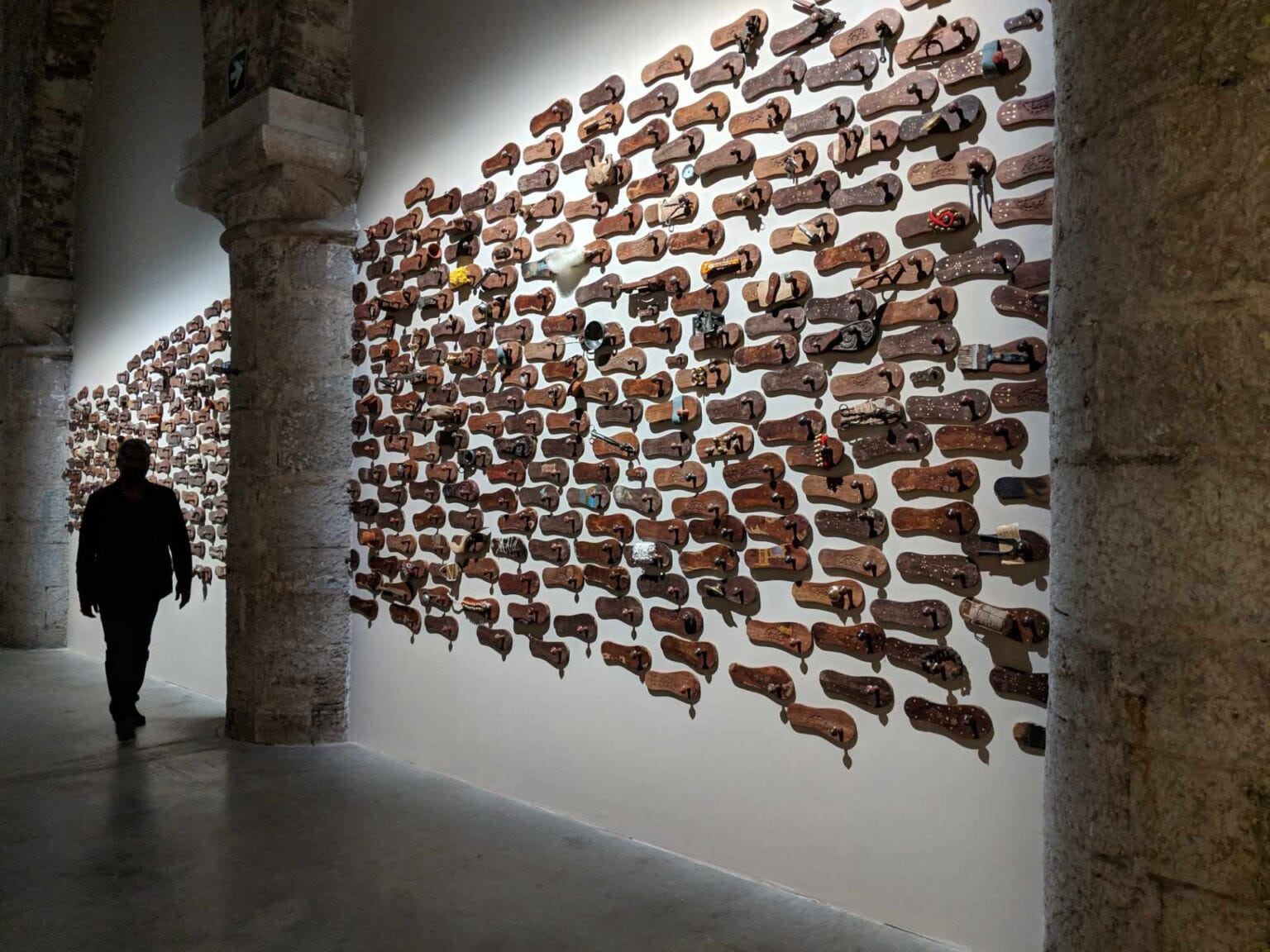
In 2019, the India Pavillion at the 58th Venice Biennale carried a work by GR Iranna — an installation of wooden slippers, resembling the padukas worn by monks, titled “Naavu” — displayed across an entire wall of the venue.
The wooden slipper was an object-symbol, utilised by the artist to indicate the working class, a mass of bodies walking/working together, when he first made the work in 2012.
Seven years later, Roobina Karode, the curator of the India pavilion, reformulated Iranna’s object-symbol to allude to Mahatma Gandhi’s idea of satyagraha, or passive resistance, attained through collective mass action of walking/marching.
Gandhi, it is believed, on an average, walked 20 kilometres every day. During the Dandi March in 1930, for instance, Gandhi and his followers walked over 380km from Sabarmati to Dandi, a coastal town in Gujarat, in 24 days, with several stopovers to spread his message about the unjust British salt laws. Karode’s curatorial framework nodded to Gandhi’s contribution as a peace activist, as 2019 marked 150 years of his birth.
Naavu, which means “we together” in Kannada, worked at both levels: zoom out, and the swarm of slippers was a show of collective strength, a sort of mass action caught in the act, as it were; zoom in, and the distinct nature of each paduka — some with straps, some with ghunghroos, some plain, some decorated — indicated diversity and uniqueness.
In his latest exhibition, Iranna reformulates the object-symbol to indicate the end of civilisations, not to make a nihilistic point but rather to allude to the more generative idea: the ruins that remain preserve the memory of the past. Harking to its association with the monk-scholar, Iranna arranges the paduka — many of which have been burnt down to black soot in this new work — in the form of a wall. Nalanda, Hampi, Vijayanagar… all were great civilisations, with scholars and students, imparting and learning knowledge. Where are they now? Maps have changed. Kingdoms have come and gone. Do we even know what religion meant 1,000 years ago?
This was foremost on his mind, Iranna told me in his New Delhi studio, a few weeks before his solo exhibition organised by Gallery Espace opened at the Bihar Museum, in Patna, on November 21. (The exhibition continues till February 4, and if you find yourself in Patna, do drop in to view the works.)
But, there is another, personal layer to Iranna’s object-symbol.
The son of a farmer from Karnataka, Iranna studied in a gurukul. He remembers his teachers wearing such slippers in the ashram where he and other students lived.
Drawing from the poetry of 12th-century Kannada poet Allama Prabhu, Iranna invokes monumental concepts like the emptiness and hope in his new set of works, which includes paintings and sculptures as well as a sound installation made up of towers of metallic begging bowls — the kind used by Buddhist monks for centuries — with chants emerging from within them.
Allama Prabhu, according to D Nagaraj (translated recently by NS Gundur), was a master of Buddhist thinking: He did not consider sansar and nirvana as different, and in line with Buddhist pratityasamutpada (interdependence), he viewed everything as interconnected, though the mind created maya (illusion).
Iranna’s interpretation of this interconnectedness finds a more material exploration on his canvases. Over the past decade, Iranna has also deployed materials like ash in his paintings. Mixing it with glue, excavating it from under layers of gold paint, Iranna creates something all together new on his oversized canvases.
We encounter these seemingly opposite ideas — grandeur and dust — in most of the works that have been exhibited at the Bihar Museum, including The Witness, To Walk is To Arrive, Lost Golden Stories in Ash, and The Many in One.
Dhamini Ratnam is culture editor at Hindustan Times. Ways of Seeing is her fortnightly newsletter that takes you through only the most important cultural happenings you need to know of. You can write to her at dhamini.ratnam@htlive.com or comment on this newsletter below.