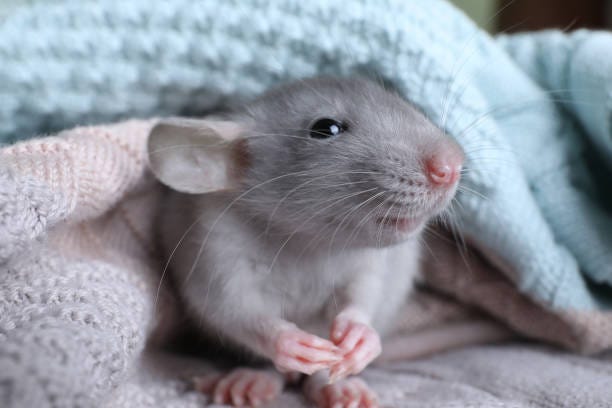
Nobody cares about rats.
In fact, there is almost no issue more bipartisan than not caring in the slightest about the welfare of rats. Almost no belief is more widely shared by the American public than not giving a rat’s ass about…well…a rat’s ass. There are many times more people who think the earth is 6,000 years old than people who care the slightest bit about the welfare of rats.
Rats are about as smart as cats. It’s undeniable that they feel pain; one way we know this is that they have the same brain regions that activate in humans when humans feel pain. Another is that when you try to inflict pain on them, they thrash around horribly—trying desperately to get away. It is obvious when a dog is in pain. It is likewise obvious when a rat is in pain for precisely the same reasons, in exactly the same ways.
They solve mazes and do puzzles. They play and can imagine far-off locations; they display meta-cognition, being able to think about their thoughts. They feel more empathy for one another than we do for them. They engage in self-sacrifice for the sake of their friends. On some cognitive tests, they outscore humans.
But nobody cares in the slightest about rats. We slowly and painfully poison billions of rats to death every year. Often it takes days to kill them. Rethink Priorities noted:
Rodenticides are thought to cause rodents 2-3 days of intense pain before eventually causing death. For example, some types of rodenticides cause symptoms of internal bleeding in rodents: dizziness, abdominal pain, diarrhea, hypothermia, rapid heartbeat, and difficulty breathing. Poisoned rodents often act in ways suggesting that they are in pain, including discontinuing eating, standing in a hunched posture, and wandering into open spaces where they are vulnerable to predators.
Rethink Priorities then polled people on whether they thought this was a better argument for reducing rodenticide use than other arguments. 0% of people thought this was the best argument. People were much more moved by the argument that pets might ingest trace amounts of poisonous rodenticides than the argument that rodents might ingest non-trace amounts and die horribly.
Remember: your rats are like your pets. Rats are as smart as your pets and as conscious. The only difference is how we treat them. Rats are inconvenient to us and they carry disease. From the outside, they are pests. From the inside, the life of a rat is like the life of a cat or a dog. Think of rats as being like dogs trapped in the body of a furry, disease-spreading rodent. I’m reminded of a speech given by Philip Wollen:
I heard the screams of my dying father as his body was ravaged by the many cancers that killed him. And I realised I had heard those screams before. In the slaughterhouse, on the cattle ships to the Middle East and the dying mother whale as a harpoon explodes in her brain as she calls out to her calf. Their cries were the cries of my father. They were identical.
I discovered when we suffer, we suffer as equals. And in their capacity to suffer, a dog is a pig is a bear. . . . . is a boy.
When I look into your beautiful faces tonight I recall the words of the Greek poet Horace “Change only the names and my story is also about you.”
Change only the exterior of your pet, let it loose in the wild, and the story is also about them.
And yet nobody cares. Nobody cares that we are slowly poisoning them to death, so that they die over the course of days—bleeding from their abdomens, struggling to breathe, undergoing horrible, horrible deaths. Because they are inconvenient to us, almost no one in the world has the slightest shred of concern for their welfare. There is perhaps no better demonstration of the inconsistency of our attitudes towards animals.
We say we love animals. In practice, we do not. We only care about their interests when they are convenient to us. Take a being with a mind like a dog, make it so that it’s a pest, and there will be complete unanimity in thinking that it’s totally unimportant that its species is horribly poisoned to death by the billions.
When it comes to animals, there are approximately four kinds of attitudes we have to them:
Pets: we pamper them and care about their interests.
Food and lab animals: we occasionally mutter promissory notes about how important it is to treat them well. Then, we subject them to
literal torturefor their whole lives. In this case, we do not live up to our rhetoric; we say we should treat them well, but we don’t, and most people don’t try very hard to live up to their stated ideals in this domain. (If you would like to help us live up to our rhetoric,remember to applyto incubate an animal charity—deadline is tomorrow).Charismatic wild animals: some wild animals, like gorillas and lions, are charismatic. For this reason, we care moderately about their interests. We at least mildly oppose directly killing them horribly for trivial reasons and are concerned about their populations declining. However, virtually no one thinks their welfare is actually worthy of promotion—while we think we shouldn’t go out of our way to harm them, almost nobody thinks it’s a big deal that, say, deer are often eaten alive by predators over the course of many minutes. When hunters shoot them, we care a lot. When other predators kill them much more painfully, nobody cares. (Note: I am not commenting on exactly how we should improve their welfare. I am merely noting that most people don’t think that their welfare is important in principle.)
Uncharismatic wild animals: the vast majority of wild animals are not charismatic. They’re not cute or maybe they are but they’re inconvenient to us in some ways (mice are cute but nobody cares about them). Thus, everybody agrees that their interests count for zero, we can do whatever we want, harm them however much we’d like, and it doesn’t matter at all. The only thing that might possibly matter is if this threatened conservation goals—if their populations dwindled or they went extinct. But the lives of particular individuals are seen as completely unimportant. If rodenticides caused a million times more suffering—if they made rats undergo experiences much worse than the most painful human death—people still wouldn’t care.
Rats are in the fourth category. The price of our inconsistency is paid in their blood.
My cousins have a dog who we sometimes dog sit. She is very small and cute, nearer in size to a rat than a large dog. When I imagine someone like her being interrupted from innocently playing by a horrible poison, so that she struggles to breathe and bleeds internally and cries out—all alone—and then dies, in horrible pain, over the course of days, it’s just too awful to imagine. Yet that is the situation for rats.
Ultimately, wild animal suffering is complicated. It’s not entirely clear how we should treat rats. But I think the clearest thing is that we should have compassion for them. To completely ignore their interests out of convenience is evil and grotesque—to ignore the rich inner lives of animals, to only consider how they are of use to us. Imagine what it would be like to be these rats, rather than writing off their interests because it is annoying to consider them.
Wilfred Owen famously wrote about the deaths from poisonous gas in World War one. I’m going to quote it. Remember that this is roughly how the rats die (though more slowly), that these are creatures who feel pain just like you and me, and that despite that, absolutely nobody cares.
Dim through the misty panes and thick green light,
As under a green sea, I saw him drowning.
In all my dreams before my helpless sight,
He plunges at me, guttering, choking, drowning.
If in some smothering dreams, you too could pace
Behind the wagon that we flung him in,
And watch the white eyes writhing in his face,
His hanging face, like a devil’s sick of sin;
If you could hear, at every jolt, the blood
Come gargling from the froth-corrupted lungs,
Obscene as cancer, bitter as the cud
Of vile, incurable sores on innocent tongues,