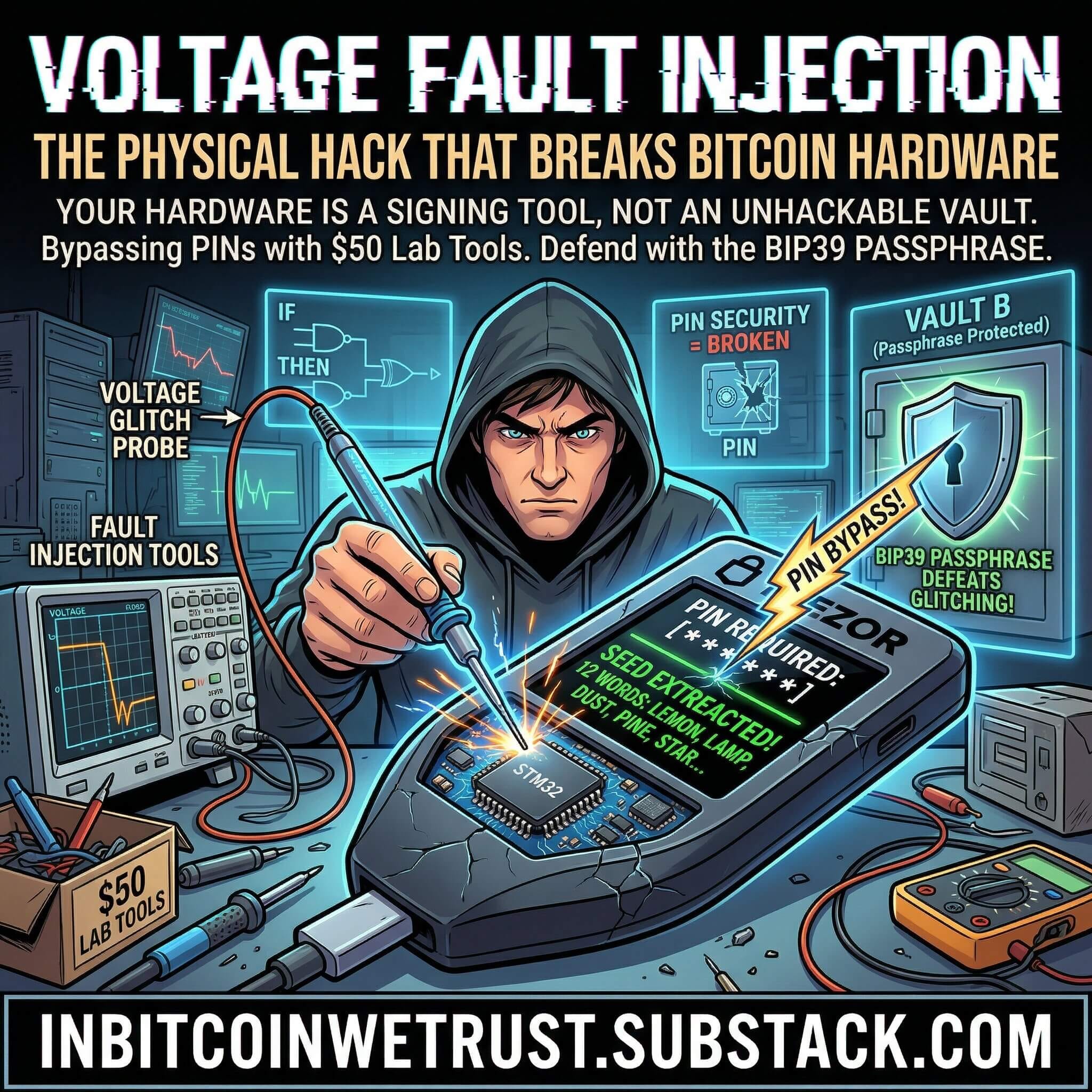
You bought a 100% open-source hardware wallet because you refused to trust corporate black boxes.
But what happens when an attacker physically steals your device and uses laboratory-grade lasers to bypass your PIN?
Here is why your hardware is a signing tool, not a vault—and the one cryptographic trick that saves your stack.
Beyond the Illusions of Omnipotence: How the Trump-Led War on Iran Confirmed that Geography, Industrial Production, and Public Mandate Define Global Warfare.
Let us imagine a highly probable scenario in 2026.
You have done the hard work of unbanking yourself. You withdrew your Bitcoin from the legacy exchanges. You rejected the Wall Street ETFs. You bought a popular, highly recommended, 100% open-source hardware wallet—perhaps a Trezor, a Blockstream Jade, or a similar device built on transparent architecture.
You generated your 12-word seed phrase, stamped it into steel, and hid it perfectly. You locked the hardware wallet itself in a standard home safe. You set a strong 8-digit PIN on the device. You sleep peacefully, knowing that your generational wealth is offline.
Then, the unthinkable happens. Your home is burglarized, or perhaps your device is seized during a legally gray border crossing by customs agents.
You panic for exactly five seconds, and then your heart rate settles. You smile to yourself. They don’t have my PIN,** you think. **The device is encrypted. If they guess the PIN wrong ten times, it wipes itself. My steel plate is safely buried elsewhere. I will buy a new device tomorrow, type in my 12 words, and restore my Bitcoin. I am unhackable.
You are wrong. And depending on the sophistication of the adversary who now holds your physical device, you might be entirely wiped out before you even order the replacement hardware.
The security model you are relying on is based on software encryption. But when an attacker has unlimited physical access to your device, software rules no longer apply. They do not need to guess your PIN. They do not need to hack the cryptographic math of the Bitcoin network.
They just need to attack the silicon.