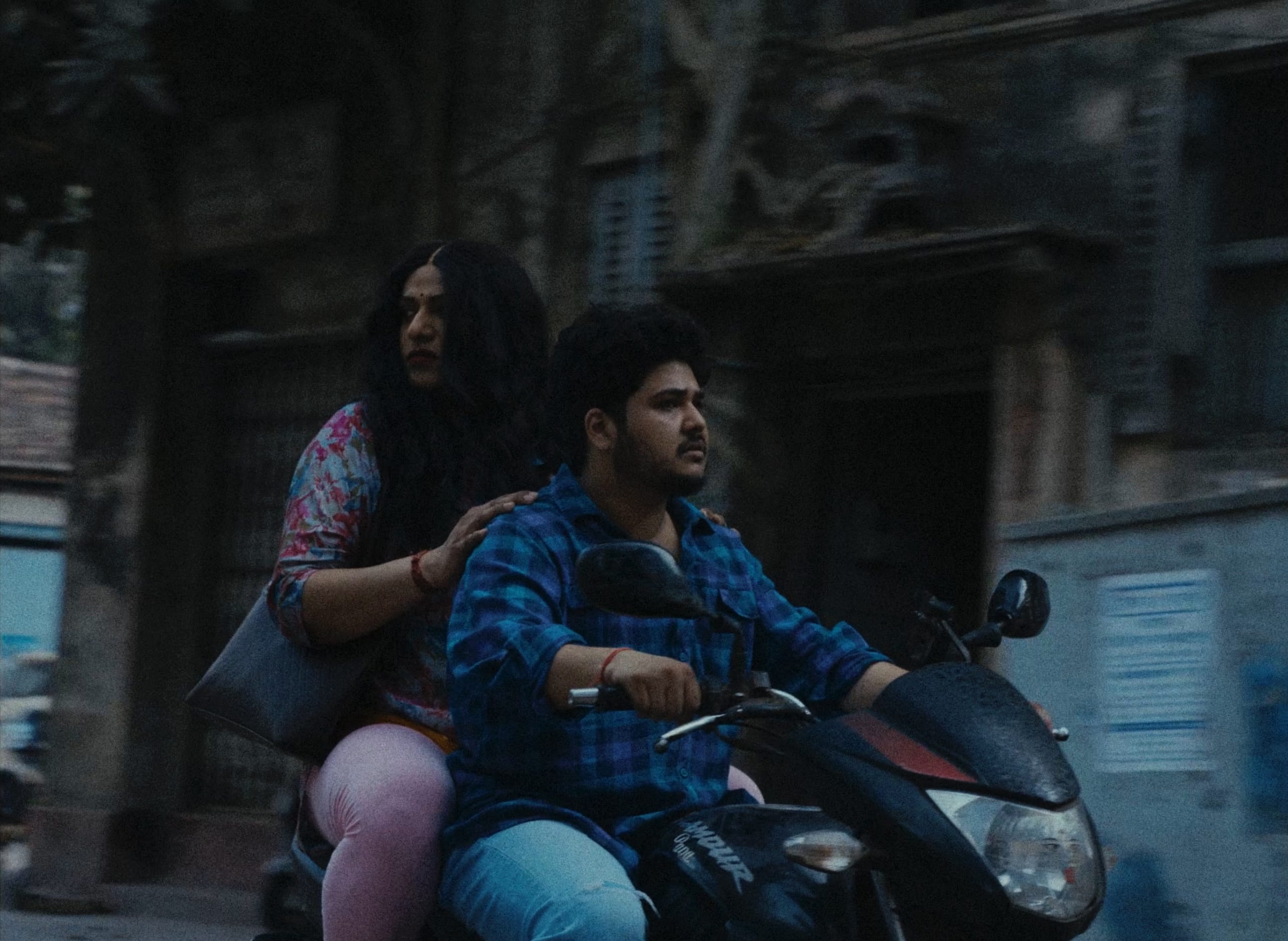
Last week, Rahul Roye’s film, Aman, won the best short film at the BFI London Film Festival. Kabir Maan plays the titular character in the 15-minute film, which also stars Sirat Taneja (a trans woman, who was the subject of I Am Sirat, a 2023 documentary co-directed by Sirat and Deepa Mehta). Aman is revelatory not least because of Roye’s choice of subject — a trans man who discovers he is pregnant on the eve of his gender affirmative surgery — but also because it cracks open conventional masculinity and lays it bare for our examination.
The film starts with Aman having intercourse with another man. Not from the front, we hear him say. His partner insists: Last time, I promise.
There are many kinds of men, the opening shot of the film tells us. Not hearing a “no” may be a common trait among men, but it’s certainly not the only way to be one. Later, in the film, Aman confronts his lover, who asks him for the baby if it is male. “First learn how to be a man before trying to become a father,” Aman spits out angrily and walks away.
“I always imagined Aman to be a guy-next-door, who won’t get a second look if you pass by. I also didn’t want someone very muscular. It certainly would never occur to anyone that Aman is a trans man,” Roye told me, when I spoke to him shortly after his win.
“Pregnancy is one of the most gendered experiences,” said Roye, who identifies as a non-binary person. “I thought that if I put a trans man at the epicenter of a pregnancy, then that will help us explore how fragile our definitions of gender truly are,” Roye said. The film not only drives a wedge between gender and biological sex — not the same, at all — but also displays multiple ways of being a man.
Harjant Gill, an anthropologist living in Washington D.C, recently released his book, Coming of Age in Macholand, nearly a decade after the third film in his trilogy was screened at the Public Service Broadcasting Trust’s Open Frame Film Festival. During the screening of his second film, titled Mardistan, in Mumbai, Gill told me a little bit about how his own notions of masculinity emerged from his upbringing.
“You can’t talk about sexuality without talking about gender,” he had told me at the time. Examining masculinity meant one had to prise these two apart to an extent and his own personal history—the child of migrant parents from Punjab, who chose to leave the country due to the economic and political uncertainty in the region; growing up gay in the United States, finding himself a misfit in the popular notion of a Sikh “mard”—made this an enriching exercise. “These three films make up what (to me) seem like the three most important social/cultural aspects of forming Punjabi masculinities: religion/faith, sex/sexuality, and mobility/transnational migration,” Gill had said.
In his new book, he delves deeper into his own story as well as the lives of the men who form the subject of his research.
The book opens with the story of Sandeep Brar, a 27-year-old man from rural Punjab, who gunned down his family and himself in 2019 after his marriage was arranged by his family. In his final letter, Brar questioned a world in which marriage is the measure of manhood. Gill also narrates the story of a young white man in Dayton, Ohio, who gunned down nine people, including his transgender brother, barely two days after Brar’s shooting spree.
“As I discuss in my book, there’s something disturbingly familiar in the despair and nihilistic rage of the two men from two opposite parts of the globe. Both turned to violence as an exit strategy – not senselessly, but tragically and coherently. Of course, none of this excuses the horrific violence Sandeep committed. Women and children ultimately paid the price for his despair. But his story reveals how patriarchy can make men powerful within the family while leaving them unable to imagine a life outside its script,” Gill said in a recent interview published on his book’s website.
However, Gill also describes a side of patriarchy not many speak about — which is, the emotional intimacy it engenders between cisgendered men growing up.
“Because boys and girls are often kept apart through adolescence, male friendship becomes one of the few places where young Indian men can experience emotional and physical intimacy. Friends spend nearly all their time together. They hold hands, lean against one another, share beds, exchange secrets, and speak about friendship in the language of love and devotion. These relationships can be incredibly tender. Patriarchy permits that intimacy because it assumes the men are heterosexual and that friendship is only preparation for adult life,” Gill said. This, he said, is the tragedy of patriarchy: it creates conditions for deep intimacy between men in childhood, but “fractures” them in adulthood.
Zeeshan Ali, remembers what it was like to come out as queer when they were 19. “My mom said, ‘maradon ke sath mein sona hai to is ghar se nikal ja [if you want to sleep with men then get out of this home].’ We cried and I said, okay, I will leave. I packed my bags and then we cried some more, and then I told her, we can do this differently. We can talk. It took us 10 years of those conversations, fights and arguments, and now we’re at this point where she is okay with me. She is okay with my partner. She treats him like a son, and it’s beautiful to experience that, because the stereotypes of what it means to be masculine is so strongly ingrained, it restricts our acceptance. I have been lucky.”
Ali’s sexuality — and their subsequent fight for acceptance from their family and community — is one part of the story. The other part is their gender expression. Zeeshan is a well-known drag queen, better known by the stage name Zeesh. More recently, Zeesh became a bit of an internet sensation after photographs of them walking through the Dadar flower market in Mumbai went viral. “It was a very mixed feeling,” Zeesh said, when we met at The Lalit in Mumbai, where they work as a programmer for queer events at Kitty Su, the five-star’s nightclub.
“There were some people who were coming at me with such hate, and some people were so enamoured, you could see it on their face!”
Drag, which traces its origins in 16th century English theatre — with men playing women’s roles — is now understood to be a subculture within queer communities, where exaggerated role-playing, bending gendered stereotypes, using make-up and fashion all form part of the drag persona. However, to reduce it to an individualistic act is to deny the very real power of community that sustains drag artists. Kitty Su, with its regular drag show nights, is among a small group of employers who provide a steady source of income to a handful of such artists. Zeesh said that they have received offers to be on magazine covers, host award shows, shoot videos for Pride collectives, and recently hosted a night of remembrance for the singer Dolly Parton at Kitty Su, Mumbai. “For a young Muslim boy growing up, I would have never imagined this to be possible,” they said.
Dhamini Ratnam is culture editor at Hindustan Times. Ways of Seeing is her fortnightly newsletter that takes you through only the most important cultural happenings you need to know of. You can write to her at dhamini.ratnam@htlive.com or comment on this newsletter below.