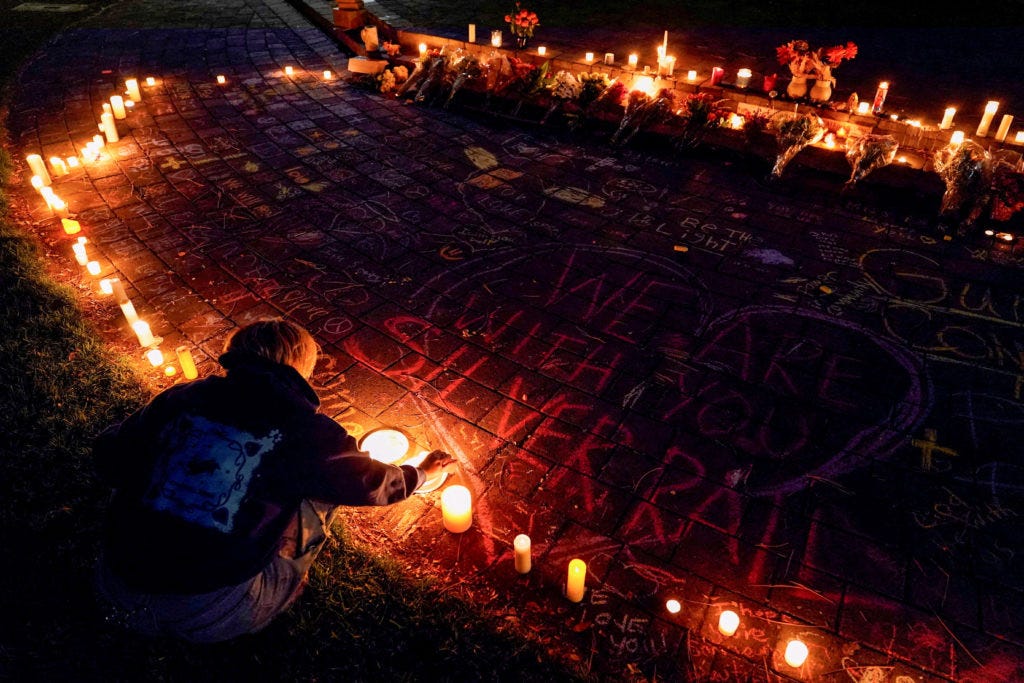
Three children. Ages five, eight, and eleven. And a teacher.
That’s how many innocent people were murdered Thursday at Silver Rail Elementary School in Bend, Oregon.
The shooter was sixteen years old.
According to police, he fired through locked doors to get inside the school and started killing people. Another child and teacher were critically injured. Within approximately three minutes of the first 911 call, police were on the scene.
But somebody else got there first.
A member of the community who witnessed the shooter entering the building followed him inside, confronted him, and shot him dead.
Think about that for a second.
The school had locked doors. The police responded almost immediately. And the proverbial good guy with a gun actually fucking showed up.
Four innocent people still died.
I want to be absolutely clear about something. The person who intervened deserves our gratitude. What they did required an extraordinary amount of courage. They put their own life on the line to protect children and teachers they may not have even known. And their actions may very well have prevented an even greater loss of life.
But I can’t stop thinking about the fact that somebody had to do it in the first place.
We’ve reached a point in this country where we can look at four murdered people, including three little kids, and talk about how fortunate we were that the shooting wasn’t worse.
And that’s a pretty fucking horrifying standard for success.
I spent twenty years in law enforcement. I understand the importance of responding quickly to an active threat. I understand the necessity of being prepared to use deadly force when innocent lives are in immediate danger. And I understand that sometimes stopping a violent individual means somebody else has to put their life on the line.
But I also understand something that gets lost in virtually every conversation we have about mass shootings.
Stopping a killer isn’t the same thing as preventing a killing.
By the time somebody walks into an elementary school carrying a shotgun and starts murdering children, we’ve already lost our best opportunity to prevent the violence.
At that point, we’re reacting to a catastrophe. We’re trying to stop the bleeding, literally and figuratively.
And sometimes, even when everything goes right with the response, people still die.
So maybe it’s time we started talking about what happens before the first shot is fired.
We Can’t Legislate Our Way Out of Every Tragedy
Every time there’s a mass shooting in America, we have the same goddamn conversation.
One side demands more gun laws. The other side argues that we need more armed security. Politicians offer their thoughts and prayers. Everybody retreats into their respective corners, and within a few weeks, we’re right back where we started.
Until the next shooting.
Oregon already has substantial gun regulations on the books. Background checks. Safe-storage requirements. A process for restricting firearm access when someone presents a serious danger. Voters also approved additional restrictions under Measure 114, although implementation has been delayed.
I’m not suggesting these laws don’t matter. They do. And I’m certainly not arguing that we should stop trying to keep deadly weapons out of the hands of dangerous individuals.
But there’s a limit to what legislation alone can accomplish.
You can pass another law. Put another lock on a classroom door. Install another security camera. Hire another armed guard.
You can conduct a thousand active-shooter drills and teach kindergarteners how to barricade themselves inside their classrooms.
But none of those things, by themselves, addresses the person who has decided to commit an act of mass violence.
And that’s the conversation we desperately need to have.
Because there is a human being behind that weapon. Somebody with a history. Relationships. Grievances. Behaviors. Access to people who may know them better than anybody else.
And sometimes, long before they become a murderer, that person starts showing signs that something is seriously fucking wrong.
Mass Shooters Don’t Just Snap
This isn’t speculation. It’s something federal law enforcement has been studying for years.
The FBI’s Behavioral Analysis Unit has examined the behaviors of individuals who commit acts of targeted violence. And one of the conclusions of that research is that these attacks frequently aren’t spontaneous.
People often spend time thinking about violence. Planning it. Preparing for it. Sometimes communicating their intentions to others.
The United States Secret Service studied 41 incidents of targeted school violence between 2008 and 2017. In that study, 89 percent of the attackers had exhibited objectively concerning or prohibited behavior that somebody else observed before the attack.
Let that sink in.
In nearly nine out of ten of those cases, somebody had observed behavior serious enough to warrant intervention.
That doesn’t mean those people knew a shooting was coming. It doesn’t mean every attack could have been stopped. And it certainly doesn’t mean everyone who knew the attacker bears responsibility for what happened.
But it does mean there were opportunities for intervention that deserve a hell of a lot more attention than they’re getting.
Now, before somebody twists what I’m saying, let me make something clear.
I’m not talking about profiling every socially awkward teenager or treating somebody suffering from depression like a future mass murderer.
Mental illness is not synonymous with violence. Most people struggling with mental health issues will never hurt anybody.
And the FBI itself makes clear that no single behavior predicts whether somebody will commit an act of targeted violence.
I’m talking about credible threats. Detailed plans to hurt people. A growing fixation on committing violence. Attempts to acquire weapons in connection with those threats. Behavior that suggests someone is moving beyond anger or fantasy toward actually carrying out an attack.
Those are things we need to teach people to recognize.
Not so they can play detective.
So they know when to ask for help.
And here’s the critical point.
The first person to notice something may not be a cop, a therapist, or a teacher.
It might be a parent.
A sibling.
A friend.
Somebody who loves the person exhibiting those behaviors.
And that can make doing the right thing a hell of a lot harder.
Sometimes Loving Somebody Means Making the Hardest Call of Your Life
Imagine being a parent who starts to suspect your own child might be dangerous.
Maybe you’ve discovered credible threats they’ve made online. Maybe they’re becoming fixated on carrying out violence. Maybe you’ve found evidence of a plan, or you’ve noticed that their behavior has escalated beyond anything you can reasonably dismiss as teenage anger.
What do you do?
Who do you call?
How do you know whether your child is genuinely dangerous or simply going through a terrible period in their life?
And what happens if you report them?
Are you getting your kid help? Or are you handing them over to the criminal justice system? Are you protecting your family, or potentially tearing it apart?
Those are terrifying questions for any parent.
And I understand why somebody might want to convince themselves that everything is fine.
Because the alternative means confronting the possibility that someone you love could be capable of doing something absolutely horrific.
But love cannot become an excuse for ignoring a credible threat.
Sometimes protecting your child means protecting other people from your child.
And sometimes the greatest act of love you can demonstrate is intervening before that person does something they can never take back.
We need to make it easier for families to do that.
People need to know where to turn when they’re concerned about someone they love. They need to understand how to seek a professional threat assessment, what kinds of interventions might be available, and when law enforcement involvement is necessary.
And they need to trust that raising a concern won’t automatically mean criminalizing somebody who’s struggling.
Because if the only options people believe they have are doing nothing or calling the cops, some of them are going to choose to do nothing.
And that’s a problem we can actually work to fix.
We Teach Children How to Survive Shootings. Why Aren’t We Teaching Adults How to Prevent Them?
Think about the amount of time and energy America has invested in preparing for the next school shooting.
Children practice lockdown drills. Teachers receive active-shooter training. School districts develop emergency response plans. Police departments rehearse how to enter buildings and neutralize threats.
All of that serves a purpose.
But how much comparable energy are we investing in teaching ordinary people how to recognize and report the warning signs of targeted violence?
How many parents have received meaningful education about what those behaviors actually look like?
How many families understand what to do if they discover their child is making threats?
How many teachers know exactly where to bring a concern, and have confidence that somebody qualified will take it seriously?
How many communities have accessible, multidisciplinary teams capable of evaluating those reports and helping people before the situation reaches a crisis?
Because those systems aren’t some fantasy.
Behavioral threat assessment is an established approach to preventing targeted violence. It brings together professionals from different disciplines to evaluate concerning behavior and determine what kind of intervention is appropriate.
Sometimes that means connecting somebody with mental health services. Sometimes it means working with their family or addressing an escalating grievance. Sometimes it means making sure they can’t access a firearm.
And sometimes, when a credible and immediate danger exists, it means involving law enforcement.
But the objective should be the same.
Intervene early enough that nobody has to pull a trigger.
The FBI has already developed a public awareness campaign called Prevent Mass Violence, encouraging people to recognize concerning behavior and report it to somebody they trust.
The Secret Service and federal school safety agencies have published guidance on creating effective reporting programs.
So the information exists.
What I’m asking is why we haven’t made it a much more visible part of everyday American life.
Why aren’t we discussing this at parent-teacher meetings? Why aren’t school districts regularly educating families about how to report concerning behavior? Why aren’t we investing in community workshops, public awareness initiatives, and clear pathways for people to get help?
If we can teach a six-year-old where to hide when somebody starts shooting, we can damn well teach adults when and how to speak up before it happens.
Mental Health Professionals Can’t Help Somebody They Don’t Know Is in Trouble
There’s another familiar response we hear after every mass shooting.
We need better mental health care.
And yes, we absolutely do.
We need a system where people can get affordable, timely treatment, particularly when they’re experiencing a serious crisis.
But mental health care isn’t some magic fucking solution that absolves everybody else of responsibility.
A therapist cannot intervene in a situation they don’t know exists.
A psychiatrist cannot evaluate somebody who never comes through the door.
And no clinician has a crystal ball that allows them to predict who will commit an act of mass violence.
We need to recognize the limitations of these systems while doing everything we can to improve them.
That’s where families, friends, schools, and communities come in.
The people closest to somebody may be the first to recognize that they’re moving toward violence. They may hear the threats, discover the plans, or witness the escalation.
But noticing something is only the beginning.
They need the knowledge to understand why it’s concerning. They need the courage to report it. And they need access to professionals who can evaluate the situation and respond appropriately.
We shouldn’t expect ordinary Americans to become psychologists or criminal profilers.
We should expect our society to give them the tools to recognize when something is wrong and the confidence to do something about it.
That’s not replacing government responsibility with individual responsibility.
It’s recognizing that one doesn’t work nearly as well without the other.
We Should Never Have Needed Somebody to Be a Hero
There are still a lot of unanswered questions about Thursday’s shooting in Oregon.
We don’t yet know what motivated this sixteen-year-old. We don’t know whether he exhibited warning signs or whether anyone had an opportunity to intervene before he attacked that school.
Maybe there were signs.
Maybe there weren’t.
Maybe somebody tried to get help.
We owe it to the victims and their families to establish those facts before assigning blame.
But we don’t need to know every detail of this particular case to recognize the larger problem.
Our national approach to school shootings remains overwhelmingly focused on what happens when somebody starts killing people.
How fast can police get there? How secure are the doors? Is there somebody armed nearby who can stop the shooter?
Those are legitimate questions.
But they’re questions about surviving a failure of prevention.
And on Thursday, a member of the Bend community was forced to answer them in the most terrifying circumstances imaginable.
That person stepped forward when innocent people desperately needed somebody to act.
I’m grateful they did.
But I keep coming back to one question.
What if we spent as much time teaching people how to recognize and interrupt the progression toward violence as we spend preparing them to confront it?
What if every parent knew exactly where to turn when they became afraid their child might hurt somebody?
What if teachers, friends, classmates, and family members understood that reporting a credible threat isn’t betraying someone they love?
What if we built systems that encouraged people to come forward before the warning signs became a tragedy?
We will never prevent every act of violence. Anyone promising otherwise is full of shit.
And no amount of training will allow us to predict with certainty what every troubled or angry individual might do.
But that’s not an excuse to ignore the opportunities we do have.
Preventing mass violence has to become a shared responsibility.
Not just the responsibility of lawmakers. Not just police officers. Not just mental health professionals.
Ours.
As parents. As friends. As siblings. As neighbors. As members of a community.
And that responsibility becomes especially important when speaking up means having a difficult conversation about somebody we love.
Because it’s one thing to recognize danger in a stranger.
It’s another thing entirely to recognize it in your own home.
Three children and a teacher are dead in Oregon.
Three kids who should have gone home to their families. A teacher who should have finished the school day and returned to their own life.
Instead, their families are facing a grief that no parent, spouse, sibling, or loved one should ever have to experience.
We were fortunate that somebody had the courage to confront their killer.
But the next time we’re congratulating ourselves because an armed citizen or a police officer managed to stop a school shooter, I hope we’ll ask a more important question.
Why did we have to rely on somebody risking their life to stop this in the first place?
We cannot keep waiting until the floors of another American school run red with the blood of innocent children and educators before deciding that someth…