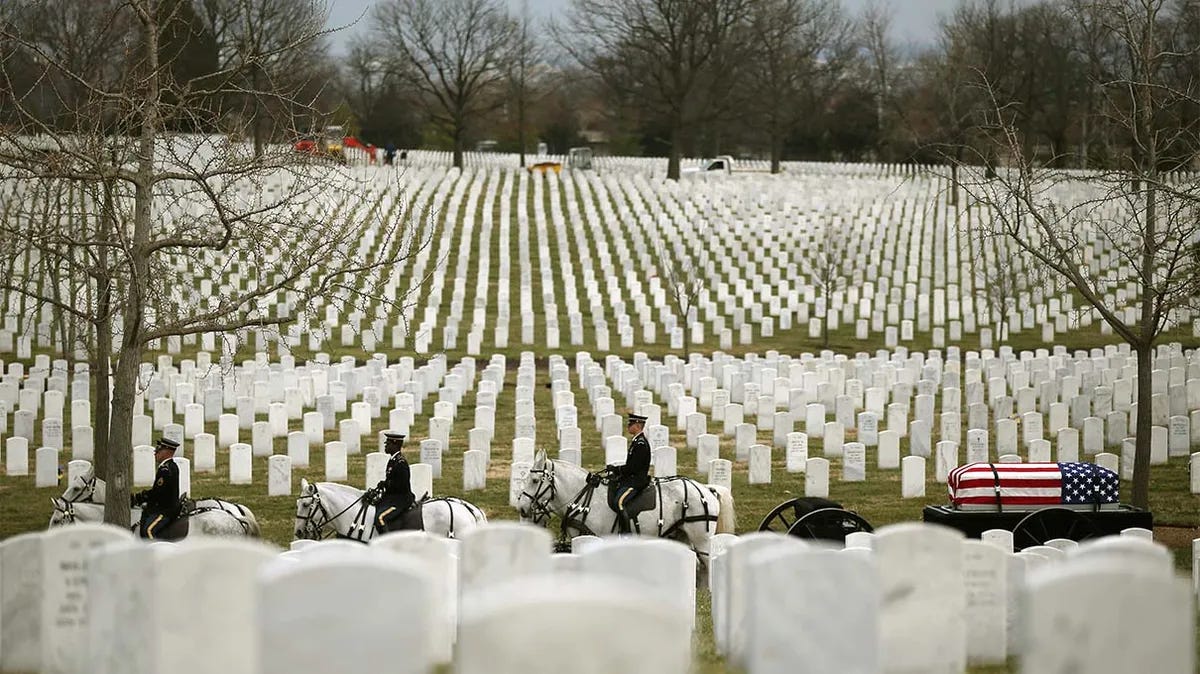
Arlington National Cemetery is a complicated landscape, layered with history and memory that remain silent, marginalized or distorted. Those silences have always been choices made by those with the power to impose a narrative on what are now hallowed grounds.
That complexity rarely reveals itself to visitors. Row upon row of graves, beginning with the thousands of Union soldiers who dominate the “field of the dead” and other spaces announces the purpose of the site. It is a resting place for the men and women who have served and paid the ultimate sacrifice in defense of the nation.
In the beginning it was indigenous land before it became a working plantation with hundreds of enslaved men, women, and children owned by George Washington Parke Custis, the adopted grandson of President George Washington. Visitors can catch a bit of this story at the top of the hill. After decades of silence on this subject, the National Park Service now interprets this history in some of the outbuildings behind the Custis-Lee mansion. It is a meaningful step in the right direction.
But for those visitors, who take the time to learn, the stories of the Syphax, Burke, Parks, and Gray families, there are countless other stories and facts that remain obscure. How could anyone really envision the grounds of Arlington as a working plantation while strolling past the Tomb of the Unknown Soldier and the graves of prominent Americans from nearly every generation?
These were all the result of choices made.
By the end of the Civil War, Arlington had been set aside as a final resting place for the citizen-soldier who gave “the last full measure of devotion” to saving the Union. African American men, who answered that same call, were buried in a segregated section then referred to as the “Lower Cemetery.” Even today, few visitors make it over to what is now called “Section 27.”
For decades after the war, formerly enslaved people lived and worked at Freedmen’s Village on the grounds of Arlington. It was here that they made meaning of freedom by attending school, church, and even by voting. Nothing remains of it today.
In 1914, a choice was made to honor hundreds of Confederate soldiers, who gave their lives as part of an attempt to destroy the United States and protect the institution of slavery. A massive memorial was dedicated to their memory and in celebration of the Confederacy and its “loyal slaves.” In contrast to the Black soldiers buried in the Lower Cemetery, the Confederate section was placed in a prominent location that would be impossible to miss.
In December 2023, Congress decided to remove it through the Naming Commission. In early 2025, the Trump administration announced that the memorial would be returned to its original location in 2027. In preparation for that return, the staff at Arlington deleted text from both its website and a wayside marker located at the Confederate section that educated visitors about the memorial’s complicated history.
In the coming weeks, the Trump administration will likely begin the construction of a massive memorial arch that will block one of the most iconic views of Arlington National Cemetery from across the Potomac River in Washington, D.C.
All choices.
In Arlington National Cemetery we can see our most noble instincts directed toward our collective responsibility to remember those who came before us. Few places in this country that can do that.
But Arlington has also drawn out our worst instincts of racism, fear, and the use of history merely to divide Americans for political purposes.
The choice to honor and the choice to erase have never been separate impulses at Arlington National Cemetery. They are two expressions of the same power, exercised again and again over more than a century and a half. Understanding the cemetery, and the nation it represents, means refusing to look away from either one.