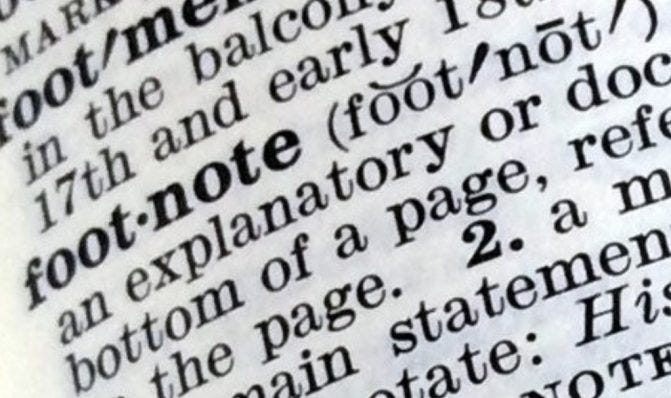
I recently picked up a book that I later learned had no footnotes or endnotes and no bibliography. It came as a real shock to see such a book without any references, especially since the author holds a PhD in history and has a substantial following on social media.
We’ve seen this more and more, particularly from large trade presses that are looking to minimize costs and book length. Historian Karen Wulf lamented their absence a decade ago. In this tightening book market, I get it, but it also seems to me that we are sacrificing something essential in the production of history and historical narratives.
Footnotes or endnotes constitute a roadmap for how an author arrived at her conclusions. History isn’t produced in a vacuum. It is built on the work of those who came before as well as on a wide range of archival or primary sources. They transform a story into provable, verifiable scholarship rather than a work of fiction or opinion. They allow readers, critics, and fellow historians to trace a claim back to its original source to see if the author interpreted the evidence honestly and reliably.
But notes are not just for simple citations. They give historians a space to offer side-commentary, address conflicting accounts, or explain subtle nuances that would interrupt the flow of the main narrative.
Historians have no independent access to historical truth, but the inclusion of a proper reference section indicates the intention on the part of the author, specifically the intention to say something truthful about the past.
This is especially important at a time when history programs are being canceled and a president routinely demonizes public historians in the National Park Service and Smithsonian. Our discipline has increasingly become politicized. The result is a public that, I fear, has little understanding of what it is that historians do when they research and write. In short, when they do history.
I do think that, as historians, we have a responsibility to stand up for our craft. This includes demanding that our publishers acknowledge the necessity of including a proper reference section.
As for the book referenced above, it is still sitting on my shelf unread.