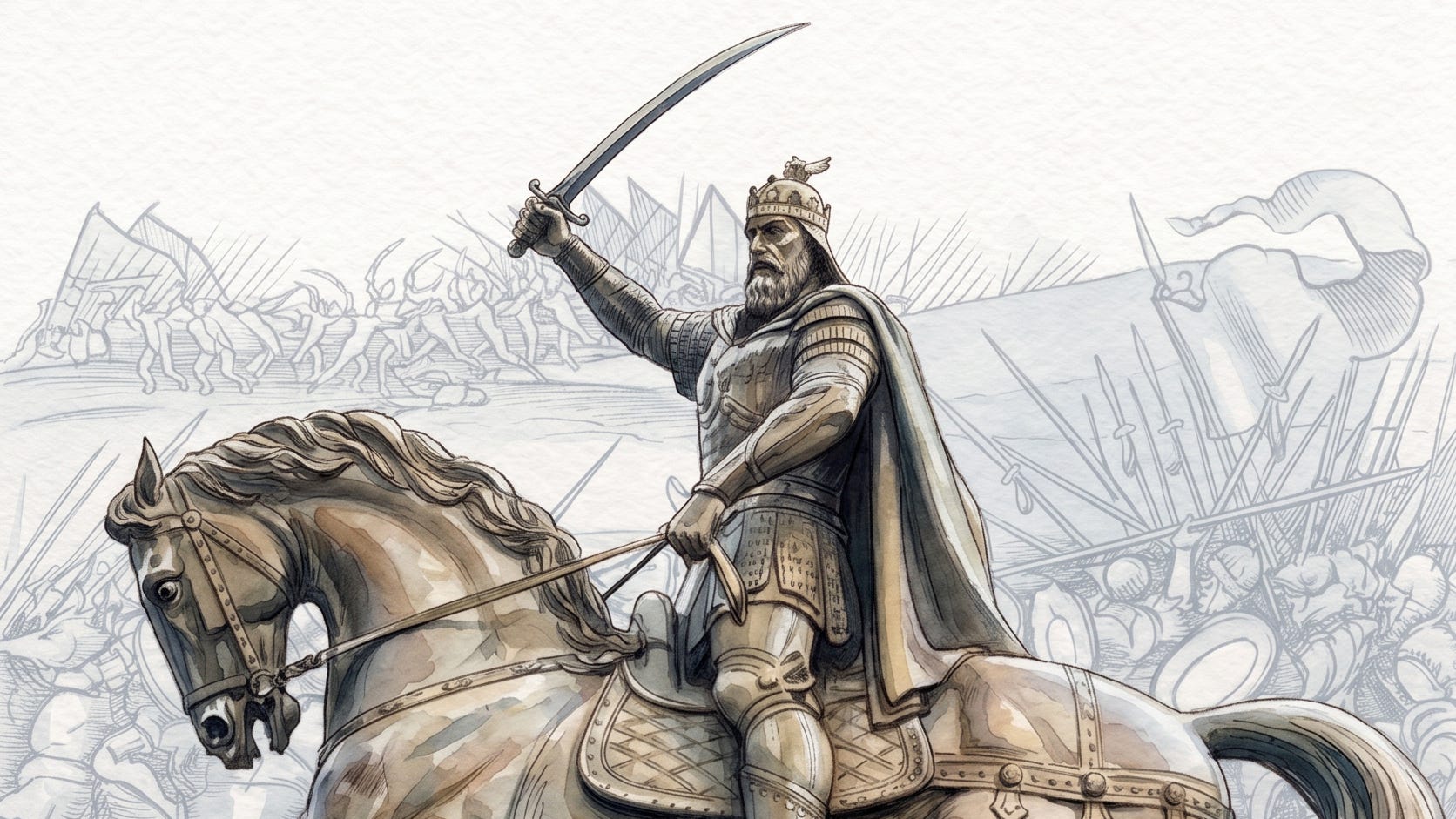
KRUJË, ALBANIA—Everyone in this country of sea and mountains, Christianity and Islam, tradition and tolerance, and vibes that bridge Greek and Italian, has told me about Skanderbeg, the national hero.
I knew nothing about this 15th-century mountain chieftain. I came to Albania firstly because it is outside the Schengen zone, because it is friendly to Ukraine and thin on Russians, and because after four years of war I needed somewhere to rest and recharge for whatever fresh hells are coming.
After just a few days in the capital, Tirana, I was not only seeing Skanderbeg’s name on signs and squares but hearing it everywhere. A woman who works with Western think-tanks told me to read about him. So did several bartenders, and a taxi driver, and the man who sold me water. *Read about Skanderbeg, everyone said. *So I did: Harry Hodgkinson’s Skanderbeg.
Today Skanderbeg is chiefly known to Albanians. In the 1400s he was in demand across Europe—Pope Calixtus III called him Athleta Christi, the Athlete of Christ. And in the chambers of Mehmed II, the Ottoman sultan, he was both feared and respected. He became, indeed, the wall preventing Turkish conquest of Christendom.
I spent days reading about Skanderbeg from the ruins of the castle at Krujë where he was born—and which he later would fortify as a point defending all of Europe from Turkish invasions. He repeatedly requested European troops for reinforcement. Only after his death, unprotected by their Albanian chieftain ally, did the Venetians at last send troops to his stronghold.
Through the windows of my inn in the castle of his birth, I could see the plains and the coastal towns where early renaissance history played out: the Venetian seaports, the passes through which the Ottomans invaded, and the wild mountains in which Christendom was defended.
George Kastrioti was reportedly—though there is dispute about this—taken from his Christian Albanian family as a boy and sent to the Ottoman court, where he was converted to Islam, trained as a soldier (the Christian soldiers forcibly converted to Islam, known as Janissaries), and given the name Iskander—Alexander—with the rank of bey: Lord Alexander, that is, Skanderbeg.
In 1443 he rode away from an Ottoman army in the field, went home to the mountains north of what is now the Albanian capital, Tirana, and raised his father’s flag over the castle on the rocky outpost at Krujë. He began the resistance to the Turks.
For the next twenty-five years he kept the largest military power on earth out of Albania, and by extension out of Italy, Austria, and the rest of Europe. Sultan Murad II came in person and failed. Mehmed II, who had taken Constantinople, came and failed. The Ottomans besieged Krujë four times and never took it while Skanderbeg lived.
He had a country of perhaps half a million people. He fought with the terrain, struck supply lines, refused the battles he could not win, and changed his methods faster than a massive empire could change its own.
While he held, the Ottoman advance into Europe stopped at the Adriatic.
He died of a fever, possibly malaria, at Lezhë on 17 January 1468, aged sixty-four or so. With 12 years after the shield was buried, the invaders Skanderbeg had been holding back were in Italy.
Krujë fell ten years later. The northern Albanian lakeside city of Shkodër fell the year after that. In the summer of 1480 an Ottoman fleet crossed the Adriatic and landed at Otranto, on the heel of Italy. The city was taken, the archbishop was killed in his own cathedral, and 813 men were beheaded on a hill outside the walls for refusing to convert. The Church canonized them in 2013 as the Martyrs of Otranto.
In Rome, with the Turkish threat growing, Pope Sixtus IV considered fleeing to Avignon.
What stopped the advance on Naples and Rome was not an army. Mehmed II died in May 1481, his sons fell to fighting each other over the throne, and the garrison at Otranto was left to its own devices. The Italians retook the city that September.
“I CAN TELL HE IS BALANCED FROM SENTENCE ONE”
Skanderbeg had been so vital to the defense of Europe, and so feared by those who sought to break Europe, that throughout the centuries tributes with varying degrees of myths have been written—most notably by Marin Barleti, a priest from Shkodër, whose Latin life of him appeared in Rome around 1508 and was translated across Europe.
The book I was carrying is Harry Hodgkinson’s Scanderbeg: From Ottoman Captive to Albanian Hero, published in 1999.
I showed it to the keeper of an antique shop and Albanian history expert here in the stone mountainside city of Gjirokaster, up a lane off the bazaar. He opened it, read for about fifteen seconds, and handed it back.
“I can tell he is balanced from sentence one.”
Why?
“Because he starts off describing Albania, rather than by overly praising Skanderbeg.”
Hodgkinson, who oversaw Albania and Yugoslavia for British naval intelligence under Ian Fleming during the Second World War, and who as a young man walked from Charing Cross to Jerusalem, opens the life of a national hero with a description of limestone.
I read most of the book in Krujë, in an inn built into the castle ruins, looking down at the plain those armies crossed and past it to the Adriatic and the old Venetian ports. You can see the whole argument from up there.
THE ATHLETE OF CHRIST
Popes and princes across Italy knew Albania under Skanderbeg was the shield of Christendom, the wall behind which the rest of Europe tried to go about its business.
They meant it, and they paid for it—subsidies from Rome and Naples, grain and supplies from the Republic of Venice, a formal alliance with Alfonso of Aragon, King of Naples, sealed at Gaeta in 1451. This was not charity. Everyone understood that the route to Rome, Buda, and Vienna ran through Albania, and they were buying a buffer.
What they would not do was send an army.
The crusades meant to relieve him were announced, funded, postponed, abandoned. At Mantua in 1459, Pius II summoned the princes of Christendom to a crusade. Few came, and fewer committed.
Pius II died at Ancona in 1464 waiting for a fleet that never assembled.
He warned them. He wrote, sent envoys, and wrote again. A man in his position fights two wars, and the second one is fought with paper.
EUROPE'S SHIELD, AGAIN
I have spent four years reporting from a country described, in almost exactly the same words, as Europe’s shield.
Ukraine is a country on the edge, holding the line for Europe and the free world against barbaric invaders (at least the Ottomans had a civilization). Ukraine receives weapons yes but the West as in the days of Skanderbeg is happier to send thoughts and prayers. Aid arrives late and smaller than promised, subject to the domestic politics of countries that are not being bombed yet. Some Western partners still have commercial interests on the enemy’s side. Strongly-worded warnings sent and filed.
And underneath all of it, never quite said aloud, the assumption that the shield will hold because it has held so far.
Here is what Skanderbeg understood and the courts of Italy did not.
**A shield is not a feature of the landscape. It is a man, or a nation of people, doing something extremely difficult at enormous cost. **
We publish this newsletter every day at 9:05am NYC time / 4:05pm Kyiv.Your subscription fuels our work.
*JP Lindsley, an American journalist based in Ukraine, is co-founder and editor-in-chief of UnderFire.News. *
What else we’re watching today:
Moscow’s Election Day Ends Under Ukrainian Drones—Ukraine has struck Moscow with what Russian authorities described as the largest drone attack on the capital since the war began. Moscow’s mayor claimed that 450 drones were intercepted around the city, while Russia’s Defense Ministry reported more than 1,100 interceptions nationwide. Some nevertheless reached the capital, setting its major oil refinery ablaze, striking other infrastructure, and forcing all three principal Moscow airports to suspend flights.
The operation coincided with the final day of Russia’s stage-managed parliamentary elections, turning a ritual intended to advertise Kremlin control into a demonstration of the state’s vulnerability. The refinery alone processed 11.6 million metric tons of crude in 2024, making it both an economic target and a highly visible symbol.Russia Holds an Election Without a Choice—United Russia has retained its overwhelming control of the State Duma after Russia’s first parliamentary election since the full-scale invasion of Ukraine. With more than 95 percent of ballots counted, Vladimir Putin’s ruling party received 57.83 percent of the vote and was projected to win 355 of 450 seats—enough to preserve its constitutional majority. The result exceeded its 2021 performance, but it cannot be treated as a normal measure of popular support. The anti-war Yabloko party was barred from the ballot, serious opponents have been imprisoned, killed, or driven abroad, electronic voting operated without meaningful scrutiny, and no OSCE observation mission was invited.
Voting was also conducted in occupied Ukrainian territories that Moscow claims to have annexed. The remaining parliamentary parties offer different brands of nationalism, communism, or managed criticism, but none presents a credible challenge to the war or Putin’s rule.
A massive Ukrainian drone attack on Moscow during the final day supplied an unintended counterpoint to the Kremlin’s ceremony: oil infrastructure burned and airports closed while the state staged a demonstration of complete political control.Chinese Materials Feed Russia’s Expanding Drone War—Internal documents indicate that Russia plans to expand production of the carbon fiber used in Geran attack drones, potentially enabling another 28,000 airframes annually. Rosatom’s sanctioned Alabuga-Volokno plant in Tatarstan is preparing a new production line capable of manufacturing 500 additional tons of aerospace-grade carbon fiber each year by 2029. One expert estimates that this could increase Russia’s output of weaponized drones by 78 percent, on top of Ukraine’s estimate that Moscow can already manufacture more than 36,000 Gerans annually. Construction preparations are reportedly visible in satellite imagery, while American and Ukrainian officials have assessed the underlying documents as authentic.
The expansion also exposes the weakness of sanctions that target Russian factories while leaving their foreign supply chains insufficiently constrained. Earlier this year, China’s state-owned Jilin Chemical Fiber Group shipped 46 tons of precursor material to Alabuga-Volokno under an apparently misleading civilian customs classification—enough, by one estimate, for roughly 1,300 long-range drones.Trump Meets Xi as China Builds Its Option for Conflict—China analyst Gordon Chang has warned that Xi Jinping is preparing Chinese society and the People’s Liberation Army for a possible conflict with the United States. His comments come before Xi’s September 24 summit with President Donald Trump in Washington, where artificial intelligence, trade, and critical minerals are expected to dominate negotiations. Chang also pointed to reports that Chinese entities supplied satellite imagery used by Iran before an attack that killed three American service members in Jordan, arguing that Beijing is already imposing costs on the United States through partners.
The broader warning cannot be dismissed. China is expanding its nuclear arsenal, rehearsing operations around Taiwan, strengthening military-civil fusion, securing strategic supply chains, and preparing its population for prolonged confrontation. None of this proves that an attack is imminent, but it shows that Beijing wants the option to fight from a position of strength.Merz Struggles as Germany’s Political Center Collapses—German Chancellor Friedrich Merz has refused to resign after his Christian Democratic Union suffered historic defeats in two state elections. In Mecklenburg-Western Pomerania, the CDU received only 4.9 percent—its worst result in any postwar state election—and lost its parliamentary representation, while the AfD finished first with 38.2 percent. In Berlin, Die Linke won 25.7 percent, displacing the governing CDU, which fell from 28.2 percent in 2023 to 18.8 percent. Merz called the northeastern result a “disaster” but promised to continue pursuing economic, tax, welfare, and administrative reforms. His problem is that German voters have heard promises of reform for years while growth stagnated, migration remained politically explosive, and public services deteriorated.
The victories of the AfD in the east and Die Linke in the capital are different expressions of the same collapse in confidence: the governing center increasingly survives through coalitions and institutional exclusion rather than popular enthusiasm. Merz may remain chancellor, but perseverance alone will not recover lost authority. Unless his government produces visible improvements before the 2029 federal election, the firewall around the AfD will merely postpone a political reckoning—and Germany’s support for Ukraine will become increasingly vulnerable to the parties benefiting from establishment failure.Ukraine’s Shrike Earns a Second Pentagon Contract—Ukrainian manufacturer SkyFall has again placed among the winners of the Pentagon’s Drone Dominance program, this time partnering with Britain’s SkyCutter to field the Shrike 10-FCV. The strike drone scored 66.6 points and finished fourth in the Deep Strike category, which required competitors to hit a target 15 kilometers away. Its purpose-built configuration combines fiber-optic and radio communications with terminal guidance, addressing two defining battlefield problems: electronic warfare and the difficulty of striking precisely after an operator loses a reliable control link.
The five highest-scoring teams are expected to receive Pentagon supply contracts. SkyFall is also the only Ukrainian company to place in both rounds of the program. Its earlier Shrike 10-F won the first phase with 99.3 points, securing an order for 2,560 drones, half of which have reportedly been delivered.The U.S. Army Buys Another Ukrainian Combat-Proven Drone—The U.S. Army has awarded the American subsidiary of Ukrainian drone manufacturer Skyeton a $10.64 million contract for Raybird reconnaissance systems and related services. The firm-fixed-price agreement was signed through Army Contracting Command, although the number of aircraft, funding allocation, and intended operational users have not been disclosed. Delivery is expected by December 15, making this a near-term procurement rather than another indefinite evaluation program.
Raybird is a compact fixed-wing UAV built for persistent intelligence, surveillance, and reconnaissance. The current platform offers up to 24 hours of endurance, a 2,500-kilometer maximum flight range, a ceiling of 5,500 meters, and capacity for electro-optical, radar, and radio-frequency payloads. Skyeton claims the system has accumulated more than 350,000 combat hours in Ukraine, giving the Arm…