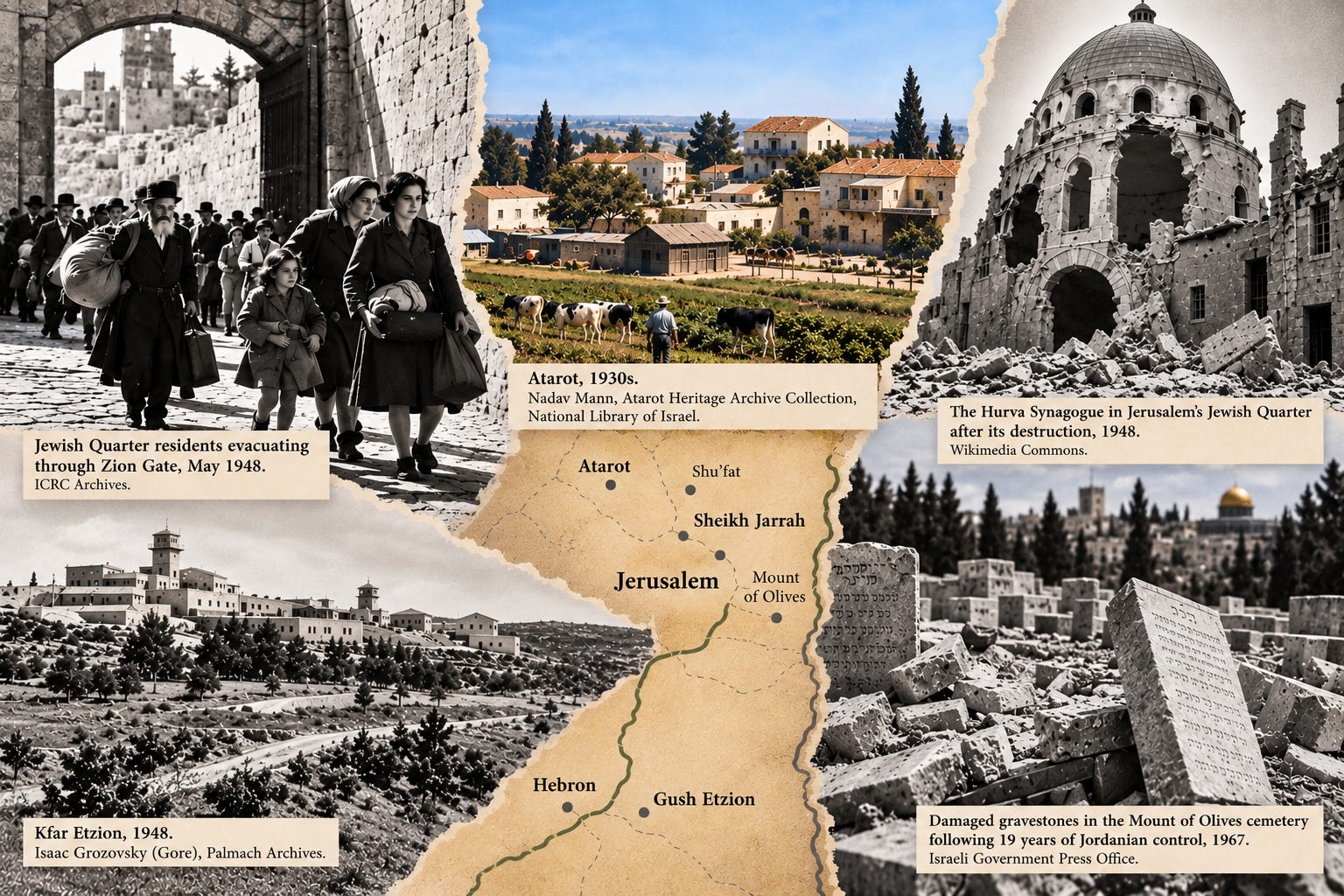
The Green Line cut through fields, roads, villages, and neighborhoods, but it also separated people from property they still legally owned. Jews had homes in Jerusalem’s Old City and in the neighborhoods around Shimon HaTzadik. Jewish families lived north of Jerusalem in Atarot and Neve Yaakov and south of the city in the four communities of Gush Etzion. Jewish-owned parcels were scattered through East Jerusalem, Hebron, Bethlehem, Silwan, Beit Jala, Beit Iksa, Beit Safafa, and other places that ended up under Jordanian control.
Some of the property belonged to individual families. Other parcels belonged to banks, religious trusts, the Jewish National Fund, the Hebrew University, and Jewish organizations. There were farms, houses, shops, synagogues, cemeteries, schools, and undeveloped land. When the fighting ended and the armistice line was settled in 1949, thousands of dunams (a unit of land equal to about a quarter acre) belonging to Jews were now on Jordan’s side. Most of the owners were on the other.
The Jewish Quarter of Jerusalem’s Old City surrendered to the Arab Legion on May 28, 1948. The following morning, the American vice consul in Jerusalem sent Washington the surrender terms. Approximately 2,000 women, children, elderly, and religious residents were to be evacuated to Jewish-held Jerusalem under the supervision of the International Red Cross. About 300 military-age men would be taken as prisoners of war to Amman. Of approximately 150 wounded, the seriously injured would be turned over to the Red Cross while the others became prisoners.
The evacuation continued through Zion Gate into the night. By the following morning, the Jewish civilian population of the quarter was gone. A community that had survived Ottoman rule, the British Mandate, riots, and repeated periods of violence had been emptied.
Its buildings remained. There were houses and shops, courtyards and yeshivas, charitable institutions, and synagogues. The Hurva’s great dome had towered above the quarter for decades, and nearby stood Tiferet Yisrael, another large nineteenth-century synagogue. Smaller houses of prayer were scattered through streets where Jews had lived for generations.
The destruction began immediately. The Hurva was blown up after the quarter fell. Tiferet Yisrael was destroyed as well. During the nineteen years of Jordanian rule, other synagogues were demolished, damaged, stripped, or converted to other uses. Later accounts disagree over the number because they counted synagogues and smaller houses of prayer differently, but when Jews returned in 1967, much of the Jewish Quarter’s former religious landscape was gone.