[Cross-posted from The Tattooed Historian’s Dispatch]
What exactly are we doing when we communicate history to the public?
Most of us would agree that accuracy matters, evidence matters, context matters, historical rigor matters. But we also live in a world where attention matters (and attention spans are dropping at an alarming rate).
Whether we’re posting on social media, producing videos, hosting podcasts, giving public talks, or designing museum programs, we’re all competing with countless other demands on people’s time. The public doesn’t simply stumble into history anymore. Now, good history has to find people where they already are.
This raises a difficult question: Is making history entertaining part of good historical practice, or is it simply what we must do to remain relevant?
“Entertainment” is often treated as the opposite of seriousness. But what do we mean when we use the term itself? Does entertainment mean simplifying the historical record? Does it mean telling compelling stories in a lively manner? Is there a difference between being engaging and being entertaining? And who gets to decide where that line is?
These questions become even more complicated online. Social media platforms reward attention. Algorithms reward engagement (the positive and the negative). Visibility often depends on producing content that people are willing to click, watch, share, and discuss. What happens when those incentives shape the way history is presented?
Can historians work within those systems without letting those systems define the work? Are public audiences being served better than ever before, or are platform incentives changing what kinds of history rise to the surface?
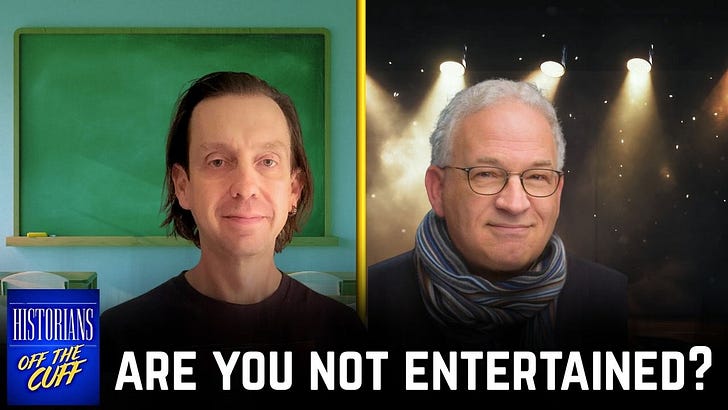
These are just a few of the issues that I discuss with in our latest installment of “Historians Off the Cuff.”
Feel free to suggest future topics for us to discuss in the comments section below.
Hope you are entertained. LOL