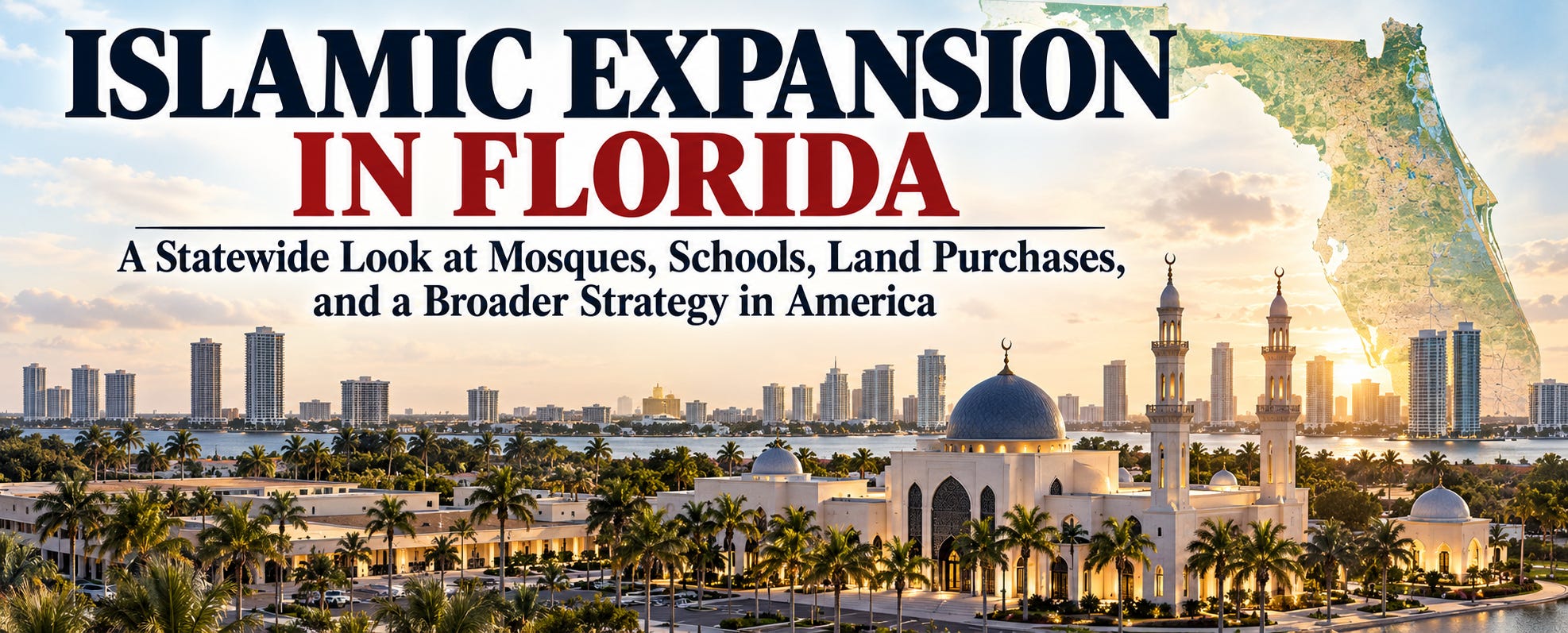
As I mentioned in last week’s Lioness Ledger, investigations like this will be heavily paywalled going forward. People who dig into these networks have faced lawsuits, intimidation, and harassment. Putting the deeper research behind a paywall gives me a little more protection while still allowing me to keep doing it.
In 2010, researchers counted 118 mosques in Florida. By 2020, there were 157, an increase of 33 percent in a decade. That put Florida fourth in the country, behind New York, California, and Texas.
The numbers were rising elsewhere too. New York had 343 mosques, California 304, Texas 224, New Jersey 141, Illinois 128, Michigan 127, and Pennsylvania 112. Michigan had just 77 ten years earlier.
But counting mosques only tells part of the story.
The 2020 U.S. Religion Census estimated 127,172 Muslim adherents in Florida, then a state of more than 21 million people. Around some of those 157 congregations were schools, daycares, gyms, athletic fields, medical clinics, cemeteries, banquet halls, youth programs, and additional property. Some communities that began in apartments or rented storefronts eventually bought several acres. Others built a mosque and kept building around it.
The same change has been happening nationally. In 2000, researchers counted 314 purpose-built mosques in the United States. By 2020, there were 1,025. Two-thirds of the mosques surveyed that year had moved into their current locations since 2000.
The survey found Muslim families increasingly moving into suburbs and newer parts of metropolitan areas, with mosques following them. In Florida, that movement can be traced through deeds, construction plans, county approvals, and the histories of the Islamic centers themselves.
Some of those histories begin with a handful of families praying in a rented room. A generation later, the same community may have a mosque, school, gym, playground, clinic, and several acres of land.