KYIV—It was a simple message, but it encapsulated well what has been happening in Ukraine in the past few years:
“Our small but very dedicated family of 3 staff members are preparing for the warmer season and doing everything we can to keep this place alive for the community that built it. At the moment, however, we are struggling to cover our operating costs. Your support right now truly helps secure the future of our restaurant.”
We publish this newsletter every day at 9:05am NYC time / 4:05pm Kyiv.If you’re not already subscribing, why not do so now?
One of the restaurants I frequently visit in Kyiv was struggling.
At first, I did not really notice what was happening all over Ukraine in the past months and years. An empty shop or restaurant, after all, is normal in peacetime too. Maybe the owner retired. Or the place changed ownership, and the new owner is just about to start her renovations.
Even cafés that lost windows or parts of a wall to a Russo-Iranian Shahed drone or a nearby ballistic missile would re-open a few weeks later, or sometimes the next morning!
But in the past few months I slowly started understanding that what was going on was not normal. If you spend enough time living and walking through Ukrainian cities today, you will eventually start noticing that slowly, one after the other, the places you go to, or the places you see in your everyday life, start closing down.
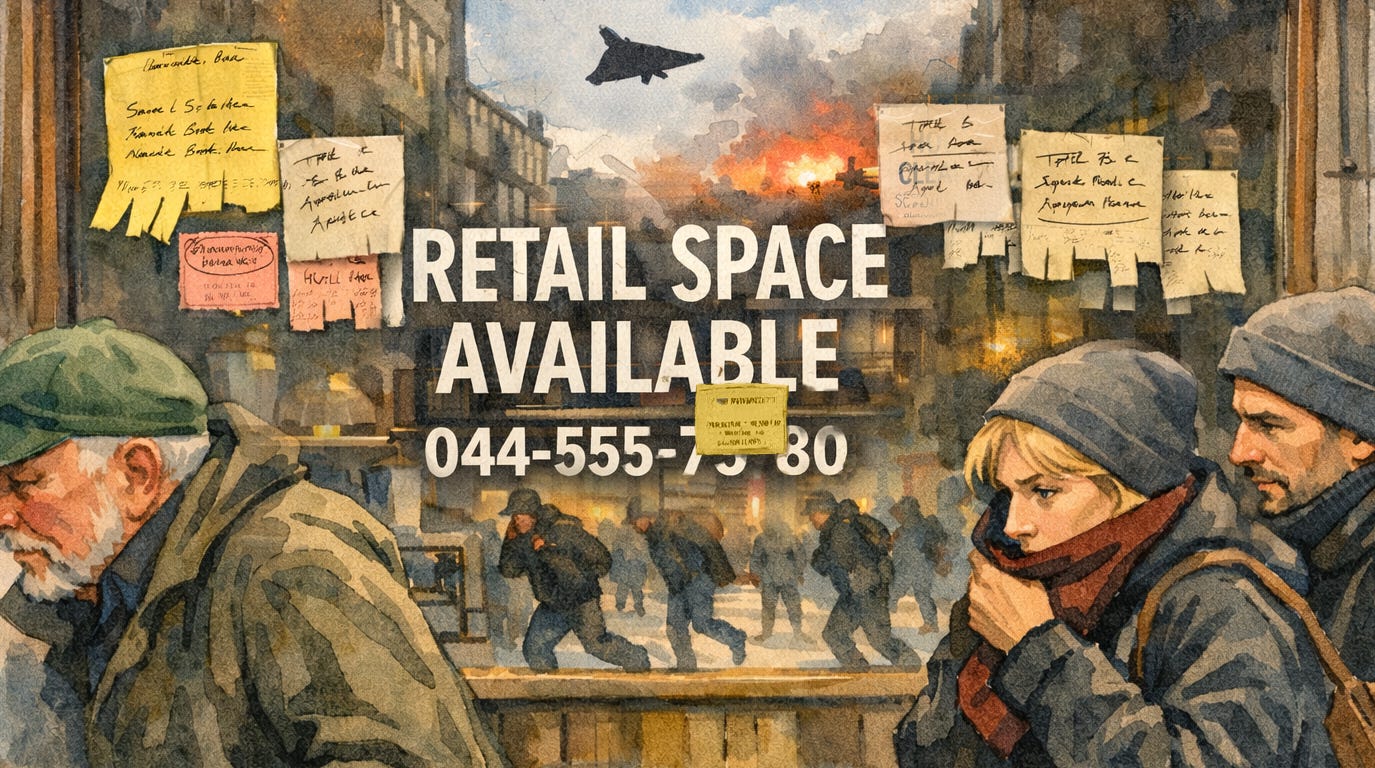
The gym in your apartment block, previously full of people working out, now sitting all quiet and empty, devoid of the energy that used to radiate from a place where people invested in their health, especially in wartime. A café interior that used to glow warmly in the evening, now sitting in darkness, chairs stacked upside down on tables that have not seen customers in months. Sometimes there is a small piece of paper taped to the glass simply saying, Зачинено, “Closed.” Occasionally the note is longer, thanking loyal guests for years of support. But often there is no message at all, only silence behind the glass and the faint dust that gathers when a place has been empty for too long.
And I realized: Ukraine is slowly being suffocated by Russia’s war.
The general feeling seemed to be that after the Maidan Revolution, the country was truly moving in the right direction.
Ukraine in the decade before 2022 was a country slowly rediscovering the simple optimism of building things.
When I arrived for my first visit as a humble tourist in November 2018, I could feel that optimism. Small coffee shops were opening on side streets that had once been lined with decaying Soviet storefronts. Young chefs were experimenting with restaurants that blended Ukrainian tradition with modern European cuisine. Bookstores were doubling as wine bars. Tattoo studios, art galleries, and design shops were appearing in neighborhoods that only a generation earlier had been grey and neglected.
For many Ukrainians, opening a café or restaurant or small shop was the most personal way of declaring that the country was moving forward, away from the dark Moscow-controlled past.
The general feeling seemed to be that after the 2014 Maidan Revolution, the country was truly moving in the right direction (and for many young Ukrainians I met, that could mean only one direction: West).
For many Ukrainians, opening a café or restaurant or small shop was therefore the most personal way of declaring that the country was moving forward, that the long shadow of Soviet stagnation was finally lifting, and that Ukraine was becoming a normal European place—only more innovative—where people could imagine building their own future.
Every new storefront represented a risk taken, money saved, late nights spent planning something that might or might not succeed. And the willingness to take those risks said something powerful about the spirit of the country. It meant that people believed tomorrow might be better than today.
Then Russia came with war.
In the early weeks of the full-scale invasion in 2022, destruction was immediate and overwhelming. Russian missiles struck cities across the country. Armored columns pushed toward Kyiv. Entire neighborhoods burned. In those first terrible months, survival itself became the only priority. Businesses closed not because of economic pressure but because people were hiding in basements, evacuating their families, or volunteering for the army.
Flower shops reopened near metro stations because people still wanted to bring something beautiful home after long days filled with grim news. Every open door was carrying the same message: Ukraine is still alive.
And yet, once the front lines stabilized, life began to return: slowly and cautiously at first, but then with renewed vigor, as people started to realize that despite all the suffering, life is meant to be enjoyed, even if it’s only for a fleeting moment. And consequently, cafés reopened even while air raid sirens continued to interrupt conversations.
Jazz clubs started to have shows again, but at 2pm instead of 9pm, because of wartime curfew. Restaurants served dinners by candlelight during power outages. Flower shops reopened near metro stations because people still wanted to bring something beautiful home after long days filled with grim news. Every open door was carrying the same message: Ukraine is still alive.
Even cafés that lost windows or parts of a wall to a Russo-Iranian Shahed drone or a nearby ballistic missile would re-open a few weeks later, or sometimes the next morning!
But war has a second phase that is harder to see than the explosions.
It is the slow phase, the phase where pressure accumulates quietly, month after month, until the strain becomes impossible to ignore. Workers are mobilized into the army and cannot easily be replaced. Proper tourism, beyond the war sort, has been gone for more than four years now.
Investors first withdrew, and now are scared to come back in. Insurance companies refuse coverage in a war zone. Energy infrastructure is attacked repeatedly by Russia, causing blackouts that interrupt entire days, even weeks, of work. Supply chains become unpredictable, costs rise, and customers simply have less money to spend.
Eventually, the owners begin doing the calculations they have tried to avoid: Rent remains the same. Electricity becomes more expensive. Deliveries arrive late or not at all. Without power, expensive produce spoils in your fridge. Fewer people walk through the door each week. The numbers that once worked slowly stop adding up.
This is the moment when many dreams begin to die.
A café that survived the first year of the invasion suddenly closes in the third. A small restaurant that once buzzed with evening conversations with folk musicians and embassy staff and IT engineers and soldiers on brief leave shuts its doors after months of dwindling customers. A clothing store disappears from a street where it had stood for a decade. The dream of freedom begins to vanish.
No international cameras arrive when a bakery shuts its doors for the final time. But if you live in these cities long enough, you begin to feel the accumulation of these losses.
Each closure is small enough that the outside world rarely notices. There are no headlines when a café closes. No international cameras arrive when a bakery shuts its doors for the final time. But if you live in these cities long enough, you begin to feel the accumulation of these losses.
A neighborhood that once had three cafés now has one. A street that used to glow with light and conversation at night becomes darker and quieter. A familiar place where friends used to meet after work simply ceases to exist. And so do some of those friends.
Behind every one of those closed doors lies a deeply human story. Someone spent years saving money to open that coffee shop. Someone convinced their parents that leaving a stable office job to start a bakery was worth the risk. Someone stayed up late perfecting a menu or designing an interior or dreaming about the future of a business they hoped would grow.
If you’re not already subscribing, why not do so now?
War destroys many things. It destroys lives, buildings, roads, bridges, and factories. But it also destroys something less visible and perhaps more painful: the fragile optimism that allows people to build new things in the first place.
Russia’s invasion of Ukraine has always been about more than territory. It is about crushing the possibility that Ukraine might live freely, develop freely, and imagine freely. The Kremlin’s strategy does not rely only on tanks and missiles.
With few concrete military gains on the ground, Russia relies primarily on civilian exhaustion, on the slow pressure that makes normal life increasingly difficult until people begin to feel that the future itself is slipping away, and they give up.
And when a business finally closes, it leaves a silence that will not be filled for some time, if at all. Multiply that quiet moment by thousands across the country, and you begin to understand the deeper cost of this war. It is not only measured in destroyed vehicles or shifting front lines. It is measured in vanished futures.