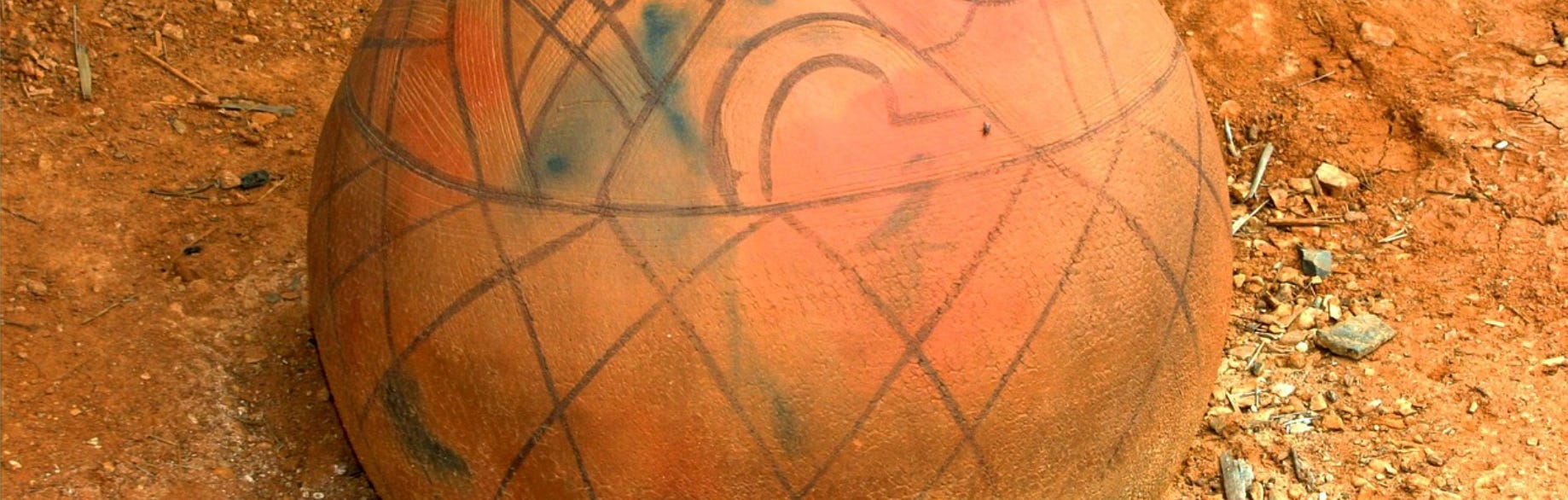
But we have this treasure in jars of clay, to show that the surpassing power belongs to God and not to us.— 2 Corinthians 4:7
Corinth knew fine things. Its bronze was prized across the Roman world. So when Paul reached for an image of himself, his readers might have expected something that gleamed.
He picked the clay jar. The word is ostrakinos (ὀστράκινος), baked earth, the everyday container of the ancient world. It held water, oil, grain, garbage. It cost almost nothing.
Some in Corinth had already said as much about him: his bodily presence is weak, and his speech of no account (2 Corinthians 10:10). Paul doesn’t argue. This is not self-contempt. It is accuracy. God remembers that we are dust (Psalm 103:14) and has never been confused about it. On our own, we are ordinary clay. There is an odd relief in saying so.
Becoming a Christian does not mean the jar got upgraded. We are the same clay we were the day before. What changed is what we carry, and we did not put it there. God did.
Paul names it one verse earlier: the light of the knowledge of the glory of God in the face of Jesus Christ (2 Corinthians 4:6). The treasure has a face. It is Christ Himself, and with Him everything He brings: His word, His love, our salvation, and eternal life, which Jesus defined as knowing the only true God and the One He sent (John 17:3).
I have come to think of the life of faith as a long discovery of what we were already given. Paul, decades into following Christ, was still writing that I may know Him (Philippians 3:10). Apparently we can own the treasure and still barely know it. Gratitude grows at the pace of that knowing.
A treasure sealed in clay is safe. It is also invisible. So the jar cracks.
We are afflicted in every way, but not crushed; perplexed, but not driven to despair; persecuted, but not forsaken; struck down, but not destroyed. — 2 Corinthians 4:8–9
There is a detail here that is easy to read past. Perplexed, but not driven to despair is a wordplay in Greek: at a loss, but not utterly at a loss. That second verb, exaporeomai (ἐξαπορέομαι), appears only twice in the New Testament. Both times are in this letter. And the other time, Paul says the opposite.
At the opening of the letter he describes something that happened to him in the province of Asia. He never says what. Only that he was burdened beyond his strength, so that we despaired of life itself (2 Corinthians 1:8). Same verb. The man who writes “not driven to despair” has already told these readers that he was.
It is tempting to hear 4:8 as temperament, as though Paul were made of tougher clay than the rest of us. He wasn’t. He went to the bottom of himself and found out what the bottom was for: to make us rely not on ourselves but on God who raises the dead (2 Corinthians 1:9). Set that beside our verse. Not on ourselves but on God. To God and not to us. Nearly the same sentence. The jar of clay is not an image Paul thought up at his desk. It is what Asia taught him.
So “not crushed” is not the boast of someone who never broke. It is the report of someone who did, and met God on the other side. And what came through the break did not stay with him: death is at work in us, but life in you (2 Corinthians 4:12).
He had seen this shape before, in Christ, who emptied Himself and went down as far as a cross. Therefore God has highly exalted Him (Philippians 2:7–9). In every other arithmetic, emptying means empty. In Christ, the One poured out is the One who is filled.
Most of what wears us out with other people, if I am honest about my own case, is the labor of protecting the jar. Being noticed. Being right. Being served first.
Habakkuk knew Babylon was coming (Habakkuk 1:6). His body trembled, his lips quivered, his legs shook beneath him (Habakkuk 3:16). A clay jar, rattling on the shelf.
Then he takes inventory. No figs. No grapes. The olive crop failed, the fields bare, the stalls empty (Habakkuk 3:17). For a farming people, that is everything. And then: yet I will rejoice in the Lord; I will take joy in the God of my salvation (Habakkuk 3:18).
There is nothing left in his circumstances to rejoice in. He is rejoicing in the one possession the Babylonians cannot carry off. That is what a person sounds like who knows what is in the jar.
If everything on Habakkuk’s list went missing from our lives, would we know what we still had?
We would like to say we have made peace with being clay. Most days we would still rather be bronze. But the text is patient with that. Our outer self is wasting away, Paul says without flinching, because our inner self is being renewed day by day (2 Corinthians 4:16).
God knew exactly what He was putting His fortune in. He chose the clay anyway.
© 2026 Bible Portal. Free to share with attribution. Please keep the source and a link to Bible Portal intact. For other uses, contact us.