And join them one to another into one stick, that they may become one in your hand.— Ezekiel 37:17
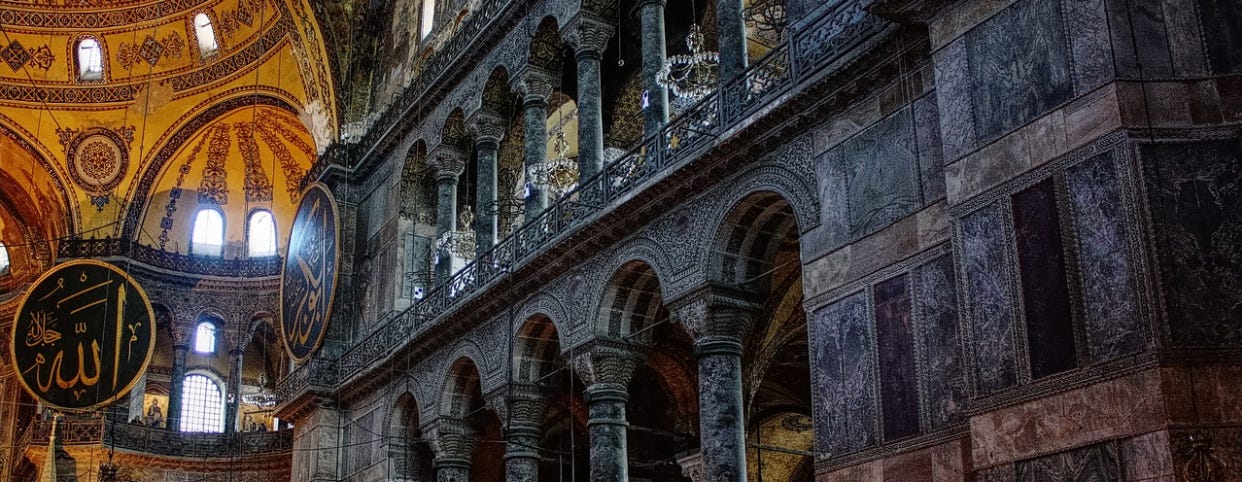
At the door they bought tickets. They went in through the tourist entrance and looked up for the faces of Christ they knew were in the mosaics.
They found curtains.
Most of the people around them had come to see a monument. The pilgrims had come looking for a church.
Hagia Sophia (Ἁγία Σοφία) means Holy Wisdom. It was dedicated in 537 under the emperor Justinian, and for more than nine hundred years it was the great church of the Christian East. The name does not honor a saint called Sophia. It points to Christ Himself, whom Paul called the power of God and the wisdom of God (1 Cor 1:24).
Paul knew how that sounded. A crucified Messiah was a stumbling block to Jews and folly to Gentiles (1 Cor 1:23). Greece had given the world philosophia, the love of wisdom. The church answered by placing the wisdom of the cross under the largest dome of its age.
Constantinople fell to the Ottomans in 1453, and the church became a mosque. In 1934 the Turkish Republic decided to make it a museum, and it opened as one the following year. For eighty-five years anyone could walk in and see the mosaics. In 2020 it became a mosque again, and most of the Byzantine mosaics have been kept covered since.
The pastor who had led the group stood under the dome, in light that has come through the same windows for fifteen centuries. He said it quietly, almost to himself.
So this is what it feels like to be ruled by someone else.
It is bitter to be ruled by someone else. But the first hand that broke this city was not someone else’s.
In 1204 the knights of the Fourth Crusade were supposed to be on their way to the Holy Land. They turned aside, broke into Constantinople, stripped its churches, and ruled it for fifty-seven years. Christians did it. Brother struck brother. The city never fully recovered, and when the Ottomans came two centuries later, they found it already weakened.
East and West had already separated, a split usually dated to 1054. In the sixteenth century the Reformation divided the Western church again, into Catholic and Protestant. Today the church is still divided, sometimes over truth and sometimes over far less.
This is not easy to say. We love the church, and many of us belong to traditions born out of one of those divisions. But there is a difference between a division we grieve and a division we have simply gotten used to.
The curtain in Istanbul is easy to see. The ones we have hung between ourselves are harder to notice.
Ezekiel knew what a divided people looked like. After Solomon, Israel split in two, with the northern kingdom of Israel on one side and Judah in the south. The rivalry ran deep. Isaiah had to promise a day when Ephraim shall not be jealous of Judah, and Judah shall not harass Ephraim (Isa 11:13). Then both kingdoms fell. Assyria took the north in 722 BC, and Babylon took Judah in 586 BC. Ezekiel wrote from exile, when both kingdoms were gone.
That is where God told him to do something strange. He was to take two sticks, write Judah on one and Joseph, the stick of Ephraim, on the other, and join them together in front of everyone until they became one in his hand. The people would ask, Will you not tell us what you mean by these? (Ezek 37:18). God gave the answer. They shall be no longer two nations, and no longer divided into two kingdoms (Ezek 37:22).
Two things stand out. First, God is the one who joins them. They may become one in my hand (Ezek 37:19). Second, the unity comes from a king. My servant David shall be king over them, and they shall all have one shepherd (Ezek 37:24). The tribes are not asked to negotiate a truce. They are gathered under one Shepherd.
Jesus took up that promise. So there will be one flock, one shepherd (John 10:16). The night before the cross He prayed that they may all be one (John 17:21).
We cannot glue the sticks together ourselves. We have tried for a thousand years. But sheep who move toward the same Shepherd end up closer to each other than they meant to.
Jesus once told a woman who was arguing about which mountain was the right place to worship that the hour had come when true worshipers would worship in spirit and truth (John 4:23). God has never been held by a building. Not by Hagia Sophia, and not by ours.
So the question the pilgrims brought home is not really about Istanbul. What division have we lived with so long that it no longer hurts? Who is the brother we stopped expecting to stand beside?
These are not questions to answer quickly. They are questions to carry.
But the name on that building is still true. Hagia Sophia. Holy Wisdom. It still points to Christ, the wisdom of God, crucified and risen, the one Shepherd who gathers what we have scattered. Cloth can cover a wall. It cannot reach Him.
A curtain can hide a mosaic. It has never hidden the Wisdom of God.
Next time: the churches whose doors were locked from the inside.
© 2026 Bible Portal. Free to share with attribution. Please keep the source and a link to Bible Portal intact. For other uses, contact us.