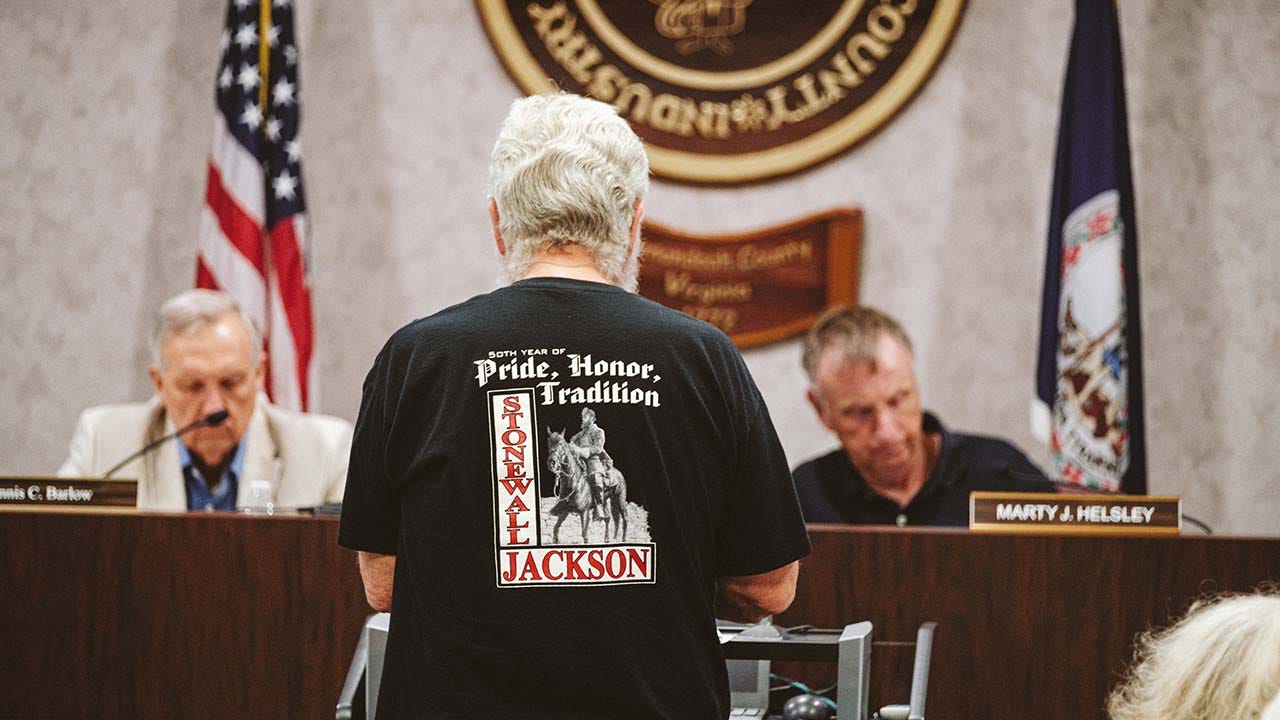
One of the things that I was impressed with in reading Judge Michael Urbanski’s opinion in Virginia State Conference NAACP v. County School Board of Shenandoah County is his use of expert testimony from historians. Yesterday I reported that Judge Urbanski ruled that Shenandoah County’s school board broke the law when it brought back Confederate names for two of its schools in 2024.
Historians Ty Seidule and Brian Daugherity both testified for the plaintiffs in the case. Seidule focused on the lives of Turner Ashby, Robert E. Lee, and Stonewall Jackson, who the schools were named after and “testified that their primary legacies are their roles in the Confederate military.”
No one familiar with recent scholarship on these three individuals and the Confederacy more broadly will be surprised by the content of his testimony.
Seidule connected the height of Confederate monument dedications and the naming/renaming of public schools to honor Confederate generals in the 1950s and 60s to the political and racial culture of the time:
Gen. Seidule testified that countless cities, counties, streets, and schools were named after Confederate leaders, and statues and monuments were erected to honor Confederates in public places, frequently in front of courthouses. Id. at 176:10-11, 177:5-16. There are two main time periods in which commemorating Confederate figures was most common: from 1890 to 1920, and from 1948 to the early 1960s. Id. at 177:18-25. To Gen. Seidule, “they’re both two sides of the same coin, which is the support of or celebration of White supremacy.” Id. at 186:19-21.
Gen. Seidule explained that between 1890 and 1920, the commemorations celebrated the end of Reconstruction and the return of the White South to dominant political power. Id. at 186:14-21. Gen. Seidule noted that the second major spike in Confederate commemorations followed the Supreme Court’s decision in Brown v. Board of Education (“Brown I”), 347 U.S. 483 (1954). Seidule Test., ECF No. 277, at 177:20-25. In response to those developments, Virginia Senator Harry Byrd urged “Massive Resistance” to prevent integration of Virginia’s schools. Id. at 189:5-23; 191:4-6. Gen. Seidule explained that the Southern states used “every means, judicial and extrajudicial, to ensure that Black students and White students didn’t come together, didn’t have to study and go to the same school.” Id. at 189:18-21. Gen. Seidule testified that during this period, additional monuments were erected and schools were named after Confederates as a way of fighting for segregation. Id. at 202:19-20
The judge was clearly impressed with Daugherity’s testimony. He is quoted numerous times throughout the “Evidence” section of his opinion. One of the things that Daugherity does is draw a direct line between the naming of schools after Confederate leaders and the maintenance of the racial status quo in public spaces:
Segregationists reframed this ideology to argue that states possessed sovereign authority to maintain racially segregated public spaces, portraying Brown as an illegitimate federal intrusion on that authority. Id. Dr. Daugherity testified that this link between the Confederate argument and the segregationists’ argument tied the two groups and positions together. Id. Dr. Daugherity explained:
“The argument that’s made during this time period is that it was the states’ rights to segregate and that the Brown v. Board of Education [decision] was therefore an imposition on that state’s right. That is a highly important relationship between the Massive Resistance era and the era of the Civil War. There’s a connection there that I think is important to emphasize. The individuals that were talking about states’ rights in the 1950s are reflecting back on that same argument that was used during the period of the Civil War and, particularly, during the period of secession.”
Id. at 16:8-17. See Letter to the Editor of the Northern Virginia Daily, ECF No. 242-213 (“In 1861 Virginians fought and died for what they deemed right and after it was over they hung their heads in sorrow . . . but never in shame. Today Southerners hold their heads high and speak again for States rights.”).
The language of Massive Resistance often contained references to the Civil War and the Lost Cause narrative. Daugherity Test., ECF No. 277, at 253:17-20. Virginia’s Senator Harry Byrd used military language when discussing opposition to school desegregation, asserting that “if Virginia’s line is broken then the rest of the South will go down, too.” Id. at 253:21-25. Mid-1950s newspaper coverage and political cartoons frequently depicted Civil War battles, uniforms, and soldiers in their discussions of the school desegregation issue. Id. at 254:1-3. There was a resurgence in the public display of the Confederate battle flag, and an increase in the use of Confederate names on schools at that time. Id. at 254:3-5, 254:21-255:11; Daugherity Test., ECF No. 278, at 38:15-39:4.
In contrast with other public school districts, Daugherity goes on to explain why Shenandoah County refused to comply with Brown v. Board of Ed. The school district went out of its way to “ to operate a dual-school system and made affirmative decisions that would preserve segregation within its schools, even after Brown II.” They did so even though the costs were much higher than simply enrolling Black and white students in the same school.
As to why Shenandoah County chose Stonewall Jackson:
Dr. Daugherity testified that naming a school after a Confederate military leader was a departure from the School Board’s previous naming practices, as other schools had been named after towns, communities, geographic features, or local educators and community leaders. Daugherity Test., ECF No. 278, at 44:9-12. Dr. Daugherity testified that “the naming of Stonewall Jackson High School was undertaken by the Shenandoah County School Board, in part, to dissuade [Black] students from requesting transfers into the newly constructed and newly opened high school.” Id. at 44:3-6.
The defense’s expert testimony came from Gibson Kerr. There is a reason you probably have never heard of him. Included in a footnote is this brief description of his qualifications:
Mr. Kerr works in commercial real estate, but considers himself a lifelong historian, particularly in the study of General Robert E. Lee. In 2024, Mr. Kerr wrote and published the book Un-Cancel Robert E. Lee because he ‘thought someone needed to tell the truth about Robert E. Lee.’ Id. at 29:25-30:2, 30:13-14. Mr. Kerr was motivated to write the book because he felt that ‘history was being erased’ as statues of Lee in Richmond and Charlottesville were taken down and Lee’s name was removed from streets and schools throughout Virginia. Id. at 30:10-25.
Needless to say that Mr. Kerr had no impact on the decision in this case and it is clear that Judge Urbanski did not take him seriously as an expert witness on the history surrounding this case.
Anyone who reads this newsletter regularly knows that historians have been on the firing line of late. It is worth taking the time to watch or even re-watch David Blight’s testimony at a recent Congressional hearing about the Smithsonian Museum of American History.
Blight argues passionately for the historian’s craft and the important public role that we play in our democracy.
Judge Urbanski’s ruling makes clear that the historical record played a decisive role in his decision. Ty Seidule and Brian Daugherity did not simply offer opinions about Confederate commemoration. They interpreted school board minutes, newspaper accounts, and the broader pattern of monument building in Virginia to help the judge and the community better understand exactly when and why these names were chosen and what they were meant to signal.
This kind of work is not partisan or political. It is historian’s practicing the historian’s craft in providing context to symbols that partisans on all sides all too often use simply to further their own agenda.
This matters beyond Shenandoah County. The Trump administration has spent much of the past year treating historians as political and partisan adversaries and ultimately as hostile to this nation simply for asking hard questions.
Urbanski’s opinion points to a very different picture of the historian’s role and place in society. When this judge needed to understand why a school board reversed itself in 2024, he did not turn to political talking points. He relied on people who have spent careers asking the tough questions and digging into the historical record, first for the sake of learning itself and hopefully to help communities better understand the stories they tell about themselves.
That is the value historians bring to public life and we need it now more than ever.