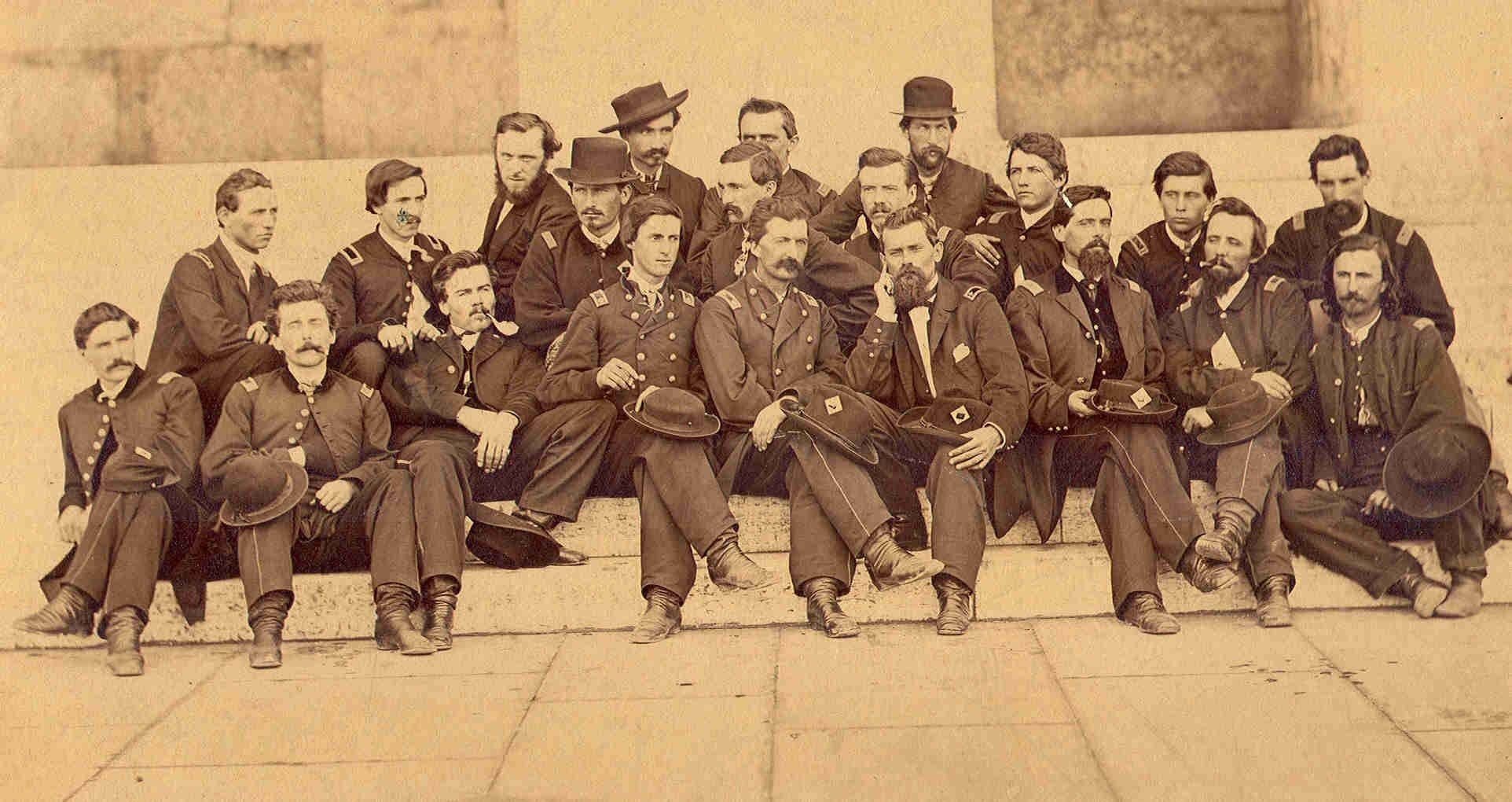
Gilbert Crawford Kniffin was a Union staff officer who served as a lieutenant colonel of U.S. Volunteers. After the war he became one of the more prolific contributors to the Military Order of the Loyal Legion of the United States. He belonged to the Commandery of the District of Columbia, and his name appears throughout its catalogued “War Papers.” The listings include “The Battle Above the Clouds” (1892), “The Cavalry of the Army of the Cumberland in 1863” (1896), “The Army of the Cumberland At Missionary Ridge” (1900), and “Raising the Siege of Knoxville” (1906).
On this Veteran’s Day, however, I want to highlight an excerpt from a short paper that Kniffin read before his fellow veterans on January 1, 1913. The address is a reminder that by the early twentieth century, the ranks of veterans was not only shrinking but those that still lived were gradually losing control over the memory of the war.
The language of reunion and reconciliation had come to dominate popular writing and served as a backdrop for monument dedications and even Blue & Gray reunions. The veterans themselves had helped to give legitimacy to this narrative. A few months after delivering this address, Union and Confederate gathered in Gettysburg, Pennsylvania to mark the battle’s fiftieth anniversary.
However, as historian Caroline Janney has shown, Union veterans drew a sharp distinction between reunion and reconciliation. Reunion was a fact of United States victory, but that did not imply that they had forgiven their enemy or admitted that the cause for which Confederates fought was, in any way, justified.
Far from it.
Consider what Kniffin had to say about this:
It has become quite common to refer to the war that raged in this country from 1861 to 1865 as a campaign of opinion, in which good men honestly differed, as if there was a question, still unsettled, as to the right of the general government to subdue the rebellion. People are being educated to the belief that because the Confederate soldier was the peer of his opponent in personal courage, the cause for which he fought was equally just.
The cause for which the South took up arms was the right of secession and the right to extend human slavery into the territories. That for which we fought was the preservation of the Union, which resulted in the extinction of slavery.
If, with the dawn of the twentieth century shining in their faces, the American people can discern no difference in the two, then indeed did our comrades die in vain….
As they [Confederates] enlisted in a bad cause, we fought them. As they were brave, we admire their courage. As they have returned to their allegiance, we give them fraternal greeting; but, my comrades, I want it understood that, while I do not require them to abate one iota of their manhood, they should frankly acknowledge, if the preservation of the Union is a boon to humanity, that the cause for which we fought, and for which a holocaust was offered, was everlastingly right. (
War Papers: District of Columbia Commandery, MOLLUS, Vol. IV, pp. 364-65)
It must have been a relief to be able to share these thoughts among comrades who not only agreed, but likely had experienced the very same frustrations.
Today we should be wary of any version of the war that makes its causes sound unsettled or its combatants morally interchangeable. Kniffin warned that Americans were being educated into that belief.
Over a century later we can see how thoroughly the lesson took hold. Listening to our veterans means more than honoring their service on a single day each November. It means taking seriously what they said they had fought for, even when their testimony complicates the more comforting stories we have inherited.
Kniffin did not leave us guessing about what he believed the war had meant, and his willingness to say so plainly, on the eve of a great reunion that would continue to blur the lines he cared about, remains a challenge to those of us who now stand as the stewards of that memory.