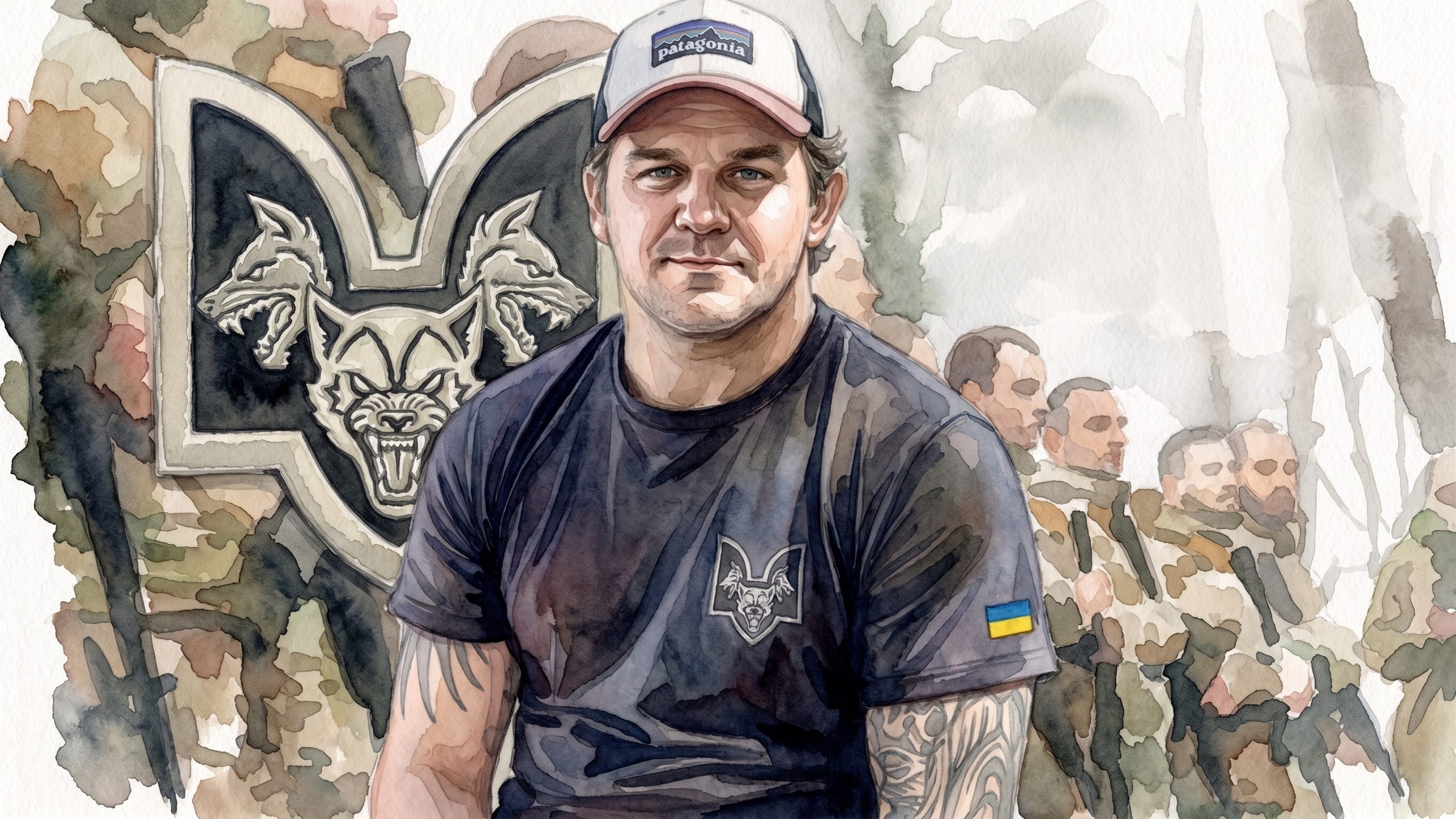
**KYIV—**When Russia invaded, “Klish”’s wife was pregnant with their fourth daughter. He left behind his family, his business, and the ordinary European life he had wanted for his children because, as he puts it, he had no choice. Today, the 43-year-old serves as an officer in the Da Vinci Wolves, the renowned Ukrainian combat unit born from the volunteer movement of 2014 and now fighting on the Pokrovsk front. In this conversation, he speaks about the friends he has buried, the technology transforming the battlefield, and the ordinary life for which Ukrainian soldiers continue to fight.
We publish this newsletter every day at 9:05am NYC time / 4:05pm Kyiv.Your subscription fuels our work.
“We do not dream about something extraordinary. We simply want the life we had before.”
The interview is published as part of an Under Fire News × Dzyga’s Paw fundraiser for the battalion: Dzyga’s Paw is a Lviv-based nonprofit that has united donors from more than 70 countries and delivered over $6.5 million in frontline technology to Ukrainian forces.
Together, we are supporting the $500,000 ** Wolves on the Hunt campaign** to provide the unit with 2 “Sokil” reconnaissance drones to help them continue defend Ukraine and the West.
KLISH: My name is Klish. I am 43 years old and I have four daughters. My youngest daughter was born after the full-scale invasion had already begun. When Russia attacked in February 2022, my wife was pregnant, and that made the decision to go to war especially difficult.
Before the war I was an entrepreneur. I worked in construction, in the IT sector, and product development. I had my own business. I travelled a lot and visited many countries around the world. Those experiences were important because I wanted my children to understand how people live in free European societies.
When the invasion started, I felt I had no real choice. I joined the defense of my country.
KLISH: At first it was fear, anger, and the understanding that we had to defend our country. That gave us strength.
Today it is different. War has unfortunately become part of everyday life. We adapted to it. What keeps us going now is responsibility.
We understand that we simply have no choice but to continue resisting Russia.
The reason is simple: We believe Russia will not stop. History shows that for centuries Russia has repeatedly tried to dominate Ukraine and erase our independence. How this war ends will only determine how long it takes before they try again. We understand that very clearly.
KLISH: Nobody believes that people should live with war forever.
I hope this war ends next year, or maybe in two or three years. For me, victory is surprisingly simple.
It means normal life.
It means our children can go to school and university without fear. My own children are currently living in Belgium. They come back during the summer, but whenever we receive warnings about missile attacks they become frightened and leave Kyiv for a nearby village.
That is not normal.
We simply want to live our own lives without Russia deciding how we should live. We want to travel. We want our children to grow up in peace.
Before the invasion people could take small boats along the Dnipro River in Kyiv. It sounds like a small thing, but those ordinary moments are exactly what we miss. We do not dream about something extraordinary. We simply want the life we had before.
KLISH: During the war I travelled to Germany, Belgium, France, and several Nordic countries. I met diplomats, military officers and ordinary people.
I understand that many people see this war only on television. They also know that Europe spends a great deal of money supporting Ukraine, money that could also be used for domestic problems.
Some people therefore say: “This is not our war.”
But I think that is a dangerous misunderstanding.
If totalitarian regimes learn that democracies eventually become tired and stop resisting, then Ukraine becomes an example. They will conclude that this strategy works.
This war is not only between Russia and Ukraine.
It is a struggle between two different worlds: democracy and authoritarianism.
That is why Europeans should care.
KLISH: Modern technology prevented Ukraine from collapsing during the first months of the invasion. Drones and long-range strike capabilities changed the battlefield completely.
But Russia also learns quickly.
They study our successes, adapt fast, and have one major advantage: They can produce successful systems on a much larger scale.
The war has become a constant game of cat and mouse.
We develop a new solution. Russia develops a countermeasure. Then we respond again. Every three or four months the battlefield changes completely.
Ukraine’s greatest advantage is flexibility. Our military is far more decentralized. Good ideas can come from almost anyone and quickly reach the battlefield.
Perhaps this also reflects our history. Ukrainian society has traditionally valued local initiative and freedom rather than rigid central control.
But we could never maintain this technological advantage without the support of our international partners.
KLISH: This is probably the hardest question.
Many of the men I serve with were my friends long before the war. We trained together in wrestling and boxing. Some of them have already been killed.
We also lost friends from civilian life.
Every fallen friend leaves a wound.
At the front you constantly experience loss. The man standing next to you today may not be there tomorrow.
Sometimes those losses make continuing incredibly difficult.
At the same time they also strengthen our determination.
We carry the memory of those who died.
And once again, we have no choice.
KLISH: Religion is an important part of Ukrainian society, and therefore naturally also of the army.
Many soldiers pray.
But for me personally there is a difference between religion and faith.
Faith is not only belief in God.
Faith means believing in truth.
Believing in your rights.
Believing that nobody has the right to decide how you should live.
That is my understanding of faith.
KLISH: Ukrainian soldiers are ordinary people.
Yesterday they were engineers, teachers, doctors, drivers or actors.
Today they are soldiers.
Not because they wanted this life.
Because history forced it upon them.
We are simply ordinary people defending our families, our homes and our country. That is all we ever wanted.
Your subscription fuels our work.
**Democrats Take Congress, Ukraine Loses Republican Allies—**Democrats havewon control of both chambers of Congress, delivering a sweeping rejection of Donald Trump’s leadership as frustration over living costs and the Iran war reached Republican strongholds. Senate victories extended into Kansas and South Carolina, underscoring the scale of the reversal just two years after Trump’s presidential win. The incoming majority will gain powers to investigate his administration, block legislation, and reject nominees. Unfortunately, the Republican losses also swept away committed supporters of Ukraine.Brian Fitzpatrick lost Pennsylvania’s 1st District to Democrat Bob Harvie, despite having won reelection by nearly 13 points in 2024. A Congressional Ukraine Caucus co-chair, Fitzpatrick championed sanctions against Moscow and recently introduced legislation to defend intelligence support for Kyiv and uphold restrictions on Russian energy imports. His defeat removes an experienced advocate capable of making the case for Ukraine inside Republican ranks. A Congress more willing to challenge Trump creates opportunities for stronger oversight of his Russia policy, but losing such Republican voices weakens the bipartisan foundation that helps sustain support across changes of administration.